

Bible Stories 앱
소리로 들려주는 성경 이야기
낭독으로 듣는 성경 이야기, 책 안내, 어려운 질문에 대한 답. 오프라인으로 어디서나 들어 보세요.




카테고리
Stories of Bible Characters
 33분
Stories of Bible Characters
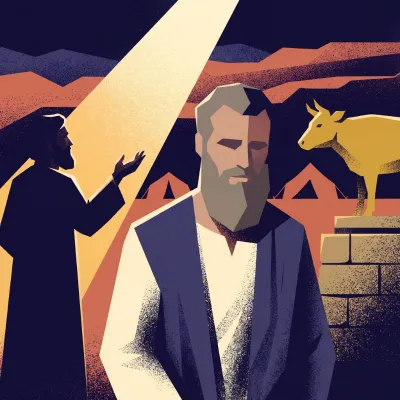
Why Wasn't AARON EXECUTED With The 3,000 Who Made The Golden Calf?
The Levites moved through the camp of Israel with swords in their hands, and by sundown three thousand people were dead. They walked past tent after tent, and at some point they walked past the one man who had melted the gold, shaped the idol with his own tool, built an altar before it, and announced the feast. They walked past Aaron, and not one sword touched him. Within months, the man who made the golden calf was standing before God in holy garments as the first high priest of Israel. How can that be right? Why was Aaron spared when three thousand others were not? In this episode, we explore the real answer the Bible gives, hidden in a single verse Moses did not speak until forty years later. We feel the fear and impatience at the foot of Sinai, look honestly at the full weight of Aaron's sin, and see that God's first sentence was against the whole nation. We discover that the Lord was angry enough with Aaron to destroy him, and that Aaron lived because Moses prayed for him by name. We also follow Moses as he "stood in the breach" and offered to be blotted out of God's book for the people, and why God refused. We trace Aaron's life after the calf: the sin offering for himself at his ordination, his failures with Miriam and at Meribah, and his death on Mount Hor. And we see how his story points to the one Mediator whose offer heaven did not refuse. Bible verses included in this episode: “Whoever is for the Lord, come to me.” (Exodus 32:26) “And the Lord was angry enough with Aaron to destroy him, but at that time I prayed for Aaron too.” (Deuteronomy 9:20) “Had not Moses, his chosen one, stood in the breach before him to keep his wrath from destroying them.” (Psalm 106:23) “But if not, then blot me out of the book you have written.” (Exodus 32:32) “Therefore he is able to save completely those who come to God through him, because he always lives to intercede for them.” (Hebrews 7:25) If you have failed under pressure and wondered whether God could ever use you again, look at what He did with Aaron. God's callings are not reserved for people with clean histories. They are given to forgiven people. Aaron did not know Moses was praying for him. If you belong to Jesus, He always lives to intercede for you. The sentence has already fallen on Him, and the God who kept a place for the man who made the golden calf has kept a place for you.
 32분
Stories of Bible Characters
Why Is There No Tribe Of Joseph In Israel? The Shocking Reason Explained
There is a name missing from the map of Israel, and it belongs to the one man who made the map possible. Joseph, the favorite son and the dreamer who saved his whole family from famine, has no territory named after him when Joshua divides the promised land among the tribes. It can look like an oversight, or even an insult. But Joseph's name is not missing because he received too little. It is missing because he received too much to fit inside a single border. In this episode, we explore the surprising reason there is no tribe of Joseph. We look at the birthright and double portion of the firstborn, how Reuben lost it, and how it passed to Joseph. We step into a dim room in Egypt where the dying Jacob adopts Joseph's two sons, Ephraim and Manasseh, as his own, and then crosses his arms to bless the younger above the older, redeeming the deception of his own youth. We see why the count of the tribes still stays at twelve because Levi's inheritance was the Lord Himself, and why two boys with an Egyptian mother became the model of blessing for generations. We also trace Joseph's name through the rest of Scripture, from Shiloh and the Psalms to Ezekiel's "two portions" and the tribe of Joseph in Revelation 7, and see how Joseph's story points to Jesus, the beloved Son whose reward is children adopted into God's family. Bible verses included in this episode: “He was the firstborn, but because he defiled his father’s bed, his birthright was given to the sons of Joseph.” (1 Chronicles 5:1) “And now your two sons, Ephraim and Manasseh, who were born to you in the land of Egypt before I came to you in Egypt, are mine; as Reuben and Simeon, they shall be mine.” (Genesis 48:5) “I know, my son, I know. He also shall become a people, and he also shall be great; but truly his younger brother shall be greater than he.” (Genesis 48:19) “By you Israel will bless, saying, ‘May God make you as Ephraim and as Manasseh!’” (Genesis 48:20) “The Lord is his inheritance.” (Deuteronomy 10:9) “Give ear, O Shepherd of Israel, You who lead Joseph like a flock.” (Psalm 80:1) “Joseph shall have two portions.” (Ezekiel 47:13) “But as many as received Him, to them He gave the right to become children of God.” (John 1:12) If you feel overlooked, left off the lists, or wonder whether your background disqualifies you, let Joseph's story stand as a witness. The people the world can no longer find on its lists are often the ones God has recorded most carefully. The God who never forgot Joseph has not forgotten you. The double portion always comes after the pit.
 32분
Stories of Bible Characters
The Fall of Lucifer: How the Most Beautiful Angel Became Satan
The most beautiful angel who ever existed did not become Satan because he was tricked, wounded, or forced. He fell because of what happened quietly inside his own heart. A creature who stood closer to God than almost anything ever made looked at his beauty, his wisdom, and his nearness to the throne, and decided it was not enough. He wanted to be like God instead of loving God. If you have ever felt far from God, unworthy, tired, or ashamed of your own heart, this story is for you. The one who fell was not far from God when he fell. He was near. And that tells us that nearness alone is not what keeps us safe. In this episode, we explore the fall of Lucifer, gathering the pieces Scripture gives us in Isaiah 14 and Ezekiel 28. We look at where the name Lucifer comes from, how high this anointed guardian once stood, and how pride grew in secret until it became rebellion. We follow him from heaven to the garden of Eden, where he offered the same lie that ruined him, and we see what he truly lost. Not a battle, which he could never win, but nearness to God. Then the story turns from warning to good news. Where Lucifer, a creature, reached up to seize God's place, Jesus, who truly is God, came down, humbled Himself, and went to the cross for us. The title the fallen angel lost, the morning star, now belongs to Christ. Bible verses included in this episode: “How you have fallen from heaven, morning star, son of the dawn!” (Isaiah 14:12) “Your heart became proud on account of your beauty, and you corrupted your wisdom because of your splendor.” (Ezekiel 28:17) “You said in your heart, ‘I will ascend to the heavens, I will raise my throne above the stars of God... I will make myself like the Most High.’” (Isaiah 14:13–14) “Become conceited and fall under the same judgment as the devil.” (1 Timothy 3:6) “I saw Satan fall like lightning from heaven.” (Luke 10:18) “The great dragon was thrown down, that ancient serpent, who is called the devil and Satan, the deceiver of the whole world.” (Revelation 12:9) “I am the bright Morning Star.” (Revelation 22:16) You are not shut out because you are weak. Weakness is not what brought down the morning star. Pride is. The nearness he threw away is offered back to you freely in Jesus Christ. Not earned. Not deserved. Given. The morning star fell reaching upward. You can be lifted up simply by kneeling down. Come low, come honest, come as you are.
 31분
Stories of Bible Characters
The Untold Truth About Methuselah, Enoch and Noah: Why God Waited for Him
Enoch walked so closely with God that he never tasted death. Noah built a boat on dry land and carried his family safely over a drowning world. And between them stands Methuselah, the man who lived longer than anyone who has ever drawn breath. He left behind no sermon and no miracle, only a name and a number so large it barely feels real. Yet Methuselah was the man God waited for. Every year he stayed alive, the flood held back. Every morning he woke, the judgment the world had already earned was pushed one more day into the future. His long life was the longest stretch of patience God ever held over a world that had run out of reasons to be spared. In this episode, we explore the story of Methuselah, Enoch, and Noah together. We step into a world filled with violence and corruption, meet Enoch, the father who walked with God until God took him, and consider what it meant for Methuselah to live 969 years, burying generation after generation while he watched faith itself fade. We see how God was quietly at work inside the long wait, raising up Noah, a man who found favor in His eyes before he ever cut a single plank for the ark. These three men, one family, show the shape of the gospel in miniature. God guards His promise, and He prepares a way of rescue before the storm ever breaks. Bible verses included in this episode: “Enoch walked faithfully with God; then he was no more, because God took him away.” (Genesis 5:24) “Altogether, Methuselah lived a total of 969 years, and then he died.” (Genesis 5:27) “He will comfort us in the labor and painful toil of our hands caused by the ground the Lord has cursed.” (Genesis 5:29) “But Noah found favor in the eyes of the Lord.” (Genesis 6:8) “The Lord is not slow in keeping his promise, as some understand slowness. Instead he is patient with you, not wanting anyone to perish, but everyone to come to repentance.” (2 Peter 3:9) If you have prayed the same prayer for years and heaven has felt silent, a long wait is not proof that God has forgotten you. Very often, the wait is where God is doing His deepest and quietest work. You are not too far behind, and you are not too late. The patience that held back a flood is patient enough to wait for you to take one small step toward home. The door is still open.
 39분
Stories of Bible Characters
Absalom - The Most Beautiful Traitor in the Bible
Absalom became a traitor because admiration was the only thing anyone ever gave him. Israel praised his face. Strangers turned in the street to watch him pass. But in all those years of being looked at, no one ever answered the one question he actually asked. He had killed a brother, and he wanted his father to rule on it. What he got was silence from his father, then a kiss, and nothing in between. The Bible almost never describes what its people looked like. Then it comes to Absalom and stops to stare. Here was a prince with royal blood on both sides, wealth, charm, and a face the nation talked about. Everyone assumed they were looking at Israel's future. In this episode, we explore the complete story of Absalom, David's third son. We follow the crime against his sister Tamar that went unanswered, the feast at Baal Hazor where Amnon was struck down, three years of exile in Geshur, and two more years living in Jerusalem without ever seeing the king's face. We watch him stand at the city gate, handing strangers the very hearing his father denied him, until he stole the hearts of Israel. We walk with David as he flees barefoot up the Mount of Olives, see Ahithophel's counsel overturned by the hand of God, and stand in the forest of Ephraim where Absalom's life ended hanging in an oak tree. Finally, we hear the cry of a father who loved his son all along, and we see how God does everything David could not do. He devises ways so that a banished person does not remain banished from Him. Bible verses included in this episode: “In all Israel there was not a man so highly praised for his handsome appearance as Absalom. From the top of his head to the sole of his foot there was no blemish in him.” (2 Samuel 14:25) “Like water spilled on the ground, which cannot be recovered, so we must die. But that is not what God desires; rather, he devises ways so that a banished person does not remain banished from him.” (2 Samuel 14:14) “Absalom behaved in this way toward all the Israelites who came to the king asking for justice, and so he stole the hearts of the people of Israel.” (2 Samuel 15:6) “I lie down and sleep; I wake again, because the Lord sustains me.” (Psalm 3:5) “For the Lord had determined to frustrate the good advice of Ahithophel in order to bring disaster on Absalom.” (2 Samuel 17:14) “O my son Absalom! My son, my son Absalom! If only I had died instead of you, O Absalom, my son, my son!” (2 Samuel 18:33) “They will see his face, and his name will be on their foreheads.” (Revelation 22:4) If you are living with a long silence of your own, it can start to sound like an answer, as if you have been set aside. That reading is wrong. God has already spoken, in a manger, at a cross, and at an empty tomb. Absalom died reaching for a face. You will see one, and it will be turned toward you.
 37분
Stories of Bible Characters
Isaiah - The Prophet of Salvation and Divine Judgment
Who was Isaiah, and why does his story still speak so powerfully today? Isaiah lived in a time of national danger, political fear, religious hypocrisy, and deep injustice. Judah still had the temple, the sacrifices, and the outward signs of worship, but many hearts had turned away from God. The rich oppressed the poor, leaders trusted in armies and alliances, and people mixed the worship of the Lord with idols made by human hands. Into that broken world, God raised Isaiah as a prophet. His message carried both divine judgment and breathtaking salvation. He warned Judah about sin, pride, false worship, and the danger of trusting human power more than God. But he also gave some of the most beautiful promises in Scripture, pointing to a coming King, a suffering Servant, comfort for the broken, living water for the thirsty, and a new heavens and a new earth. In this episode, we walk through the story of Isaiah, the prophet of salvation and divine judgment. We explore his vision of God’s holiness, his cleansing in the temple, his bold messages to kings, his warnings to the nations, and his powerful prophecies that point forward to Jesus Christ. Isaiah’s story reminds us that God is holy and cannot ignore sin, but also merciful and willing to cleanse those who turn to Him. It shows us that judgment is real, but it is not the final word. In the middle of darkness, Isaiah saw the light of salvation shining through the coming Messiah. Bible verses included in this episode: “Learn to do right; seek justice. Defend the oppressed. Take up the cause of the fatherless; plead the case of the widow.” (Isaiah 1:17) “Come now, let us settle the matter,” says the Lord. “Though your sins are like scarlet, they shall be as white as snow; though they are red as crimson, they shall be like wool.” (Isaiah 1:18) “In the year that King Uzziah died, I saw the Lord, high and exalted, seated on a throne; and the train of his robe filled the temple.” (Isaiah 6:1) “Holy, holy, holy is the Lord Almighty; the whole earth is full of his glory.” (Isaiah 6:3) “Woe to me! I am ruined! For I am a man of unclean lips, and I live among a people of unclean lips, and my eyes have seen the King, the Lord Almighty.” (Isaiah 6:5) “See, this has touched your lips; your guilt is taken away and your sin atoned for.” (Isaiah 6:7) “Whom shall I send? And who will go for us?” (Isaiah 6:8) “Here am I. Send me.” (Isaiah 6:8) “Therefore the Lord himself will give you a sign: The virgin will conceive and give birth to a son, and will call him Immanuel.” (Isaiah 7:14) “For to us a child is born, to us a son is given, and the government will be on his shoulders. And he will be called Wonderful Counselor, Mighty God, Everlasting Father, Prince of Peace.” (Isaiah 9:6) “A shoot will come up from the stump of Jesse; from his roots a Branch will bear fruit.” (Isaiah 11:1) “But he was pierced for our transgressions, he was crushed for our iniquities; the punishment that brought us peace was on him, and by his wounds we are healed.” (Isaiah 53:5) “We all, like sheep, have gone astray, each of us has turned to our own way.” (Isaiah 53:6) “The Lord has laid on him the iniquity of us all.” (Isaiah 53:6) “Comfort, comfort my people, says your God.” (Isaiah 40:1) “He tends his flock like a shepherd: He gathers the lambs in his arms and carries them close to his heart; he gently leads those that have young.” (Isaiah 40:11) “Do not fear, for I have redeemed you; I have summoned you by name; you are mine.” (Isaiah 43:1) “When you pass through the waters, I will be with you.” (Isaiah 43:2) “Come, all you who are thirsty, come to the waters; and you who have no money, come, buy and eat! Come, buy wine and milk without money and without cost.” (Isaiah 55:1) “See, I will create new heavens and a new earth. The former things will not be remembered, nor will they come to mind.” (Isaiah 65:17) “Arise, shine, for your light has come, and the glory of the Lord rises upon you.” (Isaiah 60:1) The story of Isaiah is more than ancient history. It is a mirror for our hearts and a window into God’s heart. Through Isaiah, we see a holy God who judges sin, a merciful God who cleanses guilt, and a saving God who points us to Jesus, the King and Suffering Servant who brings hope in the middle of darkness.
 46분
Stories of Bible Characters
Mary - The Mother of Jesus
Who was Mary, the mother of Jesus, really? Mary is the most famous woman in history, yet the Bible presents her with surprising quietness. She speaks only a few times, but her life stands at the center of God’s plan of salvation. In this episode, we explore the complete story of Mary like you’ve never seen it before, from her hidden early life and ancient traditions, to the angel Gabriel’s announcement, the birth of Jesus, the sword that pierced her soul, the cross, the resurrection, and her final appearance in the Upper Room. We’ll look at Mary not as a distant figure in stained glass, but as a real woman of courage, faith, suffering, and surrender. She was a young girl who risked her reputation and her life when she said yes to God. She was a mother who fled with her child into Egypt. She was a widow who watched her son leave home to begin His ministry. She was a disciple who had to learn that Jesus belonged not only to her, but to the whole world. This episode also explores ancient Christian traditions about Mary’s childhood, her betrothal to Joseph, the sorrow she endured, and the mystery of her final years. From Bethlehem to Calvary, from the manger to the cross, Mary’s story is a masterpiece of grace. She teaches us how to trust when we do not understand, how to suffer without giving up, how to treasure God’s word, and how to say with complete faith, “Let it be done to me according to your word.” Bible verses included in this episode: “The next day, Moses entered the tent of the testimony and saw that Aaron’s staff, which represented the tribe of Levi, had not only sprouted but had budded, blossomed and produced almonds.” (Numbers 17:8) “Greetings, you who are highly favored! The Lord is with you.” (Luke 1:28) “Do not be afraid, Mary; you have found favor with God. You will conceive and give birth to a son, and you are to call him Jesus. He will be great and will be called the Son of the Most High. The Lord God will give him the throne of his father David.” (Luke 1:30–32) “How will this be,” Mary asked the angel, “since I am a virgin?” (Luke 1:34) “I am the Lord’s servant,” Mary answered. “May your word to me be fulfilled.” (Luke 1:38) “Blessed are you among women, and blessed is the child you will bear! But why am I so favored, that the mother of my Lord should come to me?” (Luke 1:42–43) “Joseph son of David, do not be afraid to take Mary home as your wife, because what is conceived in her is from the Holy Spirit. She will give birth to a son, and you are to give him the name Jesus, because he will save his people from their sins.” (Matthew 1:20–21) “But the angel said to them, ‘Do not be afraid. I bring you good news that will cause great joy for all the people. Today, in the town of David, a Savior has been born to you; he is the Messiah, the Lord.’” (Luke 2:10–11) “But Mary treasured up all these things and pondered them in her heart.” (Luke 2:19) “This child is destined to cause the falling and rising of many in Israel, and to be a sign that will be spoken against, so that the thoughts of many hearts will be revealed. And a sword will pierce your own soul too.” (Luke 2:34–35) “Son, why have you treated us like this? Your father and I have been anxiously searching for you.” (Luke 2:48) “Why were you searching for me?” he asked. “Didn’t you know I had to be in my Father’s house?” (Luke 2:49) “They have no more wine.” (John 2:3) “Woman, why do you involve me?” Jesus replied. “My hour has not yet come.” (John 2:4) “Do whatever he tells you.” (John 2:5) “When his family heard about this, they went to take charge of him, for they said, ‘He is out of his mind.’” (Mark 3:21) “Who are my mother and my brothers?” he asked. Then he looked at those seated in a circle around him and said, “Here are my mother and my brothers! For whoever does the will of God is my brother and sister and mother.” (Mark 3:33–35) “When Jesus saw his mother there, and the disciple whom he loved standing nearby, he said to her, ‘Woman, here is your son,’ and to the disciple, ‘Here is your mother.’ From that time on, this disciple took her into his home.” (John 19:26–27) “It is finished.” (John 19:30) “They all joined together constantly in prayer, along with the women and Mary the mother of Jesus, and with his brothers.” (Acts 1:14) “You will not let your holy one see decay.” (Psalm 16:10) “A great sign appeared in heaven: a woman clothed with the sun, with the moon under her feet and a crown of twelve stars on her head. She was pregnant and cried out in pain as she was about to give birth.” (Revelation 12:1–2) Mary’s story is not only a story of honor. It is a story of surrender. She believed God when the path was dangerous, followed Jesus when the cost was painful, stood at the cross when others fled, and prayed with the church as the Holy Spirit came. Her life invites us to treasure the words of God, ponder them in our hearts, and trust Him completely, even when we do not yet understand the road ahead.
 33분
Stories of Bible Characters
The Prodigal Son
What if you are not too far gone to come home? In this episode, we walk through one of the most powerful stories Jesus ever told, the parable of the Prodigal Son. It is a story for anyone who feels the distance has become final, anyone who believes they have wasted too much, failed too deeply, or wandered too far for God to still want them back. Jesus told this story to tax collectors, sinners, Pharisees, and religious teachers. On one side were the people everyone had given up on. On the other side were the people who thought they had never left. And through the younger son, the older son, and the waiting father, Jesus reveals the heart of God toward both kinds of lostness. We’ll explore the younger son who demanded his inheritance, ran to a distant country, lost everything, and woke up in the lowest place of his life. We’ll see how his road home began not with fixing himself, but with remembering his father. And we’ll look closely at the moment that changes everything, when the father sees him while he is still a long way off and runs to embrace him before he can even finish his apology. This episode also looks at the older brother, the son who stayed home but was still far from the father’s heart. His resentment, scorekeeping, and refusal to celebrate reveal another kind of distance, the kind that can hide behind obedience, service, and religion. At the center of the story is the father, who runs toward the ashamed son, pleads with the bitter son, and keeps the door open for both. This is more than a story about failure. It is a story about grace, repentance, restoration, and the God who comes looking for the lost. Bible verses included in this episode: “Now the tax collectors and sinners were all gathering around to hear Jesus. But the Pharisees and the teachers of the law muttered, ‘This man welcomes sinners and eats with them.’” (Luke 15:1 to 2) “But while he was still a long way off, his father saw him and was filled with compassion for him; he ran to his son, threw his arms around him and kissed him.” (Luke 15:20) “Look, all these years I have been slaving for you and never disobeyed your orders. Yet you never gave me even a young goat so I could celebrate with my friends. But when this son of yours, who has squandered your property, comes home, you kill the fattened calf for him.” (Luke 15:29 to 30) “My son, you are always with me, and everything I have is yours. But we had to celebrate and be glad, because this brother of yours was dead and is alive again; he was lost and is found.” (Luke 15:31 to 32) “But God demonstrates his own love for us in this: While we were still sinners, Christ died for us.” (Romans 5:8) The far country does not get the final word. The pig pen does not get the final word. Your shame, your past, and your worst mistake do not get the final word. The Father does. And the Father is still watching the road, ready to run toward every child who comes home.
 30분
Stories of Bible Characters
The Tragic Fall Of King Solomon
What happened to King Solomon, the wisest man who ever lived? Solomon began his reign with humility, worship, and a heart that knew he needed God. He did not ask for riches, fame, or victory over his enemies. He asked for wisdom to lead God’s people. God blessed him with wisdom, wealth, honor, peace, and the privilege of building the temple in Jerusalem. But Solomon’s story does not end in glory. It ends with a divided heart, idols on the hills around Jerusalem, a kingdom torn apart, and an old king looking back on everything he chased and calling it meaningless. In this episode, we explore the tragic fall of King Solomon and the sad end of the wisest man who ever lived. We’ll look at his humble beginning, his God given wisdom, the building of the temple, the golden age of Israel, and the slow compromises that pulled his heart away from the Lord. Solomon’s life is a warning for every believer. A strong beginning does not guarantee a faithful ending. Wisdom without obedience is dangerous. Great gifts do not remove human weakness. And compromise rarely destroys a life all at once. It usually works slowly, quietly, and convincingly. But Solomon’s story also points us to hope. Where Solomon failed, Jesus did not. Solomon received wisdom from God, but Jesus is the wisdom of God. Solomon built a temple of stone and gold, but Jesus builds a living temple made of people who believe in Him. Solomon’s heart was divided, but Jesus loved the Father perfectly and obeyed Him completely.
 33분
Stories of Bible Characters
Archangel Michael - Heaven_s Strongest Angel
Before the first human drew a breath, God created mighty spiritual beings to serve him. Among them, one warrior stands alone as the commander of angelic armies and the defender of the people of God. In this episode, we uncover the real story of Archangel Michael. We move beyond the popular myths to see what Scripture actually reveals about this chief prince who stands in the middle of spiritual war. We explore the profound meaning of his name, which poses a question that echoes through eternity: Who is like God? We follow Michael from the ancient visions of Daniel to the final cosmic battles in Revelation. We see him resisting the prince of Persia, contending with the devil over the body of Moses, and leading the armies of heaven to cast down the dragon. This journey reveals that even the strongest angel is a humble servant whose authority is borrowed from the Creator. This episode is a call to understand the reality of spiritual warfare and to find comfort in the fact that no power of darkness can overturn the will of the Lord. Scripture References "I will ascend. I will raise my throne. I will make myself like the Most High." (Isaiah 14:13 to 14) "Michael and his angels fought against the dragon, and the dragon and his angels fought back. But he was not strong enough." (Revelation 12:7 to 9) "At that time Michael, the great prince who protects your people, will arise." (Daniel 12:1) "Multitudes who sleep in the dust of the earth will awake: some to everlasting life, others to shame and everlasting contempt." (Daniel 12:2) "But even the archangel Michael, when he was disputing with the devil about the body of Moses, did not dare to bring a slanderous accusation against him but said, 'The Lord rebuke you.'" (Jude 1:9) "For our struggle is not against flesh and blood, but against the rulers, against the authorities, against the powers of this dark world." (Ephesians 6:12 to 18) "For the Lord himself will come down from heaven, with a loud command, with the voice of the archangel and with the trumpet call of God." (1 Thessalonians 4:16) "Do not do it. I am a fellow servant with you and with your brothers and sisters who hold to the testimony of Jesus. Worship God." (Revelation 19:10) This episode shows that Michael’s story is not meant to draw our attention away from the Creator. Instead, it serves as a powerful reminder that there is no one like God. Not Satan, not any angel, and not any power on earth.
 30분
Stories of Bible Characters
Elijah - The Prophet Who Never Died
Elijah is one of the most powerful and unforgettable prophets in the Bible. He appears suddenly from the rugged land of Gilead, stands before King Ahab, and declares that there will be no rain except at his word. From that moment, his life becomes a story of fire, famine, faith, fear, miracles, and the power of the living God. In this episode, we explore the full story of Elijah, the prophet who confronted Baal worship, was fed by ravens, saw flour and oil miraculously provided for a widow, prayed for a dead child to live again, and stood alone on Mount Carmel against the prophets of Baal. We’ll see how God answered him by fire, sent rain after years of drought, strengthened him to outrun a royal chariot, and later met him not in the wind, earthquake, or fire, but in a gentle whisper. But Elijah’s story is not only about boldness and miracles. It is also about weakness, fear, exhaustion, and God’s tender care for a weary servant. After his greatest victory, Elijah ran into the wilderness, ready to give up. Yet God fed him, restored him, gave him new purpose, and reminded him that he was not alone. Finally, we follow Elijah on his last journey with Elisha, until the moment a chariot of fire and horses of fire appeared, and Elijah was taken up to heaven in a whirlwind. His story reminds us that the same God who answers by fire also speaks in a whisper, and the same God who uses mighty prophets also cares for tired and discouraged hearts. Bible verses included in this episode: “Elijah the Tishbite, from Tishbe in Gilead, said to Ahab, ‘As surely as the Lord, the God of Israel, lives, whom I serve, there will be no dew or rain for the next few years except at my word.’” (1 Kings 17:1) “Then the word of the Lord came to Elijah, ‘Leave here, turn east, and hide by the Cherith brook, east of the Jordan. You will drink from the brook, and I have commanded ravens to bring you food there.’” (1 Kings 17:2-4) “Get up and go to Zarephath in the region of Sidon and stay there. I have told a widow there to provide you with food.” (1 Kings 17:9) “As surely as the Lord your God lives, I do not have any bread. I only have a handful of flour in a jar and a little oil in a jug. I am gathering a few sticks so I can take them home and prepare this for my son and me. We will eat it, and then we will die.” (1 Kings 17:12) “For this is what the Lord, the God of Israel, says: The jar of flour will not be used up, and the jug of oil will not run dry, until the day the Lord sends rain on the land.” (1 Kings 17:14) “She went and did what Elijah had said. So there was food every day for Elijah and for the woman and her family. The jar of flour did not run out, and the jug of oil did not run dry, just as the Lord had spoken through Elijah.” (1 Kings 17:15-16) “Then he lay down on the child three times and cried out to the Lord, ‘Lord my God, let this child’s life return to him.’ The Lord heard Elijah’s cry, and the child’s life returned to him, and he lived.” (1 Kings 17:21-22) “After a long time, in the third year, the word of the Lord came to Elijah: Go and present yourself to Ahab, and I will send rain on the land.” (1 Kings 18:1) “When Ahab saw Elijah, he said to him, ‘Is that you, you troublemaker of Israel?’ Elijah replied, ‘I have not made trouble for Israel. But you and your father’s family have. You have turned away from the Lord’s commands and have followed the Baals.’” (1 Kings 18:17-18) “Elijah went in front of all the people and said, ‘How long will you keep wavering between two choices? If the Lord is God, follow him but if Baal is god, follow him.’ But the people did not say a word.” (1 Kings 18:21) “Then the fire of the Lord fell. It burned up the sacrifice, the wood, the stones, and the soil, and it dried up the water that was in the trench.” (1 Kings 18:38) “The power of the Lord came on Elijah. He tucked his cloak into his belt and ran ahead of Ahab all the way to Jezreel.” (1 Kings 18:46) “He himself went a day’s journey into the wilderness. He came to a small bush, sat down under it, and prayed that he might die. He said, ‘I have had enough, Lord. Take my life I am no better than my ancestors.’” (1 Kings 19:4) “So he got up and ate and drank. Strengthened by that food, he traveled forty days and forty nights until he reached Horeb, the mountain of God.” (1 Kings 19:8) “The Lord said, Go out and stand on the mountain in the presence of the Lord, for the Lord is about to pass by. Then a powerful wind tore the mountains apart and broke the rocks, but the Lord was not in the wind. After the wind there was an earthquake, but the Lord was not in the earthquake. After the earthquake came a fire, but the Lord was not in the fire. After the fire came a gentle whisper.” (1 Kings 19:11-12) “When they had crossed, Elijah said to Elisha, ‘Ask what I can do for you before I am taken from you.’ Elisha said, ‘Please let me receive a double share of your spirit.’” (2 Kings 2:9) “As they were walking along and talking together, suddenly a chariot of fire and horses of fire appeared and came between them, and Elijah went up to heaven in a whirlwind.” (2 Kings 2:11) Elijah’s story calls us to trust God in hard times, stand for truth when we feel alone, listen for His gentle voice, and remember that His power is both mighty and tender. The God who answered Elijah by fire, fed him in the wilderness, spoke to him in a whisper, and carried him to heaven is still alive, still listening, and still able to work in our lives today.
 33분
Stories of Bible Characters
Enoch – The Man Who Walked with God
Who was Enoch, the mysterious man who walked with God and never saw death? In a world growing darker with violence, corruption, and rebellion, Enoch lived differently. He was not remembered as a king, warrior, or ruler. He was remembered for something far greater: he walked with God. His story in Genesis is only a few verses long, yet his life echoes through the entire Bible as a powerful picture of faith, intimacy, obedience, and hope beyond the grave. In this episode, we explore the ancient world before the Flood, the godly line of Seth, the meaning of Enoch’s name, and the turning point that may have begun after the birth of his son Methuselah. We’ll look at what it truly means to walk with God, why Enoch stood as a light in a wicked generation, and how his life became a testimony that still challenges believers today. We’ll also examine Enoch as a prophet of judgment, his connection to Methuselah and Noah, and the mystery of his sudden disappearance. The Bible simply says that Enoch “was not, for God took him.” He pleased God by faith, and his life reminds us that the goal of faith is not merely doing things for God, but living in close fellowship with Him. This story does not contain policy violations. It discusses death, judgment, and destruction only in a biblical, historical, and theological context. It does not promote self harm, violence, or harmful behavior. Bible verses included in this episode: “And Adam lived one hundred and thirty years, and begot a son in his own likeness, after his image, and named him Seth.” (Genesis 5:3) “Jared lived one hundred and sixty two years, and begot Enoch.” (Genesis 5:18) “Enoch lived sixty five years, and begot Methuselah.” (Genesis 5:21) “After he begot Methuselah, Enoch walked with God three hundred years, and had sons and daughters.” (Genesis 5:22) “Can two walk together, unless they are agreed?” (Amos 3:3) “Then the Lord saw that the wickedness of man was great in the earth, and that every intent of the thoughts of his heart was only evil continually.” (Genesis 6:5) “Behold, the Lord comes with ten thousands of His saints.” (Jude 14) “To execute judgment on all, to convict all who are ungodly among them of all their ungodly deeds which they have committed in an ungodly way, and of all the harsh things which ungodly sinners have spoken against Him.” (Jude 15) “So all the days of Methuselah were nine hundred and sixty nine years; and he died.” (Genesis 5:27) “And Enoch walked with God; and he was not, for God took him.” (Genesis 5:24) By faith Enoch was taken away so that he did not see death, “and was not found, because God had taken him”; for before his taken he had this testimony, that he pleased God. (Hebrews 11:5) “But without faith it is impossible to please Him, for he who comes to God must believe that He is, and that He is a rewarder of those who diligently seek Him.” (Hebrews 11:6) “Then we who are alive and remain shall be caught up together with them in the clouds to meet the Lord in the air. And thus we shall always be with the Lord.” (1 Thessalonians 4:17)