
播客节目
 36 分钟
Bible Books Explained
Every King of Israel and Judah, and the One Choice That Decided Their Fate
Imagine your whole life pressed down into a single sentence, and that one line is all history remembers of you. That is exactly what happened to the kings of Israel and Judah. Across four centuries there were dozens of them. Some were brilliant and rich beyond imagining, others were cowards, and a few were murderers. Yet the Bible does not measure them by their armies, their gold, their buildings, or the length of their reigns. It hands each one the same kind of verdict: he did what was right in the eyes of the Lord, or he did what was evil. And the verdict almost never matches what we would expect. Kings who looked like winners are buried under the word evil, while a few who barely held their kingdom together are remembered as men who did right. There must be something the Bible is watching that we are not. In this episode, we explore the one choice that ran underneath every reign. From Israel's demand for a king like the nations, to Solomon's slow drift, Jeroboam's golden calves, and the high places that even good kings left standing, Scripture keeps asking the same question: whom will you trust as King? We look at Asa, Hezekiah, and Josiah, who cleared the ground completely, and at Manasseh and Joash, who show that faith is never inherited but chosen fresh by every heart. And we see how the promise to David kept the lamp burning until the true King came, faced the oldest temptation of all, and answered, "Him only." Bible verses included in this episode: “I have set before you life and death, blessing and curse. Therefore choose life, that you and your offspring may live.” (Deuteronomy 30:19) “They have not rejected you, but they have rejected me from being king over them.” (1 Samuel 8:7) “He did what was right in the eyes of the Lord, yet not with a whole heart.” (2 Chronicles 25:2) “He trusted in the Lord, the God of Israel, so that there was none like him among all the kings of Judah after him, nor among those who were before him.” (2 Kings 18:5) “Before him there was no king like him, who turned to the Lord with all his heart and with all his soul and with all his might, according to all the Law of Moses, nor did any like him arise after him.” (2 Kings 23:25) “All these I will give you, if you will fall down and worship me.” (Matthew 4:9) “Be gone, Satan! For it is written, You shall worship the Lord your God and him only shall you serve.” (Matthew 4:10) This message is for anyone who started well and drifted, who has let comfortable things creep back onto the hills of the heart. The same choice God set before every king is still set before you, and it is not too late to make it. The thrones are dust and the crowns are scattered, but the King who made the choice perfectly is still saying, with all the patience of those long centuries and all the love of the cross, choose life.
 34 分钟
Hard Bible Questions
Why Did God Create Satan Knowing He Would Rebel Against Him?
If God knew Satan would rebel, why create him at all? It is one of the hardest questions a believer can ask, because it tests what we believe about God's goodness, wisdom, and justice. God knows everything, and yet His creatures can choose. The Bible's answer begins with a boundary: evil is real, but evil is not original. God made all things good, including the high creature who later fell. Satan is not a rival god standing opposite the Lord. He is a creature, with a beginning, with limits, and with accountability. What God created was good because it made room for love. What God did not create was the crooked desire that set itself against Him. In this episode, we explore why real love requires a real will, and why a world of beings who could only follow but never choose would be a world without genuine worship or friendship with God. We look at the difference between God testing and a creature tempting, why foreknowledge is not the same as guilt, and how the cross shows God's plan and human responsibility standing side by side. We consider what Scripture reveals about Satan's fall and what it wisely leaves veiled, and why God chose a history in which His holiness, justice, mercy, and love would be displayed in their fullest range. Finally, we look at the end of the story, which is already certain. The deceiver's time is measured, and the devil's present activity runs on a leash. Bible verses included in this episode: “God saw all that he had made, and it was very good.” (Genesis 1:31) “You were blameless in your ways from the day you were created till wickedness was found in you.” (Ezekiel 28:15) “When tempted, no one should say, ‘God is tempting me.’ For God cannot be tempted by evil, nor does he tempt anyone.” (James 1:13) “This man was handed over to you by God’s deliberate plan and foreknowledge.” (Acts 2:23) “The secret things belong to the Lord our God, but the things revealed belong to us and to our children forever.” (Deuteronomy 29:29) “The reason the Son of God appeared was to destroy the devil’s work.” (1 John 3:8) “And the devil, who deceived them, was thrown into the lake of burning sulfur.” (Revelation 20:10) If this question has kept you up at night, you are not alone. The God who knew rebellion would come also chose to draw near, carried our shame, and promised a day when the shadows will be gone. The question begins with Satan, but the answer leads to Jesus. Evil is real, but not final.
 33 分钟
Stories of Bible Characters
Why Wasn't AARON EXECUTED With The 3,000 Who Made The Golden Calf?
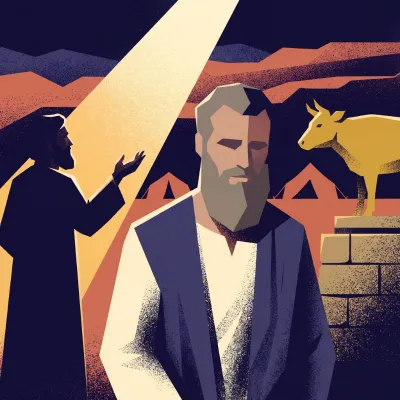
The Levites moved through the camp of Israel with swords in their hands, and by sundown three thousand people were dead. They walked past tent after tent, and at some point they walked past the one man who had melted the gold, shaped the idol with his own tool, built an altar before it, and announced the feast. They walked past Aaron, and not one sword touched him. Within months, the man who made the golden calf was standing before God in holy garments as the first high priest of Israel. How can that be right? Why was Aaron spared when three thousand others were not? In this episode, we explore the real answer the Bible gives, hidden in a single verse Moses did not speak until forty years later. We feel the fear and impatience at the foot of Sinai, look honestly at the full weight of Aaron's sin, and see that God's first sentence was against the whole nation. We discover that the Lord was angry enough with Aaron to destroy him, and that Aaron lived because Moses prayed for him by name. We also follow Moses as he "stood in the breach" and offered to be blotted out of God's book for the people, and why God refused. We trace Aaron's life after the calf: the sin offering for himself at his ordination, his failures with Miriam and at Meribah, and his death on Mount Hor. And we see how his story points to the one Mediator whose offer heaven did not refuse. Bible verses included in this episode: “Whoever is for the Lord, come to me.” (Exodus 32:26) “And the Lord was angry enough with Aaron to destroy him, but at that time I prayed for Aaron too.” (Deuteronomy 9:20) “Had not Moses, his chosen one, stood in the breach before him to keep his wrath from destroying them.” (Psalm 106:23) “But if not, then blot me out of the book you have written.” (Exodus 32:32) “Therefore he is able to save completely those who come to God through him, because he always lives to intercede for them.” (Hebrews 7:25) If you have failed under pressure and wondered whether God could ever use you again, look at what He did with Aaron. God's callings are not reserved for people with clean histories. They are given to forgiven people. Aaron did not know Moses was praying for him. If you belong to Jesus, He always lives to intercede for you. The sentence has already fallen on Him, and the God who kept a place for the man who made the golden calf has kept a place for you.
 32 分钟
Stories of Bible Characters
Why Is There No Tribe Of Joseph In Israel? The Shocking Reason Explained
There is a name missing from the map of Israel, and it belongs to the one man who made the map possible. Joseph, the favorite son and the dreamer who saved his whole family from famine, has no territory named after him when Joshua divides the promised land among the tribes. It can look like an oversight, or even an insult. But Joseph's name is not missing because he received too little. It is missing because he received too much to fit inside a single border. In this episode, we explore the surprising reason there is no tribe of Joseph. We look at the birthright and double portion of the firstborn, how Reuben lost it, and how it passed to Joseph. We step into a dim room in Egypt where the dying Jacob adopts Joseph's two sons, Ephraim and Manasseh, as his own, and then crosses his arms to bless the younger above the older, redeeming the deception of his own youth. We see why the count of the tribes still stays at twelve because Levi's inheritance was the Lord Himself, and why two boys with an Egyptian mother became the model of blessing for generations. We also trace Joseph's name through the rest of Scripture, from Shiloh and the Psalms to Ezekiel's "two portions" and the tribe of Joseph in Revelation 7, and see how Joseph's story points to Jesus, the beloved Son whose reward is children adopted into God's family. Bible verses included in this episode: “He was the firstborn, but because he defiled his father’s bed, his birthright was given to the sons of Joseph.” (1 Chronicles 5:1) “And now your two sons, Ephraim and Manasseh, who were born to you in the land of Egypt before I came to you in Egypt, are mine; as Reuben and Simeon, they shall be mine.” (Genesis 48:5) “I know, my son, I know. He also shall become a people, and he also shall be great; but truly his younger brother shall be greater than he.” (Genesis 48:19) “By you Israel will bless, saying, ‘May God make you as Ephraim and as Manasseh!’” (Genesis 48:20) “The Lord is his inheritance.” (Deuteronomy 10:9) “Give ear, O Shepherd of Israel, You who lead Joseph like a flock.” (Psalm 80:1) “Joseph shall have two portions.” (Ezekiel 47:13) “But as many as received Him, to them He gave the right to become children of God.” (John 1:12) If you feel overlooked, left off the lists, or wonder whether your background disqualifies you, let Joseph's story stand as a witness. The people the world can no longer find on its lists are often the ones God has recorded most carefully. The God who never forgot Joseph has not forgotten you. The double portion always comes after the pit.
 31 分钟
Hard Bible Questions
Who Are The FALSE GODS In The BIBLE
Have you ever wondered why the Bible spends so much time talking about other gods? If there is only one Creator, why does the Old Testament feel like a constant war against strange and dark figures like Baal, Molech, and Dagon? Most of us grew up thinking these were just harmless statues or blocks of wood, but the Bible reveals a much more disturbing reality. In this episode, we unmask the secret war of the scriptures and look at the real, intelligent spiritual beings hiding behind the idols. We explore the mystery of the Divine Council and the rebellion of the sons of God who sought to enslave humanity. We journey through the history of these ancient enemies, from the violent storm god of Canaan to the horrifying devourer of children in the valley of Hinnom. We witness the systematic dismantling of the Egyptian gods during the plagues and see the humiliation of the fish god Dagon as he falls before the Ark of the Covenant. This episode also exposes the subtle idols we create today, like the golden calves of our own making and the modern master known as Mammon. By looking at these defeated powers, we discover the true nature of the cosmic battle for our hearts and the ultimate victory of the King of Kings. Scripture References "God presides in the great assembly; he renders judgment among the gods." (Psalm 82:1) "When the Most High gave the nations their inheritance, when he divided all mankind, he set up boundaries for the peoples according to the number of the sons of God." (Deuteronomy 32:8) "But there was no response, no one answered, no one paid attention." (1 Kings 18:29) "Do not set up any wooden Asherah pole beside the altar you build to the Lord your God." (Deuteronomy 16:21) "Do not give any of your children to be sacrificed to Molech, for you must not profane the name of your God. I am the Lord." (Leviticus 18:21) "They built high places for Baal in the Valley of Ben Hinnom to sacrifice their sons and daughters to Molech, though I never commanded—nor did it enter my mind—that they should do such a detestable thing and so make Judah sin." (Jeremiah 32:35) "On that same night I will pass through Egypt and strike down every firstborn of both people and animals, and I will bring judgment on all the gods of Egypt. I am the Lord." (Exodus 12:12) "When the people of Ashdod rose early the next day, there was Dagon, fallen on his face on the ground before the ark of the Lord! They took Dagon and put him back in his place." (1 Samuel 5:3) "But the following morning when they rose, there was Dagon, fallen on his face on the ground before the ark of the Lord! His head and hands had been broken off and were lying on the threshold; only his body remained." (1 Samuel 5:4) "Then they said, 'These are your gods, Israel, who brought you up out of the land of Egypt.'" (Exodus 32:4) "Then he took his firstborn son, who was to succeed him as king, and offered him as a sacrifice on the city wall. The fury against Israel was great; they withdrew and returned to their own land." (2 Kings 3:27) "On a hill east of Jerusalem, Solomon built a high place for Chemosh the detestable god of Moab, and for Molech the detestable god of the Ammonites." (1 Kings 11:7) "We will certainly do everything we said we would: We will burn incense to the Queen of Heaven and will pour out drink offerings to her... At that time we had plenty of food and were well off and suffered no harm." (Jeremiah 44:17) "He broke into pieces the bronze snake Moses had made, for up to that time the Israelites had been burning incense to it. It was called Nehushtan." (2 Kings 18:4) "A silversmith named Demetrius, who made silver shrines of Artemis, brought in a lot of business for the craftsmen there. He called them together... and said: 'You know, my friends, that we receive a good income from this business.'" (Acts 19:24 to 25) "Great is Artemis of the Ephesians!" (Acts 19:34) "No, but the sacrifices of pagans are offered to demons, not to God, and I do not want you to be participants with demons." (1 Corinthians 10:20) "The god of this age has blinded the minds of unbelievers, so that they cannot see the light of the gospel that displays the glory of Christ, who is the image of God." (2 Corinthians 4:4) "No one can serve two masters. Either you will hate the one and love the other, or you will be devoted to the one and despise the other. You cannot serve both God and money." (Matthew 6:24) "What do you want with us, Jesus of Nazareth? Have you come to destroy us? I know who you are—the Holy One of God!" (Mark 1:24) "And having disarmed the powers and authorities, he made a public spectacle of them, triumphing over them by the cross." (Colossians 2:15) "Then Jesus came to them and said, 'All authority in heaven and on earth has been given to me.'" (Matthew 28:18) "How long will you waver between two opinions? If the Lord is God, follow him; but if Baal is God, follow him." (1 Kings 18:21) This episode shows that the false gods are empty shadows compared to the True God. It challenges us to look past the modern idols of our time and serve the only Source of life who gave everything for us.
 30 分钟
Words of Jesus
I And My Father Are One
What did Jesus mean when He said, “I and the Father are one”? In this episode, we explore one of the boldest statements Jesus ever made, the violent reaction it provoked, and why this claim stands at the very center of the Christian faith. This message reveals that Jesus was not presenting Himself as merely a teacher or prophet, but as the One who shares the Father’s divine nature, authority, and power to give eternal life. Jesus said, “I and my Father are one.” (John 10:30) The people who heard Him understood the weight of that claim immediately, saying, “For a good work we stone thee not; but for blasphemy; and because that thou, being a man, makest thyself God.” (John 10:33) Jesus also said, “My sheep hear my voice, and I know them, and they follow me: And I give unto them eternal life; and they shall never perish, neither shall any man pluck them out of my hand.” (John 10:27 to 28) Then He connected His hand with the Father’s hand, saying, “My Father, which gave them me, is greater than all; and no man is able to pluck them out of my Father’s hand.” (John 10:29) Later, Jesus made the meaning even clearer when He said, “He that hath seen me hath seen the Father.” (John 14:9) This truth does not contradict the oneness of God revealed in Scripture, for it is written, “Hear, O Israel: The Lord our God is one Lord.” (Deuteronomy 6:4) And Jesus fulfills the promise of God as Shepherd, for the Lord said, “For thus saith the Lord God; Behold, I, even I, will both search my sheep, and seek them out.” (Ezekiel 34:11) That is why Jesus could say, “I am the good shepherd: the good shepherd giveth his life for the sheep.” (John 10:11) The Gospel of John opens with this foundation, “In the beginning was the Word, and the Word was with God, and the Word was God.” (John 1:1) This episode is a call to see Jesus clearly, to understand why neutrality about Him is impossible, and to rest in the security that comes from the One whose hand is the very hand of God.
 30 分钟
Words of Jesus
Why Did Jesus Call The Father The Only True God
Why did Jesus call the Father “the only true God” (John 17:3)? In this episode, we explore one of the most misunderstood lines in the Gospel of John and uncover what Jesus was really revealing in that prayer. Far from lowering Himself, Jesus is showing how the one God makes Himself known, and why eternal life is found in knowing both the Father and the Son He sent. Jesus’ words echo Israel’s great confession, “Hear, O Israel: The Lord our God, the Lord is one.” (Deuteronomy 6:4) Then Jesus defines eternal life this way, “that they know you, the only true God, and Jesus Christ whom you have sent.” (John 17:3) Just two verses later, He speaks of the glory He shared with the Father before creation, “glorify me… with the glory that I had with you before the world existed.” (John 17:5) And after the resurrection, Thomas answers Jesus with worship, “My Lord and my God!” (John 20:28) This episode shows that when Jesus calls the Father the only true God, He is not excluding Himself. He is shutting the door on idols and false gods, while revealing that the Father is known through the Son He sent. The Father is the only true God, and the Son makes Him known. That is why eternal life is not just surviving death, but entering real fellowship with God through Jesus Christ.
 36 分钟
Words of Jesus
“I am the Bread of Life”
What did Jesus mean when He said, “I am the Bread of Life”? In this episode, we explore one of the most powerful statements Jesus ever made and why it reached so deeply into the hunger, hope, and memory of God’s people. This is not only about physical bread. It is about the One who alone can satisfy the soul, give true life, welcome the weary, and hold His people even beyond death. Jesus said, “It was not Moses who gave you the bread from heaven, but my Father gives you the true bread from heaven. For the bread of God is he who comes down from heaven and gives life to the world.” (John 6:32 to 33) Then Jesus made the meaning plain, “I am the bread of life. Whoever comes to me will never go hungry, and whoever believes in me will never be thirsty.” (John 6:35) He also gave this promise of welcome, “Whoever comes to me I will never drive away.” (John 6:37) And He said, “I am the living bread that came down from heaven. Whoever eats this bread will live forever. This bread is my flesh, which I will give for the life of the world.” (John 6:51) Long before this, God taught His people in the wilderness, “Man does not live by bread alone but by every word that comes from the mouth of the Lord.” (Deuteronomy 8:3) And through the prophet Isaiah, God gave this invitation, “Come, all you who are thirsty, come to the waters and you who have no money, come, buy and eat.” (Isaiah 55:1) This episode traces the meaning of bread through Scripture, from manna in the wilderness to the bread of the Presence, from Passover to Bethlehem, and shows how all of it points to Jesus. He is not only a teacher who speaks about life. He is the One who gives Himself as life for the world.