
Випуски подкасту
 32 хв
Bible Chapters Explained
If You Understand Genesis 3:15, You Understand the Entire Bible
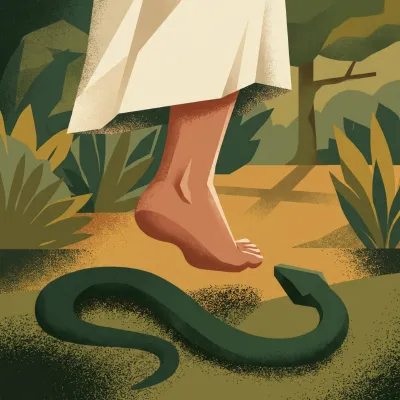
Genesis 3:15 is the first promise God ever made to guilty people, and everything the Bible does after it is God keeping that promise. One sentence, spoken in the worst hour in human history, in a garden that had just stopped being safe. Once you see what it is doing, the sixty six books of the Bible stop feeling like a stack of separate books and start reading like one story with one ending. God questioned the man. God questioned the woman. But He asked the serpent nothing. He turned to it and began sentencing, and Adam and Eve, hiding behind the trees, overheard God announce a war He was starting on their behalf. In this episode, we explore the promise hidden in Genesis 3:15. We notice that only the serpent and the ground are cursed, never the man and the woman. We unpack the rare Hebrew word for enmity, the single verb used for both the crushing of the head and the striking of the heel, and why ancient translators heard a person in this verse long before Jesus was born. We watch Adam name his wife Life, God clothe them with His own hands, Eve hold on to the word "offspring" after losing two sons, and Lamech name Noah in hope. And we follow the line through Tamar, Rahab, Ruth, and Mary to the cross, the empty tomb, and the last page of Revelation. The heel wound and the head wound are the same event described from two sides. The wound was the weapon. Bible verses included in this episode: “And I will put enmity between you and the woman, and between your offspring and hers; he will crush your head, and you will strike his heel.” (Genesis 3:15) “Adam named his wife Eve, because she would become the mother of all the living.” (Genesis 3:20) “The Lord God made garments of skin for Adam and his wife and clothed them.” (Genesis 3:21) “God has granted me another child in place of Abel, since Cain killed him.” (Genesis 4:25) “But when the set time had fully come, God sent his Son, born of a woman, born under the law.” (Galatians 4:4) “The reason the Son of God appeared was to destroy the devil's work.” (1 John 3:8) “No longer will there be any curse.” (Revelation 22:3) This message is for anyone carrying something they have never said out loud, anyone worn down by a life that keeps producing thorns, and anyone who feels God's promises were written for people with a cleaner history. God's first move toward failing people is a promise, and His anger has an enemy, and the enemy is not you. You can overhear something and still be the one it is for. The garden closed. The city opens. And the curse that started it all will not be there.
 41 хв
Hard Bible Questions
What God Meant When He Said, “Let Us Make Man in Our Image”
What does it mean when God says, "Let us make man in our image"? Why the "us," and what does "image" tell us about who we are? This short line in the first chapter of the Bible holds the key to human identity, purpose, and the story God is writing with humanity. An image points beyond itself to the one it reflects. Like a coin carrying a king's face, we are not God, but our lives are meant to carry His likeness so that people can see what He is like: truthful, just, and loving. This likeness is not about height, age, or strength. It is about the capacity to know God, to speak truth, to keep promises, and to choose love, and it carries a royal calling to care for His world. In this episode, we explore what the image of God means and why it gives every person a worth that illness, failure, poverty, or age cannot erase. We look at the different ways Christians have understood the "us" and "our" in Genesis, from a holy counsel within the life of the Father, the Word, and the Spirit to a royal court of heaven, and why the fullness of the one God shines through the text. We see how ancient kings placed statues of themselves across their lands, and how Genesis turns that picture around by placing living images of God in every field, market, and home. We also follow the image through the whole story of Scripture: marred by sin but not erased, displayed in perfection in Jesus, renewed in believers by the Spirit, and completed on the day Christ appears. Bible verses included in this episode: “Then God said, ‘Let us make mankind in our image, in our likeness, so that they may rule.’” (Genesis 1:26) “So God created mankind in his own image, in the image of God he created them; male and female he created them.” (Genesis 1:27) “The man has now become like one of us, knowing good and evil.” (Genesis 3:22) “Whom shall I send? And who will go for us?” (Isaiah 6:8) “The Son is the image of the invisible God, the firstborn over all creation.” (Colossians 1:15) “We know that when Christ appears, we shall be like him, for we shall see him as he is.” (1 John 3:2) You were not thrown into a cold universe. You were chosen to carry God's mark and to reflect His heart. Let that truth quiet shame and fear. The God who spoke galaxies into being also spoke a purpose over you, and He has not forgotten what He began.
 34 хв
Hard Bible Questions
Why Did God Create Satan Knowing He Would Rebel Against Him?
If God knew Satan would rebel, why create him at all? It is one of the hardest questions a believer can ask, because it tests what we believe about God's goodness, wisdom, and justice. God knows everything, and yet His creatures can choose. The Bible's answer begins with a boundary: evil is real, but evil is not original. God made all things good, including the high creature who later fell. Satan is not a rival god standing opposite the Lord. He is a creature, with a beginning, with limits, and with accountability. What God created was good because it made room for love. What God did not create was the crooked desire that set itself against Him. In this episode, we explore why real love requires a real will, and why a world of beings who could only follow but never choose would be a world without genuine worship or friendship with God. We look at the difference between God testing and a creature tempting, why foreknowledge is not the same as guilt, and how the cross shows God's plan and human responsibility standing side by side. We consider what Scripture reveals about Satan's fall and what it wisely leaves veiled, and why God chose a history in which His holiness, justice, mercy, and love would be displayed in their fullest range. Finally, we look at the end of the story, which is already certain. The deceiver's time is measured, and the devil's present activity runs on a leash. Bible verses included in this episode: “God saw all that he had made, and it was very good.” (Genesis 1:31) “You were blameless in your ways from the day you were created till wickedness was found in you.” (Ezekiel 28:15) “When tempted, no one should say, ‘God is tempting me.’ For God cannot be tempted by evil, nor does he tempt anyone.” (James 1:13) “This man was handed over to you by God’s deliberate plan and foreknowledge.” (Acts 2:23) “The secret things belong to the Lord our God, but the things revealed belong to us and to our children forever.” (Deuteronomy 29:29) “The reason the Son of God appeared was to destroy the devil’s work.” (1 John 3:8) “And the devil, who deceived them, was thrown into the lake of burning sulfur.” (Revelation 20:10) If this question has kept you up at night, you are not alone. The God who knew rebellion would come also chose to draw near, carried our shame, and promised a day when the shadows will be gone. The question begins with Satan, but the answer leads to Jesus. Evil is real, but not final.
 31 хв
Hard Bible Questions
Did You Know God Can Speak to You Through Your Mind? Stop Ignoring Him!
Some of the most important moments of your life may have started with a simple thought. A name that came to mind. A nudge to call someone, to pray, to forgive. There was no angel at the foot of your bed, just a thought that felt different from your usual thinking. And later you wondered, was that God? Many believers are waiting for a voice in the sky while the Lord is already whispering inside. They expect a dramatic scene and miss the quiet doorway of the mind. In this episode, we explore how God still speaks to ordinary people and how He often does it through the mind. We look at the quiet inner sentence that carries more weight than usual thoughts, the verse that rises at just the right moment, conviction that cuts through excuses, and peace that interrupts cycles of fear. We also learn how to discern which voice you are hearing, whether it comes from God, from the enemy, or from your own heart, by testing its content, its tone, and its fruit. Through the stories of young Samuel, the apostle Paul, and the early church in Antioch, this message shows how God speaks into the inner life, and what can block His voice: cherished sin, doubt, fear, busyness, and unforgiveness. Bible verses included in this episode: “Jesus Christ is the same yesterday and today and forever.” (Hebrews 13:8) “My sheep hear my voice, and I know them, and they follow me.” (John 10:27) “Do not be conformed to this world, but be transformed by the renewing of your mind.” (Romans 12:2) “Beloved, do not believe every spirit, but test the spirits, whether they are of God.” (1 John 4:1) “There is therefore now no condemnation to those who are in Christ Jesus.” (Romans 8:1) “Speak, Lord, for Your servant hears.” (1 Samuel 3:9) “Call to Me, and I will answer you, and show you great and mighty things, which you do not know.” (Jeremiah 33:3) God can speak to you through your mind. He has done it more often than you realize, and He will keep doing it as you walk with Him. The question is whether you will treat His voice as a passing thought or honor it as the word of your Shepherd. Right where you are, you can say, Lord, I want to listen. Teach me to know Your voice in my thoughts.
 33 хв
Hard Bible Questions
7 Signs You Are Under Spiritual Attack, and How God Tells You to Fight Back
There are seasons when nothing on the surface has changed, and yet everything inside you feels heavier. You are irritable with people you love, anxious for reasons you cannot name, and tired in a way sleep does not fix. You wonder if you are losing your faith or simply failing as a Christian. But what if some of what you feel is not weakness at all? What if it is resistance from an enemy who does not want you to draw closer to God? In this episode, we explore seven signs Scripture gives of spiritual attack: a sudden pull toward sin, a heaviness you cannot explain, accusation that never lets up, confusion about what is true, fear that will not release, division in your relationships, and a slow drift away from God Himself. We also keep a careful balance, because not every hard day is an attack, and fear of the enemy can become its own trap. Then we turn to how God tells you to fight back. The enemy is already defeated at the cross. You are called not to win a victory still in doubt, but to stand in the victory Jesus secured, clothed in the full armor of God, taking every thought captive, praying at all times, and standing shoulder to shoulder with other believers. Bible verses included in this episode: “For our struggle is not against flesh and blood, but against the rulers, against the authorities, against the powers of this dark world and against the spiritual forces of evil in the heavenly realms.” (Ephesians 6:12) “Be alert and of sober mind. Your enemy the devil prowls around like a roaring lion looking for someone to devour.” (1 Peter 5:8) “The thief comes only to steal and kill and destroy; I have come that they may have life, and have it to the full.” (John 10:10) “Having disarmed the powers and authorities, he made a public spectacle of them, triumphing over them by the cross.” (Colossians 2:15) “Submit yourselves, then, to God. Resist the devil, and he will flee from you.” (James 4:7) “The one who is in you is greater than the one who is in the world.” (1 John 4:4) “Simon, Simon, Satan has asked to sift all of you as wheat. But I have prayed for you, Simon, that your faith may not fail.” (Luke 22:31-32) You are not crazy, you are not failing, and you are not alone. The lion roars, but a roar is not a bite. The accuser speaks day and night, but his voice is not the verdict of heaven. Put on the armor, draw near to the God who is already near to you, and stand. The One who lives inside you is greater.
 30 хв
Hard Bible Questions
Who Is the Antichrist, and What the Bible Actually Says to Watch For
If you searched every page of the Bible for the word antichrist, you would find something unexpected. It does not appear in Revelation or Daniel, and it never comes from the lips of Jesus. It appears only in the letters of the apostle John, written by an old pastor to frightened churches he called dear children. So why has one word produced so much fear? And what does Scripture actually tell us to watch for? In this episode, we explore who the antichrist is according to the Bible itself. We look at the two meanings hidden in the word, against Christ and in place of Christ, and why a counterfeit can be more dangerous than an open enemy. We hear John's simple test, what a voice does with Jesus, and Paul's warning about the man of lawlessness who sets himself up in God's temple. We also look at Antiochus Epiphanes, Daniel's visions, the number 666, and the difference between what Scripture clearly says and the detailed timelines readers have assembled over the centuries. Most of all, this message traces the one thread behind every picture of the antichrist: self-exaltation against God. That same sin began in the garden and still pulls at every human heart, and the answer to it is not a chart or a bunker, but a King. Bible verses included in this episode: “Dear children, this is the last hour; and as you have heard that the antichrist is coming, even now many antichrists have come. This is how we know it is the last hour.” (1 John 2:18) “Every spirit that acknowledges that Jesus Christ has come in the flesh is from God, but every spirit that does not acknowledge Jesus is not from God. This is the spirit of the antichrist, which you have heard is coming and even now is already in the world.” (1 John 4:2-3) “Who is the liar? It is whoever denies that Jesus is the Christ. Such a person is the antichrist, denying the Father and the Son.” (1 John 2:22) “He will oppose and will exalt himself over everything that is called God or is worshiped, so that he sets himself up in God’s temple, proclaiming himself to be God.” (2 Thessalonians 2:4) “And then the lawless one will be revealed, whom the Lord Jesus will overthrow with the breath of his mouth and destroy by the splendor of his coming.” (2 Thessalonians 2:8) The end of the story is not in doubt. The deceiver gets his hour, but Christ gets eternity. You do not have to be strong enough to defeat the antichrist. You only have to belong to the Christ who already has. So set the fear down. Watch with clear and humble eyes, the way a child watches for a father coming home. Keep Jesus on the throne of your heart, stay close to His people, and keep going.
 33 хв
Words of Jesus
What did Jesus mean when He said, “Ask and you shall receive”?
“Ask and you shall receive.” Most of us have heard these words, but what did Jesus really mean? Is it a door anyone can open, or a promise with a path most people miss? If this line is more than a comfort phrase, it could reset how you pray, what you hope for, and how you recognize God’s answer when it arrives. In the kingdom, asking is not the language of bargaining. It is the language of belonging. A child does not submit a contract to a father. He speaks out of relationship, bold because love invites boldness and humble because love bows to wisdom. In this episode, we explore the kind of asking Jesus had in mind. We look at the boundaries He gave, not as walls to keep us out but as rails to keep us safe: asking in His name, asking according to the Father’s will, bringing our motives into the light, trusting God’s character, persevering in prayer, and receiving the Father’s definition of what is good. We consider the purpose behind the promise, that our joy may be full, and trace how it fulfills the prophets’ hope of a God who hears before we call. We also walk through how to approach God as Father, with simplicity, confession, trust, Scripture, community, and gratitude, and we clear up common misunderstandings about intensity, sovereignty, “mustard seed” faith, and what to do when prayer ends in disappointment. Bible verses included in this episode: “If you then, who are evil, know how to give good gifts to your children, how much more will your Father who is in heaven give good things to those who ask him.” (Matthew 7:11) “Whatever you ask in my name, this I will do, that the Father may be glorified in the Son.” (John 14:13) “If we ask anything according to his will he hears us.” (1 John 5:14) “You ask and do not receive, because you ask wrongly, to spend it on your passions.” (James 4:3) “Whatever you ask in prayer, believe that you have received it, and it will be yours.” (Mark 11:24) “Ask, and you will receive, that your joy may be full.” (John 16:24) “Before they call I will answer; while they are yet speaking I will hear.” (Isaiah 65:24) If you have grown tired of praying, you are not shouting into the wind. You are speaking to a Father who sees you, knows you, and invites you near. Bring what is heavy, what is hidden, and what seems too small. “Ask and you shall receive” is not the language of control. It is the language of children who know their Father. Keep asking. Keep seeking. Keep knocking.
 39 хв
Hard Bible Questions
Why Did Jesus Stay Exactly 40 Days ON EARTH after Resurrection Before Ascending to Heaven
Why did Jesus choose to stay on earth for exactly forty days after His resurrection instead of returning to the Father at once? In this episode, we explore the mystery of that brief delay and the divine purpose that continues to shape how we face our own turning points today. We walk through the undeniable proofs offered to skeptics and the deeply personal restoration of broken leaders like Peter. We follow the road to Emmaus where ancient prophecies were finally unlocked and uncover how the timing of the ascension was perfectly aligned with the sacred feasts of Israel. From the transition between physical sight and the indwelling Spirit to the final command that launched a worldwide mission, we discover why those forty days were the essential foundation for a faith that would never crack under sorrow. Scripture References "Look at my hands and my feet. It is I myself! Touch me and see." (Luke 24:39) "He also appeared to more than five hundred at once." (1 Corinthians 15:6) "Beginning with Moses and all the Prophets, he explained to them what was said in all the Scriptures concerning himself." (Luke 24:27) "Then he opened their minds so they could understand the Scriptures. He told them, ‘This is what is written: The Messiah will suffer and rise from the dead on the third day, and repentance for the forgiveness of sins will be preached in his name to all nations, beginning at Jerusalem.’" (Luke 24:45 to 47) "Put your finger here; see my hands. Stop doubting and believe." (John 20:27) "All authority in heaven and on earth has been given to me." (Matthew 28:18) "Do not leave Jerusalem, but wait for the gift my Father promised… in a few days you will be baptized with the Holy Spirit." (Acts 1:4 to 5) "You will receive power when the Holy Spirit comes on you; and you will be my witnesses in Jerusalem, and in all Judea and Samaria, and to the ends of the earth." (Acts 1:8) "Surely I am with you always, to the very end of the age." (Matthew 28:20) "Christ has indeed been raised from the dead, the firstfruits of those who have fallen asleep." (1 Corinthians 15:20) "Count off fifty days up to the day after the seventh Sabbath." (Leviticus 23:15 to 16) "It is for your good that I am going away… if I go, I will send him to you." (John 16:7) "He was taken up before their very eyes, and a cloud hid him from their sight." (Acts 1:9) "Who have been with us the whole time the Lord Jesus was living among us… For one of these must become a witness with us of his resurrection." (Acts 1:21 to 22) "What we have seen with our eyes… looked at and our hands have touched." (1 John 1:1) This episode shows that the forty days were not a random delay but a season of formation. Jesus stayed to turn fragile followers into steady builders, ensuring that when He finally ascended, His presence would become larger, not smaller, through the power of the Spirit.
 40 хв
Hard Bible Questions
Why Jesus Had to Go To HELL the 3 Days after his Death
Why did Jesus descend into hell after His death, and what did those three days really mean? In this episode, we explore the mystery of Jesus’ descent into the realm of the dead, the depth of His suffering, the fulfillment of prophecy, and His victory over sin, death, and hell. This message shows that Jesus did not only die for our sins, but entered the darkest domain of death itself to proclaim victory and secure freedom for all who believe. On the cross, Jesus cried out, “My God, My God, why have You forsaken Me?” (Matthew 27:46) John the Baptist declared of Jesus, “Behold! The Lamb of God who takes away the sin of the world!” (John 1:29) Scripture says, “Christ also suffered once for sins, the righteous for the unrighteous, to bring you to God. He was put to death in the body but made alive in the Spirit. After being made alive, He went and made proclamation to the imprisoned spirits.” (1 Peter 3:18 to 19) David prophesied, “For You will not leave my soul in Sheol, Nor will You allow Your Holy One to see corruption.” (Psalm 16:10) Jesus declares in Revelation, “I am He who lives, and was dead, and behold, I am alive forevermore. Amen. And I have the keys of Hades and of Death.” (Revelation 1:18) The prophet Isaiah wrote, “He is despised and rejected by men, A Man of sorrows and acquainted with grief. And we hid, as it were, our faces from Him. He was despised, and we did not esteem Him.” (Isaiah 53:3) And again, “But He was wounded for our transgressions, He was bruised for our iniquities. The chastisement for our peace was upon Him, And by His stripes we are healed.” (Isaiah 53:5) Scripture also says, “And He Himself is the propitiation for our sins, and not for ours only but also for the whole world.” (1 John 2:2) Paul writes, “For if we have been united together in the likeness of His death, certainly we also shall be in the likeness of His resurrection.” (Romans 6:5) And because of Christ’s victory, we can say with confidence, “Yet in all these things we are more than conquerors through Him who loved us.” (Romans 8:37) This episode is a powerful reminder that Jesus did not only go to the cross for you. He entered the deepest darkness and came out victorious, proving that death does not have the final word. Because He lives, all who trust in Him can live in hope, freedom, and victory.
 40 хв
Words of Jesus
“My yoke is easy and my burden is light”
What did Jesus mean when He said, “My yoke is easy, and my burden is light”? Many people hear these words and imagine Jesus promising an easy life with no struggle, no responsibility, and no weight to carry. But His invitation is deeper than that. Jesus was not offering a shortcut out of life’s burdens. He was inviting the weary to stop carrying the wrong burdens alone and to walk with Him under a yoke that fits. In this episode, we explore the meaning of a yoke in the first century. A yoke was not only a wooden tool used for work. It was also a picture of discipleship, teaching, allegiance, direction, and companionship. To take Jesus’ yoke is to be joined to Him, to learn His way, to walk at His pace, and to carry life’s responsibilities with His strength instead of our striving. We’ll also look at the heavy yokes Jesus confronted. Religious leaders placed burdens on people’s shoulders without helping them carry the weight. Many today still live under private yokes of fear, performance, perfectionism, productivity, reputation, anxiety, and self approval. But Jesus offers a different way. His yoke does not crush the soul. His burden does not destroy hope. His commands are carried by love, His pace is mercy, and His rest reaches deeper than circumstances. This is not a message about escaping responsibility. It is about carrying what matters with the One who is strong enough to pull, wise enough to lead, and gentle enough to restore. If you are tired, restless, or weighed down by a burden you cannot name, Jesus’ invitation is still open: come to Him, take His yoke, learn from Him, and find rest for your soul. Bible verses included in this episode: “They tie up heavy burdens, hard to bear, and lay them on people’s shoulders, but they themselves are not willing to move them with their finger.” (Matthew 23:4) “Come to me, all who labor and are heavy laden, and I will give you rest… Take my yoke upon you, and learn from me… and you will find rest for your souls. For my yoke is easy, and my burden is light.” (Matthew 11:28–30) “Stand by the roads, and look, and ask for the ancient paths, where the good way is; and walk in it, and find rest for your souls.” (Jeremiah 6:16) “For this is the love of God, that we keep his commandments. And his commandments are not burdensome.” (1 John 5:3) The yoke you choose will shape the soul you become. Choose the One whose commands are carried by love, whose pace is mercy, and whose burden is light. In walking with Him, you will not only find rest, you will become a place of rest for others.