
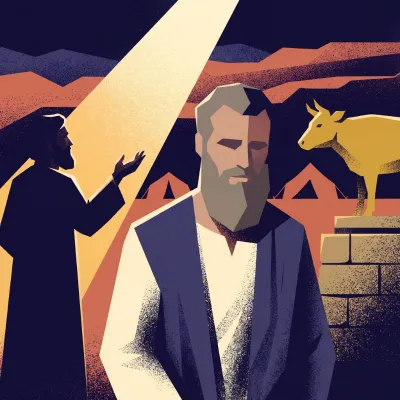
The Levites moved through the camp of Israel with swords in their hands, and by sundown three thousand people were dead. They walked past tent after tent, and at some point they walked past the one man who had melted the gold, shaped the idol with his own tool, built an altar before it, and announced the feast. They walked past Aaron, and not one sword touched him. Within months, the man who made the golden calf was standing before God in holy garments as the first high priest of Israel. How can that be right? Why was Aaron spared when three thousand others were not? In this episode, we explore the real answer the Bible gives, hidden in a single verse Moses did not speak until forty years later. We feel the fear and impatience at the foot of Sinai, look honestly at the full weight of Aaron's sin, and see that God's first sentence was against the whole nation. We discover that the Lord was angry enough with Aaron to destroy him, and that Aaron lived because Moses prayed for him by name. We also follow Moses as he "stood in the breach" and offered to be blotted out of God's book for the people, and why God refused. We trace Aaron's life after the calf: the sin offering for himself at his ordination, his failures with Miriam and at Meribah, and his death on Mount Hor. And we see how his story points to the one Mediator whose offer heaven did not refuse. Bible verses included in this episode: “Whoever is for the Lord, come to me.” (Exodus 32:26) “And the Lord was angry enough with Aaron to destroy him, but at that time I prayed for Aaron too.” (Deuteronomy 9:20) “Had not Moses, his chosen one, stood in the breach before him to keep his wrath from destroying them.” (Psalm 106:23) “But if not, then blot me out of the book you have written.” (Exodus 32:32) “Therefore he is able to save completely those who come to God through him, because he always lives to intercede for them.” (Hebrews 7:25) If you have failed under pressure and wondered whether God could ever use you again, look at what He did with Aaron. God's callings are not reserved for people with clean histories. They are given to forgiven people. Aaron did not know Moses was praying for him. If you belong to Jesus, He always lives to intercede for you. The sentence has already fallen on Him, and the God who kept a place for the man who made the golden calf has kept a place for you.
Mai multe în Stories of Bible Characters
 32 min
Stories of Bible Characters
Why Is There No Tribe Of Joseph In Israel? The Shocking Reason Explained
There is a name missing from the map of Israel, and it belongs to the one man who made the map possible. Joseph, the favorite son and the dreamer who saved his whole family from famine, has no territory named after him when Joshua divides the promised land among the tribes. It can look like an oversight, or even an insult. But Joseph's name is not missing because he received too little. It is missing because he received too much to fit inside a single border. In this episode, we explore the surprising reason there is no tribe of Joseph. We look at the birthright and double portion of the firstborn, how Reuben lost it, and how it passed to Joseph. We step into a dim room in Egypt where the dying Jacob adopts Joseph's two sons, Ephraim and Manasseh, as his own, and then crosses his arms to bless the younger above the older, redeeming the deception of his own youth. We see why the count of the tribes still stays at twelve because Levi's inheritance was the Lord Himself, and why two boys with an Egyptian mother became the model of blessing for generations. We also trace Joseph's name through the rest of Scripture, from Shiloh and the Psalms to Ezekiel's "two portions" and the tribe of Joseph in Revelation 7, and see how Joseph's story points to Jesus, the beloved Son whose reward is children adopted into God's family. Bible verses included in this episode: “He was the firstborn, but because he defiled his father’s bed, his birthright was given to the sons of Joseph.” (1 Chronicles 5:1) “And now your two sons, Ephraim and Manasseh, who were born to you in the land of Egypt before I came to you in Egypt, are mine; as Reuben and Simeon, they shall be mine.” (Genesis 48:5) “I know, my son, I know. He also shall become a people, and he also shall be great; but truly his younger brother shall be greater than he.” (Genesis 48:19) “By you Israel will bless, saying, ‘May God make you as Ephraim and as Manasseh!’” (Genesis 48:20) “The Lord is his inheritance.” (Deuteronomy 10:9) “Give ear, O Shepherd of Israel, You who lead Joseph like a flock.” (Psalm 80:1) “Joseph shall have two portions.” (Ezekiel 47:13) “But as many as received Him, to them He gave the right to become children of God.” (John 1:12) If you feel overlooked, left off the lists, or wonder whether your background disqualifies you, let Joseph's story stand as a witness. The people the world can no longer find on its lists are often the ones God has recorded most carefully. The God who never forgot Joseph has not forgotten you. The double portion always comes after the pit.
 32 min
Stories of Bible Characters
The Fall of Lucifer: How the Most Beautiful Angel Became Satan
The most beautiful angel who ever existed did not become Satan because he was tricked, wounded, or forced. He fell because of what happened quietly inside his own heart. A creature who stood closer to God than almost anything ever made looked at his beauty, his wisdom, and his nearness to the throne, and decided it was not enough. He wanted to be like God instead of loving God. If you have ever felt far from God, unworthy, tired, or ashamed of your own heart, this story is for you. The one who fell was not far from God when he fell. He was near. And that tells us that nearness alone is not what keeps us safe. In this episode, we explore the fall of Lucifer, gathering the pieces Scripture gives us in Isaiah 14 and Ezekiel 28. We look at where the name Lucifer comes from, how high this anointed guardian once stood, and how pride grew in secret until it became rebellion. We follow him from heaven to the garden of Eden, where he offered the same lie that ruined him, and we see what he truly lost. Not a battle, which he could never win, but nearness to God. Then the story turns from warning to good news. Where Lucifer, a creature, reached up to seize God's place, Jesus, who truly is God, came down, humbled Himself, and went to the cross for us. The title the fallen angel lost, the morning star, now belongs to Christ. Bible verses included in this episode: “How you have fallen from heaven, morning star, son of the dawn!” (Isaiah 14:12) “Your heart became proud on account of your beauty, and you corrupted your wisdom because of your splendor.” (Ezekiel 28:17) “You said in your heart, ‘I will ascend to the heavens, I will raise my throne above the stars of God... I will make myself like the Most High.’” (Isaiah 14:13–14) “Become conceited and fall under the same judgment as the devil.” (1 Timothy 3:6) “I saw Satan fall like lightning from heaven.” (Luke 10:18) “The great dragon was thrown down, that ancient serpent, who is called the devil and Satan, the deceiver of the whole world.” (Revelation 12:9) “I am the bright Morning Star.” (Revelation 22:16) You are not shut out because you are weak. Weakness is not what brought down the morning star. Pride is. The nearness he threw away is offered back to you freely in Jesus Christ. Not earned. Not deserved. Given. The morning star fell reaching upward. You can be lifted up simply by kneeling down. Come low, come honest, come as you are.
 31 min
Stories of Bible Characters
The Untold Truth About Methuselah, Enoch and Noah: Why God Waited for Him
Enoch walked so closely with God that he never tasted death. Noah built a boat on dry land and carried his family safely over a drowning world. And between them stands Methuselah, the man who lived longer than anyone who has ever drawn breath. He left behind no sermon and no miracle, only a name and a number so large it barely feels real. Yet Methuselah was the man God waited for. Every year he stayed alive, the flood held back. Every morning he woke, the judgment the world had already earned was pushed one more day into the future. His long life was the longest stretch of patience God ever held over a world that had run out of reasons to be spared. In this episode, we explore the story of Methuselah, Enoch, and Noah together. We step into a world filled with violence and corruption, meet Enoch, the father who walked with God until God took him, and consider what it meant for Methuselah to live 969 years, burying generation after generation while he watched faith itself fade. We see how God was quietly at work inside the long wait, raising up Noah, a man who found favor in His eyes before he ever cut a single plank for the ark. These three men, one family, show the shape of the gospel in miniature. God guards His promise, and He prepares a way of rescue before the storm ever breaks. Bible verses included in this episode: “Enoch walked faithfully with God; then he was no more, because God took him away.” (Genesis 5:24) “Altogether, Methuselah lived a total of 969 years, and then he died.” (Genesis 5:27) “He will comfort us in the labor and painful toil of our hands caused by the ground the Lord has cursed.” (Genesis 5:29) “But Noah found favor in the eyes of the Lord.” (Genesis 6:8) “The Lord is not slow in keeping his promise, as some understand slowness. Instead he is patient with you, not wanting anyone to perish, but everyone to come to repentance.” (2 Peter 3:9) If you have prayed the same prayer for years and heaven has felt silent, a long wait is not proof that God has forgotten you. Very often, the wait is where God is doing His deepest and quietest work. You are not too far behind, and you are not too late. The patience that held back a flood is patient enough to wait for you to take one small step toward home. The door is still open.
 39 min
Stories of Bible Characters
Absalom - The Most Beautiful Traitor in the Bible
Absalom became a traitor because admiration was the only thing anyone ever gave him. Israel praised his face. Strangers turned in the street to watch him pass. But in all those years of being looked at, no one ever answered the one question he actually asked. He had killed a brother, and he wanted his father to rule on it. What he got was silence from his father, then a kiss, and nothing in between. The Bible almost never describes what its people looked like. Then it comes to Absalom and stops to stare. Here was a prince with royal blood on both sides, wealth, charm, and a face the nation talked about. Everyone assumed they were looking at Israel's future. In this episode, we explore the complete story of Absalom, David's third son. We follow the crime against his sister Tamar that went unanswered, the feast at Baal Hazor where Amnon was struck down, three years of exile in Geshur, and two more years living in Jerusalem without ever seeing the king's face. We watch him stand at the city gate, handing strangers the very hearing his father denied him, until he stole the hearts of Israel. We walk with David as he flees barefoot up the Mount of Olives, see Ahithophel's counsel overturned by the hand of God, and stand in the forest of Ephraim where Absalom's life ended hanging in an oak tree. Finally, we hear the cry of a father who loved his son all along, and we see how God does everything David could not do. He devises ways so that a banished person does not remain banished from Him. Bible verses included in this episode: “In all Israel there was not a man so highly praised for his handsome appearance as Absalom. From the top of his head to the sole of his foot there was no blemish in him.” (2 Samuel 14:25) “Like water spilled on the ground, which cannot be recovered, so we must die. But that is not what God desires; rather, he devises ways so that a banished person does not remain banished from him.” (2 Samuel 14:14) “Absalom behaved in this way toward all the Israelites who came to the king asking for justice, and so he stole the hearts of the people of Israel.” (2 Samuel 15:6) “I lie down and sleep; I wake again, because the Lord sustains me.” (Psalm 3:5) “For the Lord had determined to frustrate the good advice of Ahithophel in order to bring disaster on Absalom.” (2 Samuel 17:14) “O my son Absalom! My son, my son Absalom! If only I had died instead of you, O Absalom, my son, my son!” (2 Samuel 18:33) “They will see his face, and his name will be on their foreheads.” (Revelation 22:4) If you are living with a long silence of your own, it can start to sound like an answer, as if you have been set aside. That reading is wrong. God has already spoken, in a manger, at a cross, and at an empty tomb. Absalom died reaching for a face. You will see one, and it will be turned toward you.