
Episódios de podcast
 36 min
Bible Chapters Explained
The 40 Days Jesus Was Tempted in the Wilderness, and How He Won
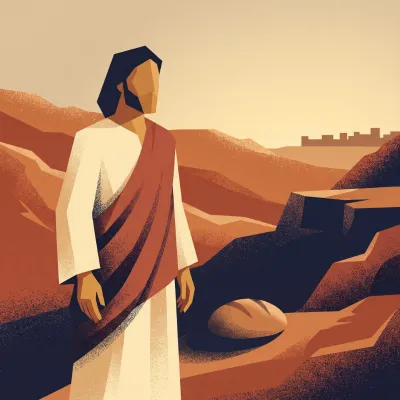
Before there was a battle, there was a voice. Jesus stood in the Jordan River, heaven opened, and the Father declared His love out loud. If you were writing the story, the next chapter would be triumph. Instead, the very next verse says the Spirit led Him into the wilderness to be tempted by the devil. We tend to believe that if God loves us, He will keep us out of the wilderness. The Bible shows us something different. Sometimes the wilderness is not the place where God's love ran out. Sometimes it is exactly where His love is leading. In this episode, we walk into the desert with Jesus and watch closely. We explore why forty is the number of testing, from Noah to Moses to Elijah, and how Jesus stepped into Israel's own story to stand where God's people had stumbled. We look at the three temptations, stones into bread, the leap from the temple, and the kingdoms of the world, and how each one attacked His identity, tempted Him to test God, and offered a crown without the cross. Every answer Jesus gave came from Deuteronomy, the very book Moses preached to the generation that failed. Jesus did not win by reaching for a power we do not have. He won with four weapons within reach of every believer: a heart full of Scripture, an identity resting in the Father's love, the power of the Spirit, and a settled refusal to take the shortcut. Bible verses included in this episode: “This is my Son, whom I love; with him I am well pleased.” (Matthew 3:17) “Then Jesus was led by the Spirit into the wilderness to be tempted by the devil.” (Matthew 4:1) “It is written: ‘Man shall not live on bread alone, but on every word that comes from the mouth of God.’” (Matthew 4:4) “It is also written: ‘Do not put the Lord your God to the test.’” (Matthew 4:7) “Away from me, Satan! For it is written: ‘Worship the Lord your God, and serve him only.’” (Matthew 4:10) “Because he himself suffered when he was tempted, he is able to help those who are being tempted.” (Hebrews 2:18) “And God is faithful; he will not let you be tempted beyond what you can bear. But when you are tempted, he will also provide a way out so that you can endure it.” (1 Corinthians 10:13) This message is for anyone in a wilderness right now, whether it is a hospital room, an empty house, a body growing older, or a faith that feels dry. Being led into a wilderness is not evidence that God has abandoned you, and you are not fighting anything your Lord has not felt in His own body. If your life feels like day forty, hold on. Angels came in the morning. The Father's supply was never late. And the Son who won in the desert is not finished with you.
 33 min
Hard Bible Questions
Will We Recognize Our Family in Heaven?
Will we recognize our family in heaven? Scripture's answer is yes. You will know them. The people who belong to God do not dissolve when they die. They keep their identity, their history, and their name. And your identity was never stored inside your own fading memory. It is held in the mind of God, who knows every person He has made by name and does not stop knowing them when they die. In this episode, we explore what the Bible reveals about recognizing our loved ones on the other side of death. We hear Job, sitting in the ashes after losing all ten of his children, insist that he himself will see God, "I, and not another." We listen to Jacob and David speak of going to children they had lost. We look at God's promise to call His people by name and engrave them on His hands, Moses and Elijah talking with Jesus on the mountain, the risen Christ keeping His scars, and Mary Magdalene recognizing Him the moment He spoke her name. We also face the hard questions honestly: what Jesus meant when He said there is no marriage in the resurrection, what it means that God is "the God of the living," how Hebrews says believers have already come to "the spirits of the righteous made perfect," what happens to the regrets and broken relationships we carry, and where Scripture stops when we grieve someone we are unsure about. Bible verses included in this episode: “I know that my Redeemer lives, and that in the end he will stand on the earth. And after my skin has been destroyed, yet in my flesh I will see God; I myself will see him with my own eyes, I, and not another. How my heart yearns within me!” (Job 19:25-27) “Do not fear, for I have redeemed you; I have called you by name; you are mine.” (Isaiah 43:1) “Though she may forget, I will not forget you! See, I have engraved you on the palms of my hands.” (Isaiah 49:15-16) “Jesus said to her, ‘Mary.’” (John 20:16) “He is not the God of the dead but of the living.” (Matthew 22:32) “For now we see only a reflection as in a mirror; then we shall see face to face. Now I know in part; then I shall know fully, even as I am fully known.” (1 Corinthians 13:12) “He will wipe every tear from their eyes. There will be no more death or mourning or crying or pain, for the old order of things has passed away.” (Revelation 21:4) “And so we will be with the Lord forever. Therefore encourage one another with these words.” (1 Thessalonians 4:17-18) If you are grieving in a house that feels far too quiet, you are not unnamed and you are not unnoticed. The people you miss are not gone. They are ahead of you, awake, whole, and gathered around the same Savior. The separation is real, but it is the shortest part of the story. Morning is coming, and nobody in that family goes unrecognized.
 36 min
Hard Bible Questions
Were There Humans BEFORE Adam and Eve?
Were there humans before Adam and Eve? The short answer is no. The Bible never shows a single human being who lived before Adam. Not a name, not a face, not one line of dialogue. So why does the question refuse to die? Because Genesis itself puts it in our hands. In the space of a few verses, chapter 4 drops a crowd, a wife, and a city into a world that seems to hold only three living people, and then moves on without explaining any of them. Who was Cain afraid of when he said, "Whoever finds me will kill me"? Who did he marry? And who filled the city he built? In this episode, we explore what Genesis actually says. We look at the three details that should not be there, the eight hundred years in which Adam had "other sons and daughters," and the popular idea that Genesis 1 and 2 describe two separate creations of people. We weigh that theory honestly against Eve's name, "the mother of all the living," and Paul's words in Athens that God made all the nations from one man. Then we turn the page most people never reach. Genesis describes the people east of Eden: herders living in tents, musicians with strings and pipes, smiths forging bronze and iron, and Lamech, who sang the first song in the Bible as a boast about killing a young man. We contrast Cain's city with Seth's family, who began to call on the name of the Lord, compare the two men named Lamech, and follow the story to Jesus, the last Adam, who turned Lamech's seventy-seven into the measure of forgiveness. Bible verses included in this episode: “Today you are driving me from the land, and I will be hidden from your presence; I will be a restless wanderer on the earth, and whoever finds me will kill me.” (Genesis 4:14) “Cain made love to his wife, and she became pregnant and gave birth to Enoch. Cain was then building a city, and he named it after his son Enoch.” (Genesis 4:17) “After Seth was born, Adam lived 800 years and had other sons and daughters.” (Genesis 5:4) “Adam named his wife Eve, because she would become the mother of all the living.” (Genesis 3:20) “From one man he made all the nations, that they should inhabit the whole earth.” (Acts 17:26) “At that time people began to call on the name of the Lord.” (Genesis 4:26) “The first man Adam became a living being”; the last Adam, a life-giving spirit. (1 Corinthians 15:45) The most gifted people of the ancient world could not build their way home. The ones who reached God were the ones credited with nothing at all. They simply called on His name, and you can do the same today.
 32 min
Hard Bible Questions
The Truth About Daily Life in Heaven Most Christians Miss
What will daily life in heaven really be like according to the Bible? Many people imagine heaven as a distant place in the clouds, where souls float forever in a vague spiritual world. But the Bible gives us a much richer and more powerful picture. Heaven is not less real than this world. It is more real. It is the renewed creation, the new heaven and new earth, where God dwells with His people and everything broken by sin is finally made whole. In this episode, we explore what Scripture reveals about daily life in heaven. We begin in Eden, where humanity was made to walk with God without fear, shame, or death. Then we follow the story all the way to Revelation, where the garden returns, the tree of life stands within reach again, and the river of life flows from the throne of God. We’ll look at what our resurrected bodies will be like, what will be gone forever, what we will actually do, why heaven will never be boring, and why seeing the face of God is the heart of eternal life. Heaven is not an endless emptiness. It is meaningful work, deep rest, perfect fellowship, unbroken joy, and the fullness of life with God. This is not just a future hope. It is a truth meant to strengthen you right now. If you are tired, grieving, lonely, aging, or carrying pain no one else sees, the Bible’s promise of heaven reminds you that none of this is the final word. The gate that was closed in Eden has been opened by Jesus, and the home He prepared will be more beautiful, more solid, and more alive than anything we have ever known. Bible verses included in this episode: “Then I saw a new heaven and a new earth, for the first heaven and the first earth had passed away.” (Revelation 21:1) “It is sown a natural body, it is raised a spiritual body.” (1 Corinthians 15:44) “He will transform our lowly bodies so that they will be like his glorious body.” (Philippians 3:21) “He will wipe every tear from their eyes. There will be no more death or mourning or crying or pain, for the old order of things has passed away.” (Revelation 21:4) “The city does not need the sun or the moon to shine on it, for the glory of God gives it light, and the Lamb is its lamp.” (Revelation 21:23) “At the resurrection people will neither marry nor be given in marriage; they will be like the angels in heaven.” (Matthew 22:30) “His servants will serve him.” (Revelation 22:3) “They will see his face, and his name will be on their foreheads.” (Revelation 22:4) “For now we see only a reflection as in a mirror; then we shall see face to face. Now I know in part; then I shall know fully, even as I am fully known.” (1 Corinthians 13:12) “Blessed are those who are invited to the wedding supper of the Lamb.” (Revelation 19:9) “My Father's house has many rooms; if that were not so, would I have told you that I am going there to prepare a place for you?” (John 14:2) The story begins with a closed gate, but it ends with an open one. The garden that was lost will return greater than before. The river of life will flow again. The tree of life will stand within reach. And the God who once walked with His people in the cool of the day will dwell with them forever. Daily life in heaven will be the fullest, freest, most alive existence any human being has ever known. A real world. A whole body. Meaningful work. Deep rest. Faces you love. And above all, the face of God Himself.
 39 min
Bible Books Explained
The Book of Leviticus
Why is there a book in the Bible that almost everyone avoids reading? In this episode, we unlock the mystery of Leviticus, the ancient scroll that acts as a safety manual for the human soul. Most people see a list of confusing rituals and outdated laws, but we reveal a divine invitation to live in the presence of a God whose holiness is like the sun. We explore the language of the five offerings and how a sacred barbecue once symbolized peace between the Creator and His children. We journey into the terrifying reality of the priesthood and the tragedy of unauthorized fire before uncovering the spiritual solar system hidden within dietary and hygiene laws. We witness the high stakes drama of the Day of Atonement and the mystery of the two goats, where one pays the price and the other carries guilt away into the wilderness. From the radical social justice of the Year of Jubilee to the master plan of history hidden in seven feasts, this episode shows that Leviticus is the scarlet thread of redemption that makes the Gospel make sense. Scripture References "In fact, the law requires that nearly everything be cleansed with blood, and without the shedding of blood there is no forgiveness." (Hebrews 9:22) "So fire came out from the presence of the Lord and consumed them, and they died before the Lord." (Leviticus 10:2) "You are to be holy to me because I, the Lord, am holy, and I have set you apart from the nations to be my own." (Leviticus 20:26) "The goat will carry on itself all their sins to a remote place; and the man shall release it in the wilderness." (Leviticus 16:22) "Do not seek revenge or bear a grudge against anyone among your people, but love your neighbor as yourself. I am the Lord." (Leviticus 19:18) "For Christ, our Passover lamb, has been sacrificed." (1 Corinthians 5:7) "But Christ has indeed been raised from the dead, the firstfruits of those who have fallen asleep." (1 Corinthians 15:20) "Consecrate the fiftieth year and proclaim liberty throughout the land to all its inhabitants." (Leviticus 25:10) "For the life of a creature is in the blood, and I have given it to you to make atonement for yourselves on the altar; it is the blood that makes atonement by one’s life." (Leviticus 17:11) "The Word became flesh and made his dwelling among us. We have seen his glory, the glory of the one and only Son, who came from the Father, full of grace and truth." (John 1:14) "But just as he who called you is holy, so be holy in all you do." (1 Peter 1:15) This episode reveals that the Book of Leviticus is not a barrier to the Bible but its foundation. It teaches us that while our rebellion costs a life, God has provided a way to lift us up to be with Him forever.
 31 min
Hard Bible Questions
Who Are The FALSE GODS In The BIBLE
Have you ever wondered why the Bible spends so much time talking about other gods? If there is only one Creator, why does the Old Testament feel like a constant war against strange and dark figures like Baal, Molech, and Dagon? Most of us grew up thinking these were just harmless statues or blocks of wood, but the Bible reveals a much more disturbing reality. In this episode, we unmask the secret war of the scriptures and look at the real, intelligent spiritual beings hiding behind the idols. We explore the mystery of the Divine Council and the rebellion of the sons of God who sought to enslave humanity. We journey through the history of these ancient enemies, from the violent storm god of Canaan to the horrifying devourer of children in the valley of Hinnom. We witness the systematic dismantling of the Egyptian gods during the plagues and see the humiliation of the fish god Dagon as he falls before the Ark of the Covenant. This episode also exposes the subtle idols we create today, like the golden calves of our own making and the modern master known as Mammon. By looking at these defeated powers, we discover the true nature of the cosmic battle for our hearts and the ultimate victory of the King of Kings. Scripture References "God presides in the great assembly; he renders judgment among the gods." (Psalm 82:1) "When the Most High gave the nations their inheritance, when he divided all mankind, he set up boundaries for the peoples according to the number of the sons of God." (Deuteronomy 32:8) "But there was no response, no one answered, no one paid attention." (1 Kings 18:29) "Do not set up any wooden Asherah pole beside the altar you build to the Lord your God." (Deuteronomy 16:21) "Do not give any of your children to be sacrificed to Molech, for you must not profane the name of your God. I am the Lord." (Leviticus 18:21) "They built high places for Baal in the Valley of Ben Hinnom to sacrifice their sons and daughters to Molech, though I never commanded—nor did it enter my mind—that they should do such a detestable thing and so make Judah sin." (Jeremiah 32:35) "On that same night I will pass through Egypt and strike down every firstborn of both people and animals, and I will bring judgment on all the gods of Egypt. I am the Lord." (Exodus 12:12) "When the people of Ashdod rose early the next day, there was Dagon, fallen on his face on the ground before the ark of the Lord! They took Dagon and put him back in his place." (1 Samuel 5:3) "But the following morning when they rose, there was Dagon, fallen on his face on the ground before the ark of the Lord! His head and hands had been broken off and were lying on the threshold; only his body remained." (1 Samuel 5:4) "Then they said, 'These are your gods, Israel, who brought you up out of the land of Egypt.'" (Exodus 32:4) "Then he took his firstborn son, who was to succeed him as king, and offered him as a sacrifice on the city wall. The fury against Israel was great; they withdrew and returned to their own land." (2 Kings 3:27) "On a hill east of Jerusalem, Solomon built a high place for Chemosh the detestable god of Moab, and for Molech the detestable god of the Ammonites." (1 Kings 11:7) "We will certainly do everything we said we would: We will burn incense to the Queen of Heaven and will pour out drink offerings to her... At that time we had plenty of food and were well off and suffered no harm." (Jeremiah 44:17) "He broke into pieces the bronze snake Moses had made, for up to that time the Israelites had been burning incense to it. It was called Nehushtan." (2 Kings 18:4) "A silversmith named Demetrius, who made silver shrines of Artemis, brought in a lot of business for the craftsmen there. He called them together... and said: 'You know, my friends, that we receive a good income from this business.'" (Acts 19:24 to 25) "Great is Artemis of the Ephesians!" (Acts 19:34) "No, but the sacrifices of pagans are offered to demons, not to God, and I do not want you to be participants with demons." (1 Corinthians 10:20) "The god of this age has blinded the minds of unbelievers, so that they cannot see the light of the gospel that displays the glory of Christ, who is the image of God." (2 Corinthians 4:4) "No one can serve two masters. Either you will hate the one and love the other, or you will be devoted to the one and despise the other. You cannot serve both God and money." (Matthew 6:24) "What do you want with us, Jesus of Nazareth? Have you come to destroy us? I know who you are—the Holy One of God!" (Mark 1:24) "And having disarmed the powers and authorities, he made a public spectacle of them, triumphing over them by the cross." (Colossians 2:15) "Then Jesus came to them and said, 'All authority in heaven and on earth has been given to me.'" (Matthew 28:18) "How long will you waver between two opinions? If the Lord is God, follow him; but if Baal is God, follow him." (1 Kings 18:21) This episode shows that the false gods are empty shadows compared to the True God. It challenges us to look past the modern idols of our time and serve the only Source of life who gave everything for us.
 37 min
Hard Bible Questions
Who Is The Holy Spirit Really - This Powerful Truth Will Change Your Life
Who is the Holy Spirit really? Many people think of the Holy Spirit as a feeling, a glow, a force, or a spiritual influence. But Scripture reveals Someone far greater and far closer. The Holy Spirit is not an “it.” He is God. He is personal. He speaks, guides, comforts, convicts, teaches, seals, and brings the life of Christ into the believer from the inside out. In this episode, we explore the powerful truth of who the Holy Spirit is and why it changes everything. From Genesis to Pentecost, from creation to new birth, the Spirit is present in the work of God. He hovered over the waters, empowered prophets, rested upon Jesus, filled the early church, and now dwells in believers as the presence of God within them. We’ll also look at how the Holy Spirit reveals the beauty of the Trinity. The Father, Son, and Holy Spirit are not three gods, and they are not one Person wearing different masks. Scripture shows one God in three Persons, working together in perfect unity. The Father sends, the Son redeems, and the Spirit applies the work of salvation to our hearts. This is not just a doctrine to understand. It is a truth to live by. If the Holy Spirit dwells in you, then you are not alone, not abandoned, and not powerless. He is the Helper Jesus promised, the Spirit of truth who glorifies Christ, the seal of your redemption, and the witness in your heart that you belong to the Father. Bible verses included in this episode: “The Spirit of God was hovering over the face of the waters.” (Genesis 1:2) “Another Helper… to be with you forever.” (John 14:16) “He dwells with you and will be in you.” (John 14:17) “He will guide you into all the truth.” (John 16:13) “He will glorify me.” (John 16:14) “You have lied to the Holy Spirit… You have not lied to man but to God.” (Acts 5:3–4) “Baptizing them in the name of the Father and of the Son and of the Holy Spirit.” (Matthew 28:19) “The grace of the Lord Jesus Christ and the love of God and the fellowship of the Holy Spirit be with you all.” (2 Corinthians 13:14) “This is my beloved Son.” (Matthew 3:17) “I will pour out my Spirit on all flesh.” (Joel 2:28) “The Spirit of the Lord is upon me, because he has anointed me to proclaim good news to the poor.” (Luke 4:18) “And when Jesus was baptized, immediately he went up from the water, and behold, the heavens were opened to him, and he saw the Spirit of God descending like a dove and coming to rest on him; and behold, a voice from heaven said, ‘This is my beloved Son, with whom I am well pleased.’” (Matthew 3:16–17) “When the Spirit of truth comes, he will guide you into all the truth… He will glorify me.” (John 16:13–14) “All these are empowered by one and the same Spirit, who apportions to each one individually as he wills.” (1 Corinthians 12:11) “And do not grieve the Holy Spirit of God, by whom you were sealed for the day of redemption.” (Ephesians 4:30) “For through him we both have access in one Spirit to the Father.” (Ephesians 2:18) “For there is one God, and there is one mediator between God and men, the man Christ Jesus.” (1 Timothy 2:5) “Praying in the Holy Spirit… keep yourselves in the love of God… waiting for the mercy of our Lord Jesus Christ.” (Jude 20–21) “Do you not know that your body is a temple of the Holy Spirit within you… you are not your own?” (1 Corinthians 6:19) “I will give you a new heart, and a new spirit I will put within you… And I will put my Spirit within you, and cause you to walk in my statutes.” (Ezekiel 36:26–27) “If by the Spirit you put to death the deeds of the body, you will live.” (Romans 8:13) “We all… beholding the glory of the Lord, are being transformed into the same image… For this comes from the Lord who is the Spirit.” (2 Corinthians 3:18) “The Spirit himself bears witness with our spirit that we are children of God.” (Romans 8:16) “God has sent the Spirit of his Son into our hearts, crying, ‘Abba! Father!’” (Galatians 4:6) “You were sealed with the promised Holy Spirit, who is the guarantee of our inheritance.” (Ephesians 1:13–14) “The Spirit himself intercedes for us with groanings too deep for words.” (Romans 8:26) The Holy Spirit is not distant, vague, or impersonal. He is the living presence of God within His people. He leads us to Christ, brings us to the Father, gives power for new life, and reminds us that we are never alone.
 39 min
Hard Bible Questions
Why Did Jesus Stay Exactly 40 Days ON EARTH after Resurrection Before Ascending to Heaven
Why did Jesus choose to stay on earth for exactly forty days after His resurrection instead of returning to the Father at once? In this episode, we explore the mystery of that brief delay and the divine purpose that continues to shape how we face our own turning points today. We walk through the undeniable proofs offered to skeptics and the deeply personal restoration of broken leaders like Peter. We follow the road to Emmaus where ancient prophecies were finally unlocked and uncover how the timing of the ascension was perfectly aligned with the sacred feasts of Israel. From the transition between physical sight and the indwelling Spirit to the final command that launched a worldwide mission, we discover why those forty days were the essential foundation for a faith that would never crack under sorrow. Scripture References "Look at my hands and my feet. It is I myself! Touch me and see." (Luke 24:39) "He also appeared to more than five hundred at once." (1 Corinthians 15:6) "Beginning with Moses and all the Prophets, he explained to them what was said in all the Scriptures concerning himself." (Luke 24:27) "Then he opened their minds so they could understand the Scriptures. He told them, ‘This is what is written: The Messiah will suffer and rise from the dead on the third day, and repentance for the forgiveness of sins will be preached in his name to all nations, beginning at Jerusalem.’" (Luke 24:45 to 47) "Put your finger here; see my hands. Stop doubting and believe." (John 20:27) "All authority in heaven and on earth has been given to me." (Matthew 28:18) "Do not leave Jerusalem, but wait for the gift my Father promised… in a few days you will be baptized with the Holy Spirit." (Acts 1:4 to 5) "You will receive power when the Holy Spirit comes on you; and you will be my witnesses in Jerusalem, and in all Judea and Samaria, and to the ends of the earth." (Acts 1:8) "Surely I am with you always, to the very end of the age." (Matthew 28:20) "Christ has indeed been raised from the dead, the firstfruits of those who have fallen asleep." (1 Corinthians 15:20) "Count off fifty days up to the day after the seventh Sabbath." (Leviticus 23:15 to 16) "It is for your good that I am going away… if I go, I will send him to you." (John 16:7) "He was taken up before their very eyes, and a cloud hid him from their sight." (Acts 1:9) "Who have been with us the whole time the Lord Jesus was living among us… For one of these must become a witness with us of his resurrection." (Acts 1:21 to 22) "What we have seen with our eyes… looked at and our hands have touched." (1 John 1:1) This episode shows that the forty days were not a random delay but a season of formation. Jesus stayed to turn fragile followers into steady builders, ensuring that when He finally ascended, His presence would become larger, not smaller, through the power of the Spirit.
 29 min
Hard Bible Questions
“The Kingdom Of Heaven ” Vs “The Kingdom Of God”
What is the real difference between “the kingdom of heaven” and “the kingdom of God”? Many people use these two phrases as if they mean exactly the same thing. But when we look carefully at Scripture, each phrase points to a distinct part of God’s kingdom plan. One shows God’s present spiritual rule received through new birth. The other points to the promised public reign of Jesus on earth when the King returns and rules openly. In this episode, we explore the kingdom of heaven as the visible, promised rule of Christ, the hope the prophets looked forward to, the kingdom tied to David’s Son, restored justice, renewed creation, and the 1,000-year reign of Jesus. This kingdom is not merely an idea or a metaphor. It is the world made right under the authority of the true King. We also examine the kingdom of God as God’s present spiritual reign in the hearts of those who are born again. It begins not with borders, politics, or human power, but with repentance, faith, new birth, and the work of the Holy Spirit. It is seen today in righteousness, peace, joy, obedience, holiness, and transformed lives. This episode walks through the full story from Adam to Christ’s return, showing how God gives new life now and will set the world right then. The kingdom of God gathers a people for the King. The kingdom of heaven reveals the King and His people in open view before the nations. Bible verses included in this episode: “The kingdom of heaven is at hand.” (Matthew 3:2) “The kingdom of God is at hand; repent and believe the gospel.” (Mark 1:15) “Your kingdom come.” (Matthew 6:10) “Unless one is born again he cannot see the kingdom of God.” (John 3:3) “Flesh and blood cannot inherit the kingdom of God.” (1 Corinthians 15:50) “The kingdom of heaven suffers violence.” (Matthew 11:12) “The kingdom of God is righteousness and peace and joy in the Holy Spirit.” (Romans 14:17) “Heaven must receive the King until the time for restoring all things.” (Acts 3:21) “He must reign until He has put all His enemies under His feet.” (1 Corinthians 15:25) The kingdom of God is the King’s reign within His people today. The kingdom of heaven is the King’s reign over the world in the open when He returns. One King rules both, and keeping that truth clear helps us read Scripture more faithfully, live with stronger hope, and wait with confidence for the day the whole world sees the King.
 30 min
Stories of Bible Characters
The Apostle Paul (Full Story)
Before he became the Apostle Paul, he was Saul of Tarsus, the most feared enemy of the early church. In this episode, we walk through the full story of the man who tried to crush Christianity, from his violent persecution of believers to his shocking encounter with the risen Jesus on the road to Damascus. This is the story of how God turned a destroyer into a builder, a persecutor into a preacher, and a murderer into one of the boldest voices of the gospel. As Stephen was dying, he prayed, “Lord, do not hold this sin against them.” (Acts 7:60) Then Saul’s own life changed forever when a voice from heaven said, “Saul, Saul, why do you persecute me?” (Acts 9:4) Saul answered, “Who are you, Lord?” And Jesus replied, “I am Jesus, whom you are persecuting. Now get up and go into the city, and you will be told what you must do.” (Acts 9:5 to 6) The Lord then spoke to Ananias and said, “Go to the house of Judas on Straight Street and ask for a man from Tarsus named Saul, for he is praying.” (Acts 9:11) God also declared, “Go! This man is my chosen instrument to proclaim my name to the Gentiles and their kings and to the people of Israel. I will show him how much he must suffer for my name.” (Acts 9:15 to 16) When Ananias obeyed, he said, “Brother Saul, the Lord Jesus, who appeared to you on the road as you came here, has sent me so that you may see again and be filled with the Holy Spirit.” (Acts 9:17) After Saul began preaching Christ, the people were stunned and said, “Isn't he the man who raised havoc in Jerusalem among those who call on this name? And hasn't he come here to take them as prisoners to the chief priests?” (Acts 9:21) Later Paul wrote, “I did not go up to Jerusalem to see those who were apostles before I was, but I went into Arabia. Later I returned to Damascus.” (Galatians 1:17) He also described his suffering this way, “Five times I received from the Jews the forty lashes minus one. Three times I was beaten with rods, once I was pelted with stones, three times I was shipwrecked, I spent a night and a day in the open sea.” (2 Corinthians 11:24 to 25) To the Galatians, Paul wrote, “It is for freedom that Christ has set us free. Stand firm, then, and do not let yourselves be burdened again by a yoke of slavery.” (Galatians 5:1) To the Corinthians, he wrote, “Love is patient, love is kind. It does not envy, it does not boast, it is not proud.” (1 Corinthians 13:4) And to the Romans, “For the wages of sin is death, but the gift of God is eternal life in Christ Jesus our Lord.” (Romans 6:23) As his mission neared its end, Paul said, “I consider my life worth nothing to me; my only aim is to finish the race and complete the task the Lord Jesus has given me.” (Acts 20:24) And in his final letter, he declared, “For I am already being poured out like a drink offering, and the time for my departure is near. I have fought the good fight, I have finished the race, I have kept the faith.” (2 Timothy 4:6 to 7) This episode is a powerful reminder that no one is too far gone for the grace of God. The man who tried to destroy the church became one of its greatest builders, and his story still speaks to anyone who needs a new beginning.
 41 min
Stories of Bible Characters
The Full Story of Jesus’ Brothers
Who were the brothers of Jesus, and why are they so often overlooked? In this episode, we uncover the complete story of James, Joses, Judas, and Simon - the men who grew up in the same home as Jesus, doubted Him during His ministry, and were later transformed into bold leaders of the early church. From family tension and unbelief to resurrection faith, martyrdom, and legacy, this is the story of the brothers of Jesus like you’ve never seen it before. The people of Nazareth were shocked when Jesus began His ministry, asking, "Is not this the carpenter, the son of Mary and brother of James and Joses and Judas and Simon? And are not his sisters here with us?" (Mark 6:3) Despite their shared life in Nazareth, the scriptures reveal a difficult family dynamic during Jesus' earthly ministry, noting, "For not even his brothers believed in him." (John 7:5) The tension grew so great that at one point His family even tried to physically stop Him from preaching, because "when his family heard it, they went out to seize him, for they were saying, 'He is out of his mind.'" (Mark 3:21) Everything changed when the risen Christ appeared to His family. Paul records this turning point, writing, "Then he appeared to James, then to all the apostles." (1 Corinthians 15:7) This encounter led the brothers into the heart of the movement, where they were found praying alongside the disciples: "All these with one accord were devoting themselves to prayer, together with the women and Mary the mother of Jesus, and his brothers." (Acts 1:14) James soon rose to become a pillar of the faith in Jerusalem. When Paul visited the city, he noted, "But I saw none of the other apostles except James the Lord’s brother." (Galatians 1:19) During the critical Council of Jerusalem, it was James who gave the final ruling on how to welcome non-Jewish believers, stating, "Therefore, my judgment is that we should not trouble those of the Gentiles who turn to God." (Acts 15:19) James’s authority was so significant that even the Apostle Peter was swayed by his influence during a conflict in Antioch, as Paul observed, "For before certain men came from James, he was eating with the Gentiles; but when they came he drew back and separated himself, fearing the circumcision party." (Galatians 2:12) In his own letter, James emphasized a practical, active faith, urging believers, "But be doers of the word, and not hearers only, deceiving yourselves." (James 1:22) He famously challenged those who claimed faith without action, writing, "For as the body apart from the spirit is dead, so also faith apart from works is dead." (James 2:26) The brother Jude also contributed to the New Testament, though he identified himself with great humility: "Jude, a servant of Jesus Christ and brother of James." (Jude 1:1) Jude’s writing was urgent and protective, calling on the church to "contend for the faith that was once for all delivered to the saints." (Jude 1:3) His letter is known for its vivid and unique references, including a cosmic struggle: "But when the archangel Michael, contending with the devil, was disputing about the body of Moses, he did not presume to pronounce a blasphemous judgment, but said, 'The Lord rebuke you.'" (Jude 1:9) Jude even cited ancient prophecies to warn against false teachers, noting, "It was also about these that Enoch, the seventh from Adam, prophesied, saying, 'Behold, the Lord came with ten thousands of his holy ones, to execute judgment on all and to convict all the ungodly...'" (Jude 1:14-15) Finally, Jude closed his message with one of the most famous prayers in all of scripture: "Now to him, who is able to keep you from stumbling, and to present you blameless before the presence of his glory with great joy..." (Jude 1:24)
 27 min
Words of Jesus
Why Did Jesus Say The Father Is Greater Than I
Why did Jesus say, “the Father is greater than I”? In this episode, we explore one of the most debated lines in the Gospel of John and look at how many Christians understand it in light of Jesus’ humility, His earthly mission, and His eternal glory. Rather than treating one verse in isolation, this study walks through the wider context of Scripture to ask what Jesus meant, why He said it on that night, and how His words fit with other passages that speak of His divine identity. Jesus said, “You heard Me say to you, ‘I am going away and coming back to you.’ If you loved Me, you would rejoice because I said, ‘I am going to the Father,’ for My Father is greater than I.” (John 14:28) The same Gospel also says, “In the beginning was the Word, and the Word was with God, and the Word was God.” (John 1:1) Scripture says of Christ, “Who, being in the form of God, did not consider it robbery to be equal with God, but made Himself of no reputation, taking the form of a bondservant, and coming in the likeness of men. And being found in appearance as a man, He humbled Himself and became obedient to the point of death, even the death of the cross.” (Philippians 2:6 to 8) Jesus also prayed, “And now, O Father, glorify Me together with Yourself, with the glory which I had with You before the world was.” (John 17:5) Later, Thomas answered and said to Him, “My Lord and my God!” (John 20:28) And Scripture says, “Now when all things are made subject to Him, then the Son Himself will also be subject to Him who put all things under Him, that God may be all in all.” (1 Corinthians 15:28) This episode looks at the difference between role and nature, service and glory, humility and deity, and why Jesus’ words in John 14:28 are often understood not as a denial of His divinity, but as part of the story of His willing descent, obedience, and return to the Father.