
ポッドキャストのエピソード
 37分
Bible Chapters Explained
Daniel Saw the End of the World Thousands of Years Ago. Here Is What He Wrote
An old man stands on the bank of the Tigris River. He was taken from his home as a boy, forced to serve kings who did not know his God, and has outlived more than one empire. Then a figure clothed in linen appears, with a face like lightning and eyes like burning fire, and shows Daniel the end of the world. Many people assume the Bible's words about the end must be a book of terror, or a code for clever people to crack. But Daniel did not write to frighten anyone. He wrote for people who feel small and afraid in a world that seems out of control, people who watch good things crumble and wonder if God has forgotten them. In this episode, we follow Daniel through his visions in the order he came to understand them. We look at the great statue of gold, silver, bronze, iron, and clay, and the stone cut without hands that becomes a mountain filling the earth. We see four beasts rise from a stormy sea, a heavenly courtroom where the books are opened, and one like the Son of Man coming with the clouds of heaven to receive an everlasting kingdom. We trace the ram and the goat, the Anointed One who would be cut off, the measured season of trouble, and the promise of resurrection at the very end of the book. Daniel was never given a date he could circle. What he was given, over and over, was a verdict, and it falls on the side of God and His people. He was not finally pointing at a date. He was pointing at a Person. Bible verses included in this episode: “In the days of these kings shall the God of heaven set up a kingdom, which shall never be destroyed: and the kingdom shall not be left to other people, but it shall break in pieces and consume all these kingdoms, and it shall stand for ever.” (Daniel 2:44) “I saw in the night visions, and, behold, one like the Son of man came with the clouds of heaven, and came to the Ancient of days, and they brought him near before him.” (Daniel 7:13) “To finish the transgression, and to make an end of sins, and to make reconciliation for iniquity, and to bring in everlasting righteousness.” (Daniel 9:24) “And many of them that sleep in the dust of the earth shall awake, some to everlasting life, and some to shame and everlasting contempt.” (Daniel 12:2) “And they that be wise shall shine as the brightness of the firmament; and they that turn many to righteousness as the stars for ever and ever.” (Daniel 12:3) “But go thou thy way till the end be: for thou shalt rest, and stand in thy lot at the end of the days.” (Daniel 12:13) If the world around you feels like it is coming apart, or you feel old, forgotten, and far from home, Daniel's last words are for you. The kingdoms that frighten you have an expiration date, and the One who meets us at the end is the Son of Man, with kindness in His eyes and a kingdom in His hands. Go your way, one faithful day at a time. You shall rest, and you shall rise, and you shall stand in your place among His own.
 32分
Bible Chapters Explained
The Book of Daniel: The Prophecy That Gave the Exact Year of the Messiah
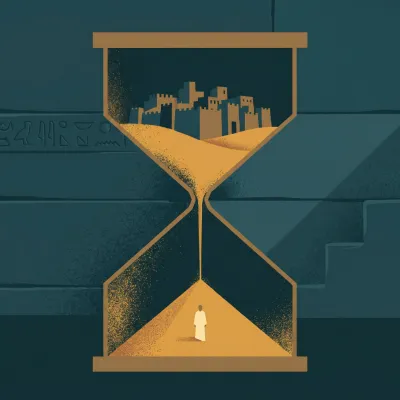
There is a prophecy in the ninth chapter of Daniel that measured out the years until the Messiah would come. It is not a poem or a symbol. It is a count. A command goes out to rebuild a ruined city, a set number of years is marked off, and at the end of those years the Anointed One arrives. Follow the count, and it lands in the very generation when Jesus of Nazareth walked the roads of Judea. But God did not hand this timeline to an old man in exile so we could be impressed by arithmetic. He gave it inside an answer to a prayer about sin. And the first thing the prophecy promises is not a date on a calendar. It is an end to guilt. In this episode, we explore Daniel chapter 9. We find Daniel, old and far from home, reading the scroll of Jeremiah and falling to his knees to confess, "We have sinned," on behalf of his whole people. We watch Gabriel arrive while he is still praying, calling him greatly beloved. We look at the six purposes of the seventy sevens, all circling the ending of sin, then walk through the count of four hundred and eighty three years from the command to rebuild Jerusalem, and why every careful reckoning lands in the early decades of the first century. And we hear the words that turn a tragedy into the gospel: the Anointed One would be cut off, but not for himself. The prophecy told the world when. The cross told the world how. And the empty tomb told the world it was finished. Bible verses included in this episode: “We have sinned, and have committed iniquity, and have done wickedly, and have rebelled.” (Daniel 9:5) “Seventy weeks are decreed about your people and your holy city, to finish the transgression, to put an end to sin, and to atone for iniquity, to bring in everlasting righteousness, to seal both vision and prophet, and to anoint a most holy place.” (Daniel 9:24) “The going out of the word to restore and build Jerusalem.” (Daniel 9:25) “Cut off, but not for himself.” (Daniel 9:26) “He was cut off out of the land of the living: for the transgression of my people was he stricken.” (Isaiah 53:8) This message is for anyone who feels their failures have gone on too long, anyone waiting on God for a promise that has not yet come, and anyone who feels old, tired, or alone in their faith. Daniel died without seeing the prophecy fulfilled, and still he believed, because he knew the character of the God who made it. Your forgiveness was not an emergency repair. It was an appointment on God's calendar, and He kept it. The God who declared the end from the beginning is calling you, as He called Daniel, greatly beloved.
 30分
Hard Bible Questions
Why God Still Sends His Angels to Watch Over You
The Bible reveals a powerful truth that our eyes cannot always see. God has not left His children to walk through danger alone. From Elisha surrounded by chariots of fire, to Hagar in the wilderness, to Elijah under the tree, to Daniel in the lions’ den, Scripture shows again and again that heaven is closer than we think. In this episode, we explore what angels really are according to the Bible. They are not decorations, myths, or gentle figures from greeting cards. They are powerful servants of the living God, sent by His command to minister to those who belong to Him. But angels are never the center of the story. The true comfort is not that angels are watching, but that God is the One who sends them. We’ll look at the unseen protection around Elisha, the promise of Psalm 91, the angel who found Hagar in the desert, the angel who cared for Elijah when he wanted to die, Peter’s miraculous prison escape, Daniel’s night among the lions, and the warning that angels must never be worshiped in place of God. This episode also answers a hard question: if angels watch over God’s people, why do believers still suffer? The Bible does not promise a life without pain. It promises that God’s people are never abandoned in it. Sometimes God delivers before the fire. Sometimes He meets us inside the fire. But His care never fails. Bible verses included in this episode: “Then the Lord opened the servant's eyes, and he looked and saw the hills full of horses and chariots of fire all around Elisha.” (2 Kings 6:17) “Are not all angels ministering spirits sent to serve those who will inherit salvation?” (Hebrews 1:14) “For he will command his angels concerning you to guard you in all your ways.” (Psalm 91:11) “Do not forget to show hospitality to strangers, for by so doing some people have shown hospitality to angels without knowing it.” (Hebrews 13:2) “My God sent his angel, and he shut the mouths of the lions. They have not hurt me.” (Daniel 6:22) “The angel of the Lord encamps around those who fear him, and he delivers them.” (Psalm 34:7) “See that you do not despise one of these little ones. For I tell you that their angels in heaven always see the face of my Father in heaven.” (Matthew 18:10) “See, I am sending an angel ahead of you to guard you along the way and to bring you to the place I have prepared.” (Exodus 23:20) God’s angels are real, but they are not the source of our hope. They point us back to the God who commands them, the Savior they obey, and the Father who watches over even the smallest and most forgotten of His children. You are not as alone as you feared. The God who watched over His people then still watches over His people now.
 33分
Bible Books Explained
The Book of Daniel
Most people know the stories of the Book of Daniel as simple tales of bravery taught to children. But when you look closer, this ancient text is actually a highly advanced manual for surviving a culture that wants to erase your soul. In this episode, we explore the unseen war in the greatest city on earth. We follow a group of teenagers who saw their world end and were forced into a psychological tactic designed to replace their identity with Babylonian worship. We journey from the royal palace to the terrifying visions of world empires that look like predatory beasts. We see how a stone not cut by human hands can shatter the golden statues of history and how an invisible fourth man can walk through a sevenfold furnace. We uncover the cosmic mathematics of redemption and the shocking reality of spiritual warfare happening in the heavenly places. This is the complete story of Daniel, revealing how to stay human in a world of monsters and how to shine like stars in a kingdom that will never be destroyed. Scripture References "But Daniel resolved that he would not defile himself with the king's food, or with the wine that he drank. Therefore he asked the chief of the eunuchs to allow him not to defile himself." (Daniel 1:8) "Blessed be the name of God forever and ever, to whom belong wisdom and might. He changes times and seasons; he removes kings and sets up kings; he gives wisdom to the wise and knowledge to those who have understanding." (Daniel 2:20 to 21) "If this be so, our God whom we serve is able to deliver us from the burning fiery furnace, and he will deliver us out of your hand, O king. But if not, be it known to you, O king, that we will not serve your gods or worship the golden image that you have set up." (Daniel 3:17 to 18) "And this is the writing that was inscribed: Mene, Mene, Tekel, and Parsin." (Daniel 5:25) "As I looked, thrones were placed, and the Ancient of Days took his seat; his clothing was white as snow, and the hair of his head like pure wool; his throne was fiery flames; its wheels were burning fire." (Daniel 7:9) "I saw in the night visions, and behold, with the clouds of heaven there came one like a son of man, and he came to the Ancient of Days and was presented before him. And to him was given dominion and glory and a kingdom, that all peoples, nations, and languages should serve him; his dominion is an everlasting dominion, which shall not pass away, and his kingdom one that shall not be destroyed." (Daniel 7:13 to 14) "Fear not, Daniel, for from the first day that you set your heart to understand and humbled yourself before your God, your words have been heard, and I have come because of your words. The prince of the kingdom of Persia withstood me twenty one days, but Michael, one of the chief princes, came to help me, for I was left there with the kings of Persia." (Daniel 10:12 to 13) This episode shows that earthly empires may look strong but they are fragile like statues with feet of clay. It invites you to keep your heart toward heaven and realize that even in the flames, you are never alone.
 34分
Hard Bible Questions
Where Did Jesus Say, I Am God, Worship Me
Where did Jesus ever say, “I am God, worship me”? In this episode, we explore why Jesus did not use that exact modern sentence, yet still revealed His divine identity in ways His first century audience clearly understood. Through His words, actions, authority to forgive sins, acceptance of worship, and claims about judgment, the Gospels present a picture that goes far beyond one single phrase. Jesus says, “Truly, truly, I say to you, before Abraham was, I am.” (John 8:58) He also says, “I and the Father are one.” (John 10:30) When a paralyzed man was brought to Him, Jesus said, “Son, your sins are forgiven.” (Mark 2:5) The teachers of the law responded, “Why does this man speak like that? He is blaspheming! Who can forgive sins but God alone?” (Mark 2:7) Jesus also declared, “For the Father judges no one, but has given all judgment to the Son, that all may honor the Son, just as they honor the Father.” (John 5:22 to 23) After Jesus walked on the sea and calmed the storm, the disciples responded, “And those in the boat worshiped him, saying, ‘Truly you are the Son of God.’” (Matthew 14:33) After the resurrection, Thomas said to Jesus, “My Lord and my God!” (John 20:28) At His trial, Jesus said, “You have said so. But I tell you, from now on you will see the Son of Man seated at the right hand of Power and coming on the clouds of heaven.” (Matthew 26:64) The high priest answered, “He has uttered blasphemy.” (Matthew 26:65) And the vision from Daniel says, “I saw in the night visions, and behold, with the clouds of heaven there came one like a son of man… And to him was given dominion and glory and a kingdom.” (Daniel 7:13 to 14) This episode looks at the full picture the Gospels give, not just one demanded sentence. It explores how Jesus speaks with God’s authority, does what belongs to God alone, receives worship without correction, and stands at the center of God’s saving work. The question is not only what exact words He used, but what His words and actions revealed.
 33分
Stories of Bible Characters
Archangel Michael - Heaven_s Strongest Angel
Before the first human drew a breath, God created mighty spiritual beings to serve him. Among them, one warrior stands alone as the commander of angelic armies and the defender of the people of God. In this episode, we uncover the real story of Archangel Michael. We move beyond the popular myths to see what Scripture actually reveals about this chief prince who stands in the middle of spiritual war. We explore the profound meaning of his name, which poses a question that echoes through eternity: Who is like God? We follow Michael from the ancient visions of Daniel to the final cosmic battles in Revelation. We see him resisting the prince of Persia, contending with the devil over the body of Moses, and leading the armies of heaven to cast down the dragon. This journey reveals that even the strongest angel is a humble servant whose authority is borrowed from the Creator. This episode is a call to understand the reality of spiritual warfare and to find comfort in the fact that no power of darkness can overturn the will of the Lord. Scripture References "I will ascend. I will raise my throne. I will make myself like the Most High." (Isaiah 14:13 to 14) "Michael and his angels fought against the dragon, and the dragon and his angels fought back. But he was not strong enough." (Revelation 12:7 to 9) "At that time Michael, the great prince who protects your people, will arise." (Daniel 12:1) "Multitudes who sleep in the dust of the earth will awake: some to everlasting life, others to shame and everlasting contempt." (Daniel 12:2) "But even the archangel Michael, when he was disputing with the devil about the body of Moses, did not dare to bring a slanderous accusation against him but said, 'The Lord rebuke you.'" (Jude 1:9) "For our struggle is not against flesh and blood, but against the rulers, against the authorities, against the powers of this dark world." (Ephesians 6:12 to 18) "For the Lord himself will come down from heaven, with a loud command, with the voice of the archangel and with the trumpet call of God." (1 Thessalonians 4:16) "Do not do it. I am a fellow servant with you and with your brothers and sisters who hold to the testimony of Jesus. Worship God." (Revelation 19:10) This episode shows that Michael’s story is not meant to draw our attention away from the Creator. Instead, it serves as a powerful reminder that there is no one like God. Not Satan, not any angel, and not any power on earth.
 37分
Stories of Bible Characters
The Wise Men
What if the story of the Wise Men is far deeper, darker, and more powerful than the Christmas tradition we usually imagine? Most people picture three kings riding camels to a stable on the night Jesus was born. But the Bible never says there were three. It never says they were kings. And Matthew tells us they came to a house, not a manger. In this episode, we uncover the real story of the Magi, a story of ancient prophecy, political danger, divine guidance, Herod’s paranoia, and a journey of faith that risked everything. We’ll explore who the Magi really were, why they may have been connected to Daniel’s influence in Babylon, what the mysterious star could have been, why Herod was so disturbed, and why the religious leaders in Jerusalem knew the prophecy but refused to seek the Messiah for themselves. This is not just a Christmas story. It is a warning and an invitation. Herod feared Jesus. The religious leaders ignored Him. But the Wise Men sought Him, worshiped Him, and returned home by another way. Bible verses included in this episode: “Then the king placed Daniel in a high position and lavished many gifts on him. He made him ruler over the entire province of Babylon and placed him in charge of all its wise men.” (Daniel 2:48) “Seventy weeks are determined upon thy people and upon thy holy city, to finish the transgression, and to make an end of sins, and to make reconciliation for iniquity, and to bring in everlasting righteousness, and to seal up the vision and prophecy, and to anoint the most Holy.” (Daniel 9:24) “I see him, but not now; I behold him, but not near. A star will come out of Jacob; a scepter will rise out of Israel.” (Numbers 24:17) “After they had heard the king, they went on their way, and the star they had seen when it rose went ahead of them until it stopped over the place where the child was.” (Matthew 2:9) “Where is the one who has been born king of the Jews? We saw his star when it rose and have come to worship him.” (Matthew 2:2) “When King Herod heard this he was disturbed, and all Jerusalem with him.” (Matthew 2:3) “Go and search carefully for the child. As soon as you find him, report to me, so that I too may go and worship him.” (Matthew 2:8) “In Bethlehem in Judea,” they replied, “for this is what the prophet has written: ‘But you, Bethlehem, in the land of Judah, are by no means least among the rulers of Judah; for out of you will come a ruler who will shepherd my people Israel.’” (Matthew 2:5–6) “On coming to the house, they saw the child with his mother Mary, and they bowed down and worshiped him.” (Matthew 2:11) “And having been warned in a dream not to go back to Herod, they returned to their country by another route.” (Matthew 2:12) “He gave orders to kill all the boys in Bethlehem and its vicinity who were two years old and under, in accordance with the time he had learned from the Magi.” (Matthew 2:16) “Get up, take the child and his mother and escape to Egypt. Stay there until I tell you, for Herod is going to search for the child to kill him.” (Matthew 2:13) “Out of Egypt I called my son.” (Hosea 11:1) “I will not sacrifice to the Lord my God burnt offerings that cost me nothing.” (2 Samuel 24:24) Discover the complete story of the Wise Men like you’ve never seen it before, and ask yourself the same question they asked two thousand years ago: “Where is the one who has been born King?”
 33分
Words of Jesus
By Myself I Can Do Nothing
What did Jesus mean when He said, “By myself I can do nothing” (John 5:30)? In this episode, we explore one of the most misunderstood statements of Jesus and uncover how it reveals His perfect unity with the Father. This is not a statement of weakness, but a window into the mystery of who Christ is. Jesus says, “I judge only as I hear, and my judgment is just” (John 5:30) He also declares, “For just as the Father raises the dead and gives them life, even so the Son gives life to whom he is pleased to give it” (John 5:21) And, “Moreover, the Father judges no one, but has entrusted all judgment to the Son” (John 5:22) Then He reveals why this matters so deeply, “that all may honor the Son just as they honor the Father. Whoever does not honor the Son does not honor the Father” (John 5:23) Jesus also says that the Father has given Him authority to judge “because he is the Son of Man” (John 5:26 to 27) This points back to Daniel’s vision of “one like a son of man” who is brought before God, and “All nations and peoples of every language worshiped him” (Daniel 7:13 to 14) This episode shows that when Jesus says He can do nothing by Himself, He is not lowering Himself. He is revealing that He never acts apart from the Father. The Son gives life, the Son judges, and the Son is honored with the Father. His words are not a denial of His divinity, but a revelation of perfect love, perfect obedience, and perfect unity with the Father.