

Themes
What Does “Image of God” Mean?
Genesis says people are made in God’s image. That short phrase shapes how the Bible talks about work, dignity and Jesus himself.
Bible Space Editors · 6 novembre 2026 · 1 min di lettura
Genesis says people are made in God’s image. That short phrase shapes how the Bible talks about work, dignity and Jesus himself.
Bible Space Editors · 6 novembre 2026 · 1 min di lettura
Bible Chapters Explained
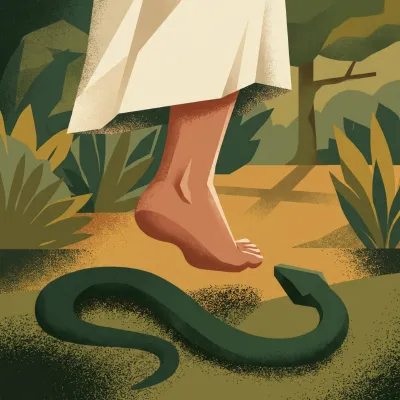
Genesis 3:15 is the first promise God ever made to guilty people, and everything the Bible does after it is God keeping that promise. One sentence, spoken in the worst hour in human history, in a garden that had just stopped being safe. Once you see what it is doing, the sixty six books of the Bible stop feeling like a stack of separate books and start reading like one story with one ending. God questioned the man. God questioned the woman. But He asked the serpent nothing. He turned to it and began sentencing, and Adam and Eve, hiding behind the trees, overheard God announce a war He was starting on their behalf. In this episode, we explore the promise hidden in Genesis 3:15. We notice that only the serpent and the ground are cursed, never the man and the woman. We unpack the rare Hebrew word for enmity, the single verb used for both the crushing of the head and the striking of the heel, and why ancient translators heard a person in this verse long before Jesus was born. We watch Adam name his wife Life, God clothe them with His own hands, Eve hold on to the word "offspring" after losing two sons, and Lamech name Noah in hope. And we follow the line through Tamar, Rahab, Ruth, and Mary to the cross, the empty tomb, and the last page of Revelation. The heel wound and the head wound are the same event described from two sides. The wound was the weapon. Bible verses included in this episode: “And I will put enmity between you and the woman, and between your offspring and hers; he will crush your head, and you will strike his heel.” (Genesis 3:15) “Adam named his wife Eve, because she would become the mother of all the living.” (Genesis 3:20) “The Lord God made garments of skin for Adam and his wife and clothed them.” (Genesis 3:21) “God has granted me another child in place of Abel, since Cain killed him.” (Genesis 4:25) “But when the set time had fully come, God sent his Son, born of a woman, born under the law.” (Galatians 4:4) “The reason the Son of God appeared was to destroy the devil's work.” (1 John 3:8) “No longer will there be any curse.” (Revelation 22:3) This message is for anyone carrying something they have never said out loud, anyone worn down by a life that keeps producing thorns, and anyone who feels God's promises were written for people with a cleaner history. God's first move toward failing people is a promise, and His anger has an enemy, and the enemy is not you. You can overhear something and still be the one it is for. The garden closed. The city opens. And the curse that started it all will not be there.

Hard Bible Questions
What does it mean when God says, "Let us make man in our image"? Why the "us," and what does "image" tell us about who we are? This short line in the first chapter of the Bible holds the key to human identity, purpose, and the story God is writing with humanity. An image points beyond itself to the one it reflects. Like a coin carrying a king's face, we are not God, but our lives are meant to carry His likeness so that people can see what He is like: truthful, just, and loving. This likeness is not about height, age, or strength. It is about the capacity to know God, to speak truth, to keep promises, and to choose love, and it carries a royal calling to care for His world. In this episode, we explore what the image of God means and why it gives every person a worth that illness, failure, poverty, or age cannot erase. We look at the different ways Christians have understood the "us" and "our" in Genesis, from a holy counsel within the life of the Father, the Word, and the Spirit to a royal court of heaven, and why the fullness of the one God shines through the text. We see how ancient kings placed statues of themselves across their lands, and how Genesis turns that picture around by placing living images of God in every field, market, and home. We also follow the image through the whole story of Scripture: marred by sin but not erased, displayed in perfection in Jesus, renewed in believers by the Spirit, and completed on the day Christ appears. Bible verses included in this episode: “Then God said, ‘Let us make mankind in our image, in our likeness, so that they may rule.’” (Genesis 1:26) “So God created mankind in his own image, in the image of God he created them; male and female he created them.” (Genesis 1:27) “The man has now become like one of us, knowing good and evil.” (Genesis 3:22) “Whom shall I send? And who will go for us?” (Isaiah 6:8) “The Son is the image of the invisible God, the firstborn over all creation.” (Colossians 1:15) “We know that when Christ appears, we shall be like him, for we shall see him as he is.” (1 John 3:2) You were not thrown into a cold universe. You were chosen to carry God's mark and to reflect His heart. Let that truth quiet shame and fear. The God who spoke galaxies into being also spoke a purpose over you, and He has not forgotten what He began.

Hard Bible Questions
If God knew Satan would rebel, why create him at all? It is one of the hardest questions a believer can ask, because it tests what we believe about God's goodness, wisdom, and justice. God knows everything, and yet His creatures can choose. The Bible's answer begins with a boundary: evil is real, but evil is not original. God made all things good, including the high creature who later fell. Satan is not a rival god standing opposite the Lord. He is a creature, with a beginning, with limits, and with accountability. What God created was good because it made room for love. What God did not create was the crooked desire that set itself against Him. In this episode, we explore why real love requires a real will, and why a world of beings who could only follow but never choose would be a world without genuine worship or friendship with God. We look at the difference between God testing and a creature tempting, why foreknowledge is not the same as guilt, and how the cross shows God's plan and human responsibility standing side by side. We consider what Scripture reveals about Satan's fall and what it wisely leaves veiled, and why God chose a history in which His holiness, justice, mercy, and love would be displayed in their fullest range. Finally, we look at the end of the story, which is already certain. The deceiver's time is measured, and the devil's present activity runs on a leash. Bible verses included in this episode: “God saw all that he had made, and it was very good.” (Genesis 1:31) “You were blameless in your ways from the day you were created till wickedness was found in you.” (Ezekiel 28:15) “When tempted, no one should say, ‘God is tempting me.’ For God cannot be tempted by evil, nor does he tempt anyone.” (James 1:13) “This man was handed over to you by God’s deliberate plan and foreknowledge.” (Acts 2:23) “The secret things belong to the Lord our God, but the things revealed belong to us and to our children forever.” (Deuteronomy 29:29) “The reason the Son of God appeared was to destroy the devil’s work.” (1 John 3:8) “And the devil, who deceived them, was thrown into the lake of burning sulfur.” (Revelation 20:10) If this question has kept you up at night, you are not alone. The God who knew rebellion would come also chose to draw near, carried our shame, and promised a day when the shadows will be gone. The question begins with Satan, but the answer leads to Jesus. Evil is real, but not final.

Hard Bible Questions
There was once a valley so green and well watered that the Bible compares it to the garden of the Lord. Then one morning it was gone. Abraham looked toward the cities of the plain and saw only smoke rising like the smoke of a furnace. Most of us think we know how Sodom died. We picture the fire and the burning sulfur and stop there. But the fire was the ending, not the answer. What had to happen in a city, over years and years, before God would let a morning like that come? In this episode, we explore what really destroyed Sodom and Gomorrah. We follow Lot's choice of the easy, beautiful land, the outcry that rose to heaven from the crushed and forgotten, and Abraham's bold plea as God agrees to spare the whole city for the sake of just ten righteous people. We walk through the terrible night at Lot's door, and then turn to the prophet Ezekiel, who names the quieter sin underneath it all: pride, excess of food, and prosperous ease, while the poor and needy were ignored. We also look at the warnings no one outgrows: the sons-in-law who thought Lot was joking, Lot himself lingering until mercy took him by the hand, and Lot's wife looking back. Jesus pointed to this very story to describe the day the Son of Man is revealed. Bible verses included in this episode: “Now the men of Sodom were wicked, great sinners against the Lord.” (Genesis 13:13) “Because the outcry against Sodom and Gomorrah is great and their sin is very grave, I will go down to see whether they have done altogether according to the outcry that has come to me.” (Genesis 18:20-21) “For the sake of ten I will not destroy it.” (Genesis 18:32) “Behold, this was the guilt of your sister Sodom: she and her daughters had pride, excess of food, and prosperous ease, but did not aid the poor and needy.” (Ezekiel 16:49) “Then the Lord rained on Sodom and Gomorrah sulfur and fire from the Lord out of heaven.” (Genesis 19:24) “They were eating and drinking, buying and selling, planting and building, but on the day when Lot went out from Sodom, fire and sulfur rained from heaven and destroyed them all.” (Luke 17:28-29) “Then the Lord knows how to rescue the godly from trials, and to keep the unrighteous under punishment until the day of judgment.” (2 Peter 2:9) The fire did not destroy Sodom. A long, slow forgetting did. But the God who heard the cry of the forgotten still hears yours, and on the cross the fire we deserved fell on Jesus instead. Do not look back, and do not mistake God's patience for permission. His hand is still open to you.

Hard Bible Questions
There was a figure who kept appearing to ordinary people, and no one who met him was ever the same. He came to a runaway slave in the desert, to a shepherd at a burning bush, to a frightened man by a river at night, and to a soldier outside a walled city. The text would call him a messenger, and then, a few words later, it would call him God. Who was the Angel of the Lord? And why does this mysterious figure stop appearing after the Old Testament closes? In this episode, we follow the Angel of the Lord through the pages of Scripture. We meet Hagar, who named Him the God who sees. We watch Jacob wrestle a stranger until dawn, Moses hide his face at the burning bush, Manoah hear a name too wonderful to be spoken, Gideon find peace in a winepress, and Joshua take off his sandals before the commander of the Lord's army. Again and again this messenger speaks as God, receives worship, carries God's name, and holds authority to forgive. Then we turn to the New Testament, where Jesus declares, "Before Abraham was, I am," and John writes that the Son has made the invisible God known. The trail of these appearances leads to Bethlehem. Bible verses included in this episode: “For I have seen God face to face, and yet my life has been delivered.” (Genesis 32:30) “I am the God of your father, the God of Abraham, the God of Isaac, and the God of Jacob.” (Exodus 3:6) “For my name is in him.” (Exodus 23:21) “Why do you ask my name, seeing it is wonderful?” (Judges 13:18) “Before Abraham was, I am.” (John 8:58) “The only Son, who is at the Father’s side, he has made him known.” (John 1:18) He stopped appearing in temporary forms because He had come in a permanent one. The One whose name was too wonderful to tell Manoah let Mary name Him Jesus. He found Hagar by a spring and an old shepherd in the wilderness. He still comes down to the tired and forgotten, and He is closer to you right now than you have ever known.

Hard Bible Questions
Every child asks it eventually, and every honest adult still wonders it in the quiet. If God made everything, then who made God? The answer is that God did not come from anywhere. He was not born and He was not built. Before there was a somewhere for anything to come from, there was only Him. And if there truly is a Being who never began, then existence is not an accident, and neither are you. In this episode, we explore where God came from and who He was before anything existed. We look at the first words of Scripture, which speak of the beginning of the heavens and the earth, not the beginning of God. We reflect on the name God gave Moses, I AM WHO I AM, and on a God who does not live inside time but holds the whole story in His hands at once. We see why the God who has life in Himself needs nothing from the world, and why the God who needs nothing does not change. Then we turn to the most beautiful answer of all. Before the world began, God was not a lonely figure in an endless dark. There was already a Father loving a Son in the joy of the Spirit. Love is older than the story, and the world came pouring out of that fullness. Bible verses included in this episode: “In the beginning God created the heavens and the earth.” (Genesis 1:1) “I am who I am.” (Exodus 3:14) “Before the mountains were brought forth, or ever you had formed the earth and the world, from everlasting to everlasting you are God.” (Psalm 90:2) “The God who made the world and everything in it is not served by human hands, as though he needed anything, since he himself gives to everyone life and breath and everything else.” (Acts 17:24-25) “For I the Lord do not change.” (Malachi 3:6) “In the beginning was the Word, and the Word was with God, and the Word was God.” (John 1:1) “He is before all things, and in him all things hold together.” (Colossians 1:17) The God who needed nothing still made you. You were not a tool He required, but a gift He wanted. His love has no first day you could arrive too late for, and no last day when it will run dry. He simply is. He always was. He always will be. And He knows your name.

Hard Bible Questions
If you have read the Bible for any length of time, you have noticed that the number seven is everywhere. Seven days of creation. Seven times around a city. Seven dips in a river. Seven churches, seven lamps, seven seals. But seven is not a lucky number, and it is not a secret code. Seven is the number God attaches to rest. It is the mark He leaves when a work is finished, when a burden is lifted, and when He draws near to stay. It is the shape of a God who does not leave things half done, and who does not intend to leave you half done either. In this episode, we explore why God keeps returning to the number seven. We begin with the seventh day of creation, the only day with no evening and no morning, and follow the thread through the Sabbath given to freed slaves, Noah's patient waiting in sevens, Joseph's seven years of plenty and famine, Israel's appointed feasts, the Sabbath year, and the Year of Jubilee. We look at the golden lampstand with its seven flames, the walls of Jericho falling on the seventh day, Naaman healed on the seventh dip in the Jordan, and Jesus' call to forgive seventy times seven. All of these threads find their center in Jesus: His seven signs in John's Gospel, His cry "It is finished," His rest in the tomb on the Sabbath, and the rest that still remains for the people of God. Bible verses included in this episode: “And on the seventh day God finished his work that he had done, and he rested on the seventh day from all his work that he had done.” (Genesis 2:2) “So God blessed the seventh day and made it holy.” (Genesis 2:3) “It is finished.” (John 19:30) “So then, there remains a Sabbath rest for the people of God.” (Hebrews 4:9) “Come to me, all who labor and are heavy laden, and I will give you rest.” (Matthew 11:28) “Behold, the dwelling place of God is with man. He will dwell with them, and they will be his people.” (Revelation 21:3) If you feel stuck on the sixth day, in the middle of the work and the waiting, this message is for you. The God who finishes what He begins has not forgotten your unfinished places. Your seventh is coming. Come to Him, lay down what you have been carrying, and rest.

Hard Bible Questions
Where was your soul before you were born? Many people would rather hear that they have always existed somewhere, waiting in a heavenly room or carrying memories from an earlier life. But Scripture gives a different answer, and a better one. Your soul was not in a place. It was in a Person's knowing. Before God formed you, there was no you at all. What existed was God, God's thought of you, and God's love set on you before you had a face to love. In this episode, we explore what the Bible actually reveals about the beginning of a human being. We notice what Scripture never says, and how it keeps turning the question from "where" to "whose." We look at Levi, who was "still in the loins" of Abraham, and what it means that you were carried in your ancestors. We return to Genesis, where God formed the man from dust and breathed life into him, and to Paul's order of "natural first, then spiritual." We walk through David's words about being knitted together in the womb, his hope for the child he lost, and God's words to Jeremiah, "Before I formed you in the womb I knew you." We also consider why the idea of an "old soul" feels so true, why Scripture says we live one life, the love of the Father for the Son before the foundation of the world, and the second birth Jesus offered Nicodemus. Bible verses included in this episode: “And the dust returns to the earth as it was, and the spirit returns to God who gave it.” (Ecclesiastes 12:7) “Then the Lord God formed the man of dust from the ground and breathed into his nostrils the breath of life, and the man became a living creature.” (Genesis 2:7) “For you formed my inward parts; you knitted me together in my mother’s womb.” (Psalm 139:13) “Your eyes saw my unformed substance; in your book were written, every one of them, the days that were formed for me, when as yet there was none of them.” (Psalm 139:16) “Before I formed you in the womb I knew you, and before you were born I consecrated you.” (Jeremiah 1:5) “That which is born of the flesh is flesh, and that which is born of the Spirit is spirit.” (John 3:6) “Even to your old age I am he, and to gray hairs I will carry you. I have made, and I will bear; I will carry and will save.” (Isaiah 46:4) Your beginning was not an accident of biology, and your years are not a rehearsal. You came from God's hand, and there was never a moment when you were unknown. The One who wanted you before there was anything of you to want has carried you from the womb, and He will carry you to gray hairs.

Hard Bible Questions
Were there humans before Adam and Eve? The short answer is no. The Bible never shows a single human being who lived before Adam. Not a name, not a face, not one line of dialogue. So why does the question refuse to die? Because Genesis itself puts it in our hands. In the space of a few verses, chapter 4 drops a crowd, a wife, and a city into a world that seems to hold only three living people, and then moves on without explaining any of them. Who was Cain afraid of when he said, "Whoever finds me will kill me"? Who did he marry? And who filled the city he built? In this episode, we explore what Genesis actually says. We look at the three details that should not be there, the eight hundred years in which Adam had "other sons and daughters," and the popular idea that Genesis 1 and 2 describe two separate creations of people. We weigh that theory honestly against Eve's name, "the mother of all the living," and Paul's words in Athens that God made all the nations from one man. Then we turn the page most people never reach. Genesis describes the people east of Eden: herders living in tents, musicians with strings and pipes, smiths forging bronze and iron, and Lamech, who sang the first song in the Bible as a boast about killing a young man. We contrast Cain's city with Seth's family, who began to call on the name of the Lord, compare the two men named Lamech, and follow the story to Jesus, the last Adam, who turned Lamech's seventy-seven into the measure of forgiveness. Bible verses included in this episode: “Today you are driving me from the land, and I will be hidden from your presence; I will be a restless wanderer on the earth, and whoever finds me will kill me.” (Genesis 4:14) “Cain made love to his wife, and she became pregnant and gave birth to Enoch. Cain was then building a city, and he named it after his son Enoch.” (Genesis 4:17) “After Seth was born, Adam lived 800 years and had other sons and daughters.” (Genesis 5:4) “Adam named his wife Eve, because she would become the mother of all the living.” (Genesis 3:20) “From one man he made all the nations, that they should inhabit the whole earth.” (Acts 17:26) “At that time people began to call on the name of the Lord.” (Genesis 4:26) “The first man Adam became a living being”; the last Adam, a life-giving spirit. (1 Corinthians 15:45) The most gifted people of the ancient world could not build their way home. The ones who reached God were the ones credited with nothing at all. They simply called on His name, and you can do the same today.

Stories of Bible Characters
There is a name missing from the map of Israel, and it belongs to the one man who made the map possible. Joseph, the favorite son and the dreamer who saved his whole family from famine, has no territory named after him when Joshua divides the promised land among the tribes. It can look like an oversight, or even an insult. But Joseph's name is not missing because he received too little. It is missing because he received too much to fit inside a single border. In this episode, we explore the surprising reason there is no tribe of Joseph. We look at the birthright and double portion of the firstborn, how Reuben lost it, and how it passed to Joseph. We step into a dim room in Egypt where the dying Jacob adopts Joseph's two sons, Ephraim and Manasseh, as his own, and then crosses his arms to bless the younger above the older, redeeming the deception of his own youth. We see why the count of the tribes still stays at twelve because Levi's inheritance was the Lord Himself, and why two boys with an Egyptian mother became the model of blessing for generations. We also trace Joseph's name through the rest of Scripture, from Shiloh and the Psalms to Ezekiel's "two portions" and the tribe of Joseph in Revelation 7, and see how Joseph's story points to Jesus, the beloved Son whose reward is children adopted into God's family. Bible verses included in this episode: “He was the firstborn, but because he defiled his father’s bed, his birthright was given to the sons of Joseph.” (1 Chronicles 5:1) “And now your two sons, Ephraim and Manasseh, who were born to you in the land of Egypt before I came to you in Egypt, are mine; as Reuben and Simeon, they shall be mine.” (Genesis 48:5) “I know, my son, I know. He also shall become a people, and he also shall be great; but truly his younger brother shall be greater than he.” (Genesis 48:19) “By you Israel will bless, saying, ‘May God make you as Ephraim and as Manasseh!’” (Genesis 48:20) “The Lord is his inheritance.” (Deuteronomy 10:9) “Give ear, O Shepherd of Israel, You who lead Joseph like a flock.” (Psalm 80:1) “Joseph shall have two portions.” (Ezekiel 47:13) “But as many as received Him, to them He gave the right to become children of God.” (John 1:12) If you feel overlooked, left off the lists, or wonder whether your background disqualifies you, let Joseph's story stand as a witness. The people the world can no longer find on its lists are often the ones God has recorded most carefully. The God who never forgot Joseph has not forgotten you. The double portion always comes after the pit.

Stories of Bible Characters
Enoch walked so closely with God that he never tasted death. Noah built a boat on dry land and carried his family safely over a drowning world. And between them stands Methuselah, the man who lived longer than anyone who has ever drawn breath. He left behind no sermon and no miracle, only a name and a number so large it barely feels real. Yet Methuselah was the man God waited for. Every year he stayed alive, the flood held back. Every morning he woke, the judgment the world had already earned was pushed one more day into the future. His long life was the longest stretch of patience God ever held over a world that had run out of reasons to be spared. In this episode, we explore the story of Methuselah, Enoch, and Noah together. We step into a world filled with violence and corruption, meet Enoch, the father who walked with God until God took him, and consider what it meant for Methuselah to live 969 years, burying generation after generation while he watched faith itself fade. We see how God was quietly at work inside the long wait, raising up Noah, a man who found favor in His eyes before he ever cut a single plank for the ark. These three men, one family, show the shape of the gospel in miniature. God guards His promise, and He prepares a way of rescue before the storm ever breaks. Bible verses included in this episode: “Enoch walked faithfully with God; then he was no more, because God took him away.” (Genesis 5:24) “Altogether, Methuselah lived a total of 969 years, and then he died.” (Genesis 5:27) “He will comfort us in the labor and painful toil of our hands caused by the ground the Lord has cursed.” (Genesis 5:29) “But Noah found favor in the eyes of the Lord.” (Genesis 6:8) “The Lord is not slow in keeping his promise, as some understand slowness. Instead he is patient with you, not wanting anyone to perish, but everyone to come to repentance.” (2 Peter 3:9) If you have prayed the same prayer for years and heaven has felt silent, a long wait is not proof that God has forgotten you. Very often, the wait is where God is doing His deepest and quietest work. You are not too far behind, and you are not too late. The patience that held back a flood is patient enough to wait for you to take one small step toward home. The door is still open.

Hard Bible Questions
The night Jacob wrestled with God is one of the most mysterious moments in the Bible. A man struggles through the darkness until sunrise, walks away with a wounded hip, receives a new name, and somehow is said to have overcome. But this is not a story about a weak God. It is the story of a strong God who bends low to transform a broken man. In this episode, we follow Jacob’s life from the womb to the river Jabbok. From the beginning, Jacob was always fighting for blessing. He grabbed Esau’s heel, bought the birthright, deceived Isaac, ran from Esau, struggled with Laban, and spent years trying to secure his future through cleverness and control. But on the night before he faced his greatest fear, God met him in the dark. Jacob’s wrestling match was not really about strength. It was about surrender. God allowed Jacob to struggle until he reached the end of himself. Then with a simple touch, God wounded the very place of Jacob’s strength. The limp became a reminder that Jacob could no longer live by tricks, running, and self reliance. He had to learn to cling to God. We’ll explore why God asked Jacob his name, why He changed it to Israel, why the limp was part of the blessing, and why Jacob’s meeting with Esau the next morning reveals that God had been working in more than one heart. This story speaks to anyone who feels like they are in a long night of struggle. Sometimes God is not fighting against you to destroy you. He is wrestling with you to change you. He may touch the place where you feel strongest so you can finally learn to lean on Him. Bible verses included in this episode: “I will not let you go unless you bless me.” (Genesis 32:26) “Your name will no longer be Jacob, but Israel, because you have struggled with God and with humans and have overcome.” (Genesis 32:28) “It is because I saw God face to face, and yet my life was spared.” (Genesis 32:30) Jacob entered the night as a deceiver who always ran. He came out as Israel, a man who had wrestled with God and learned to cling. He walked away limping, but he also walked away blessed. The old Jacob lost that night, and that loss became his salvation.

Hard Bible Questions
This is one of the hardest questions people bring to faith. For some, it is the reason they walked away from God. For others, it is the question they still carry quietly while they pray, worship, and try to believe. The pain is not abstract. It is the accident that took someone too soon, the betrayal that broke a family, the illness that will not leave, the wound from years ago that still aches. In this episode, we walk through what the Bible says about suffering, evil, and the goodness of God. Scripture does not give cheap answers or ask us to pretend pain is small. Instead, it tells the story of a good creation damaged by sin, a world groaning under brokenness, and a Savior who entered our suffering through the cross. We’ll explore where suffering comes from, including human sin, the brokenness of creation, and spiritual evil. We’ll also look at why God does not erase evil immediately, how His patience gives room for repentance, and why the cross changes everything about how we see pain. This message is not only about finding answers. It is about learning to trust God’s heart when life hurts. The Bible shows us that evil is real, but it is not final. Pain is heavy, but it is not forever. God has promised a day when Christ will return, every wrong will be judged, creation will be made new, and every tear will be wiped away. Bible verses included in this episode: “God saw all that he had made, and it was very good.” (Genesis 1:31) “We know that the whole creation has been groaning as in the pains of childbirth right up to the present time.” (Romans 8:22) “for all have sinned and fall short of the glory of God.” (Romans 3:23) “He is patient with you, not wanting anyone to perish, but everyone to come to repentance.” (2 Peter 3:9) “He was despised and rejected by mankind, a man of suffering, and familiar with pain.” (Isaiah 53:3) “But God demonstrates his own love for us in this: While we were still sinners, Christ died for us.” (Romans 5:8) “And we know that in all things God works for the good of those who love him, who have been called according to his purpose.” (Romans 8:28) “He will wipe every tear from their eyes. There will be no more death or mourning or crying or pain.” (Revelation 21:4)

Hard Bible Questions
For many people, brokenness feels like failure. It feels like loss, confusion, rejection, waiting, and pain. You may have believed God had a purpose for your life, but now it feels like He is tearing things down instead of building them up. You may wonder if you did something wrong, if God is angry with you, or if your story is over. But what if the breaking is not proof that God has left you? What if it is the place where He is preparing you for something deeper? In this episode, we explore why God allows seasons of brokenness in the lives of those He wants to use. From Abraham, Moses, Jacob, Joseph, David, Peter, and Paul, Scripture shows a clear pattern. Before God entrusts a person with greater purpose, He often walks them through pressure, wilderness, pruning, weakness, and surrender. God does not break people because He enjoys pain. He breaks what cannot stay. He removes pride, reshapes character, awakens the heart, deepens dependence, and prepares a life to carry His compassion, wisdom, and power. This message is for anyone who feels bruised, confused, emptied, or forgotten. Your brokenness is not the end of your story. In God’s hands, it can become the place where your faith grows deeper, your heart becomes softer, and your life becomes bread for others. Bible verses included in this episode: “The Lord is close to the brokenhearted and saves those who are crushed in spirit.” (Psalm 34:18) “Very truly I tell you, unless a kernel of wheat falls to the ground and dies, it remains only a single seed. But if it dies, it produces many seeds.” (John 12:24) “Every branch that does bear fruit he prunes so that it will be even more fruitful.” (John 15:2) “My sacrifice, O God, is a broken spirit; a broken and contrite heart you, God, will not despise.” (Psalm 51:17) “For this is what the high and exalted One says, he who lives forever, whose name is holy: ‘I live in a high and holy place, but also with the one who is contrite and lowly in spirit, to revive the spirit of the lowly and to revive the heart of the contrite.’” (Isaiah 57:15) “But he said to me, ‘My grace is sufficient for you, for my power is made perfect in weakness.’” (2 Corinthians 12:9) “Then the man said, ‘Your name will no longer be Jacob, but Israel, because you have struggled with God and with humans and have overcome.’” (Genesis 32:28) “The Lord is close to the brokenhearted and saves those who are crushed in spirit.” (Psalm 34:18) “God comforts us in all our troubles, so that we can comfort those in any trouble with the comfort we ourselves receive from God.” (2 Corinthians 1:4) God breaks the man He wants to use, not to destroy him, but to form him. Not to shame him, but to prepare him. Not because the story is over, but because something deeper is being born. Your breaking may be painful, but it is not wasted. Stay in His hands. Trust the Potter. One day, you may look back and realize that the season that almost crushed you was the very place where God made you.

Bible Books Explained
What if the most famous book of beginnings is actually a story about the end of everything we thought we knew? In this episode, we explore why the Book of Genesis concludes in a way that feels completely wrong: with a family living in a foreign land and a body placed inside a wooden coffin. We move past the common debates over timelines to uncover the explosive start of the greatest rescue mission in the universe. This journey takes us from the uncreated light of the first day to the dark silence of an Egyptian prison. We examine the deep mysteries of the serpent in the garden and the first promise of the Gospel hidden inside a severe curse. We look at the architectural precision of the saving ark and the terrifying beauty of a covenant made in total darkness while a man lay paralyzed in sleep. We walk with flawed heroes like Abraham who lied to save his skin and Jacob who wrestled with God to find a new identity. Finally, we see how the betrayal and rise of Joseph points directly to the ultimate sacrifice of a Savior. Genesis is the solid anchor that reveals the one true God who turns our deepest evil into absolute good. Scripture References "In the beginning, God created the heavens and the earth." (Genesis 1:1) "So God created man in his own image, in the image of God he created him; male and female he created them." (Genesis 1:27) "I will put enmity between you and the woman, and between your offspring and her offspring; he shall bruise your head, and you shall bruise his heel." (Genesis 3:15) "And I will make of you a great nation, and I will bless you and make your name great, so that you will be a blessing." (Genesis 12:2) "And he believed the Lord, and he counted it to him as righteousness." (Genesis 15:6) "As for you, you meant evil against me, but God meant it for good, to bring it about that many people should be kept alive, as they are today." (Genesis 50:20) This episode shows that the story of Genesis is an unfinished symphony of judgment and grace. It invites you to see that while the book ends with a coffin, the promise of a coming rescue is louder than the silence of death.

Hard Bible Questions
Who is the Holy Spirit really? Many people think of the Holy Spirit as a feeling, a glow, a force, or a spiritual influence. But Scripture reveals Someone far greater and far closer. The Holy Spirit is not an “it.” He is God. He is personal. He speaks, guides, comforts, convicts, teaches, seals, and brings the life of Christ into the believer from the inside out. In this episode, we explore the powerful truth of who the Holy Spirit is and why it changes everything. From Genesis to Pentecost, from creation to new birth, the Spirit is present in the work of God. He hovered over the waters, empowered prophets, rested upon Jesus, filled the early church, and now dwells in believers as the presence of God within them. We’ll also look at how the Holy Spirit reveals the beauty of the Trinity. The Father, Son, and Holy Spirit are not three gods, and they are not one Person wearing different masks. Scripture shows one God in three Persons, working together in perfect unity. The Father sends, the Son redeems, and the Spirit applies the work of salvation to our hearts. This is not just a doctrine to understand. It is a truth to live by. If the Holy Spirit dwells in you, then you are not alone, not abandoned, and not powerless. He is the Helper Jesus promised, the Spirit of truth who glorifies Christ, the seal of your redemption, and the witness in your heart that you belong to the Father. Bible verses included in this episode: “The Spirit of God was hovering over the face of the waters.” (Genesis 1:2) “Another Helper… to be with you forever.” (John 14:16) “He dwells with you and will be in you.” (John 14:17) “He will guide you into all the truth.” (John 16:13) “He will glorify me.” (John 16:14) “You have lied to the Holy Spirit… You have not lied to man but to God.” (Acts 5:3–4) “Baptizing them in the name of the Father and of the Son and of the Holy Spirit.” (Matthew 28:19) “The grace of the Lord Jesus Christ and the love of God and the fellowship of the Holy Spirit be with you all.” (2 Corinthians 13:14) “This is my beloved Son.” (Matthew 3:17) “I will pour out my Spirit on all flesh.” (Joel 2:28) “The Spirit of the Lord is upon me, because he has anointed me to proclaim good news to the poor.” (Luke 4:18) “And when Jesus was baptized, immediately he went up from the water, and behold, the heavens were opened to him, and he saw the Spirit of God descending like a dove and coming to rest on him; and behold, a voice from heaven said, ‘This is my beloved Son, with whom I am well pleased.’” (Matthew 3:16–17) “When the Spirit of truth comes, he will guide you into all the truth… He will glorify me.” (John 16:13–14) “All these are empowered by one and the same Spirit, who apportions to each one individually as he wills.” (1 Corinthians 12:11) “And do not grieve the Holy Spirit of God, by whom you were sealed for the day of redemption.” (Ephesians 4:30) “For through him we both have access in one Spirit to the Father.” (Ephesians 2:18) “For there is one God, and there is one mediator between God and men, the man Christ Jesus.” (1 Timothy 2:5) “Praying in the Holy Spirit… keep yourselves in the love of God… waiting for the mercy of our Lord Jesus Christ.” (Jude 20–21) “Do you not know that your body is a temple of the Holy Spirit within you… you are not your own?” (1 Corinthians 6:19) “I will give you a new heart, and a new spirit I will put within you… And I will put my Spirit within you, and cause you to walk in my statutes.” (Ezekiel 36:26–27) “If by the Spirit you put to death the deeds of the body, you will live.” (Romans 8:13) “We all… beholding the glory of the Lord, are being transformed into the same image… For this comes from the Lord who is the Spirit.” (2 Corinthians 3:18) “The Spirit himself bears witness with our spirit that we are children of God.” (Romans 8:16) “God has sent the Spirit of his Son into our hearts, crying, ‘Abba! Father!’” (Galatians 4:6) “You were sealed with the promised Holy Spirit, who is the guarantee of our inheritance.” (Ephesians 1:13–14) “The Spirit himself intercedes for us with groanings too deep for words.” (Romans 8:26) The Holy Spirit is not distant, vague, or impersonal. He is the living presence of God within His people. He leads us to Christ, brings us to the Father, gives power for new life, and reminds us that we are never alone.

Stories of Bible Characters
Who was Enoch, the mysterious man who walked with God and never saw death? In a world growing darker with violence, corruption, and rebellion, Enoch lived differently. He was not remembered as a king, warrior, or ruler. He was remembered for something far greater: he walked with God. His story in Genesis is only a few verses long, yet his life echoes through the entire Bible as a powerful picture of faith, intimacy, obedience, and hope beyond the grave. In this episode, we explore the ancient world before the Flood, the godly line of Seth, the meaning of Enoch’s name, and the turning point that may have begun after the birth of his son Methuselah. We’ll look at what it truly means to walk with God, why Enoch stood as a light in a wicked generation, and how his life became a testimony that still challenges believers today. We’ll also examine Enoch as a prophet of judgment, his connection to Methuselah and Noah, and the mystery of his sudden disappearance. The Bible simply says that Enoch “was not, for God took him.” He pleased God by faith, and his life reminds us that the goal of faith is not merely doing things for God, but living in close fellowship with Him. This story does not contain policy violations. It discusses death, judgment, and destruction only in a biblical, historical, and theological context. It does not promote self harm, violence, or harmful behavior. Bible verses included in this episode: “And Adam lived one hundred and thirty years, and begot a son in his own likeness, after his image, and named him Seth.” (Genesis 5:3) “Jared lived one hundred and sixty two years, and begot Enoch.” (Genesis 5:18) “Enoch lived sixty five years, and begot Methuselah.” (Genesis 5:21) “After he begot Methuselah, Enoch walked with God three hundred years, and had sons and daughters.” (Genesis 5:22) “Can two walk together, unless they are agreed?” (Amos 3:3) “Then the Lord saw that the wickedness of man was great in the earth, and that every intent of the thoughts of his heart was only evil continually.” (Genesis 6:5) “Behold, the Lord comes with ten thousands of His saints.” (Jude 14) “To execute judgment on all, to convict all who are ungodly among them of all their ungodly deeds which they have committed in an ungodly way, and of all the harsh things which ungodly sinners have spoken against Him.” (Jude 15) “So all the days of Methuselah were nine hundred and sixty nine years; and he died.” (Genesis 5:27) “And Enoch walked with God; and he was not, for God took him.” (Genesis 5:24) By faith Enoch was taken away so that he did not see death, “and was not found, because God had taken him”; for before his taken he had this testimony, that he pleased God. (Hebrews 11:5) “But without faith it is impossible to please Him, for he who comes to God must believe that He is, and that He is a rewarder of those who diligently seek Him.” (Hebrews 11:6) “Then we who are alive and remain shall be caught up together with them in the clouds to meet the Lord in the air. And thus we shall always be with the Lord.” (1 Thessalonians 4:17)

Stories of Bible Characters
Who was Judah in the Bible, and why did God choose his line for the coming of Jesus Christ? In this episode, we walk through the true story of Judah, the son of Jacob and Leah, a man marked by jealousy, failure, compromise, and deep moral weakness, yet also transformed by repentance and sacrificial love. From the sale of Joseph, to the turning point with Tamar, to Judah’s powerful intercession for Benjamin, this story reveals how God can redeem a broken life and use it for His greater purpose. When Judah was born, his mother Leah said, “Now will I praise the Lord.” (Genesis 29:35) Later, when Joseph’s brothers wanted to destroy him, Judah said, “What will we gain if we kill our brother and cover up his blood? Come, let’s sell him to the Ishmaelites and not lay our hands on him; after all, he is our brother, our own flesh and blood.” (Genesis 37:26 to 27) In the dark turning point of Judah’s life, after his sin and hypocrisy were exposed, he finally confessed, “She is more righteous than I, since I wouldn't give her to my son Shelah.” (Genesis 38:26) Years later, when Benjamin’s life was at stake, Judah stood before the ruler of Egypt and said, “Now then, please let your servant remain here as my lord’s slave in place of the boy, and let the boy return with his brothers.” (Genesis 44:33) He also pleaded, “How can I go back to my father if the boy is not with me? No! Do not let me see the misery that would come on my father.” (Genesis 44:34) Before his death, Jacob blessed Judah and declared, “Judah, your brothers will praise you; your hand will be on the neck of your enemies; your father’s sons will bow down to you.” (Genesis 49:8) He then gave the prophecy, “Judah is a lion’s cub.” (Genesis 49:9) And he said, “The scepter will not depart from Judah, nor the ruler’s staff from between his feet, until he to whom it belongs shall come and the obedience of the nations shall be his.” (Genesis 49:10) The New Testament confirms, “For it is clear that our Lord descended from Judah.” (Hebrews 7:14) And in Revelation we hear, “Do not weep! See, the Lion of the tribe of Judah, the Root of David, has triumphed.” (Revelation 5:5) This episode is a powerful reminder that God does not choose people because they are flawless. He transforms the guilty, humbles the proud, and turns broken stories into part of His plan of salvation. Judah’s life points beyond itself to Jesus Christ, the true Lion of the Tribe of Judah.