
Episode podcast
 32 mnt
Bible Chapters Explained
If You Understand Genesis 3:15, You Understand the Entire Bible
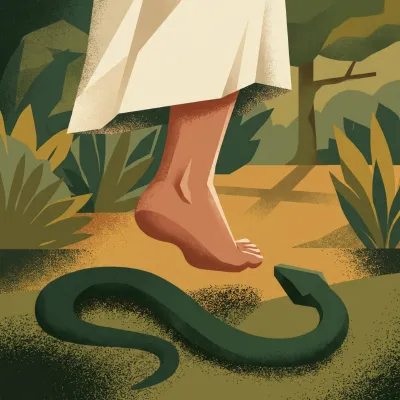
Genesis 3:15 is the first promise God ever made to guilty people, and everything the Bible does after it is God keeping that promise. One sentence, spoken in the worst hour in human history, in a garden that had just stopped being safe. Once you see what it is doing, the sixty six books of the Bible stop feeling like a stack of separate books and start reading like one story with one ending. God questioned the man. God questioned the woman. But He asked the serpent nothing. He turned to it and began sentencing, and Adam and Eve, hiding behind the trees, overheard God announce a war He was starting on their behalf. In this episode, we explore the promise hidden in Genesis 3:15. We notice that only the serpent and the ground are cursed, never the man and the woman. We unpack the rare Hebrew word for enmity, the single verb used for both the crushing of the head and the striking of the heel, and why ancient translators heard a person in this verse long before Jesus was born. We watch Adam name his wife Life, God clothe them with His own hands, Eve hold on to the word "offspring" after losing two sons, and Lamech name Noah in hope. And we follow the line through Tamar, Rahab, Ruth, and Mary to the cross, the empty tomb, and the last page of Revelation. The heel wound and the head wound are the same event described from two sides. The wound was the weapon. Bible verses included in this episode: “And I will put enmity between you and the woman, and between your offspring and hers; he will crush your head, and you will strike his heel.” (Genesis 3:15) “Adam named his wife Eve, because she would become the mother of all the living.” (Genesis 3:20) “The Lord God made garments of skin for Adam and his wife and clothed them.” (Genesis 3:21) “God has granted me another child in place of Abel, since Cain killed him.” (Genesis 4:25) “But when the set time had fully come, God sent his Son, born of a woman, born under the law.” (Galatians 4:4) “The reason the Son of God appeared was to destroy the devil's work.” (1 John 3:8) “No longer will there be any curse.” (Revelation 22:3) This message is for anyone carrying something they have never said out loud, anyone worn down by a life that keeps producing thorns, and anyone who feels God's promises were written for people with a cleaner history. God's first move toward failing people is a promise, and His anger has an enemy, and the enemy is not you. You can overhear something and still be the one it is for. The garden closed. The city opens. And the curse that started it all will not be there.
 32 mnt
Hard Bible Questions
400 Years of Silence: What Happened Between the Old and New Testaments?
For four hundred years, heaven said nothing new. No prophet rose with a fresh word from God. No vision came in the night. To the people living through it, it felt as if God had closed His mouth and turned away. And yet those four centuries were not empty. In the long quiet between the last page of the Old Testament and the first page of the New, God was building the exact world His Son would be born into. In this episode, we explore what happened during the 400 years of silence. We begin with Malachi and a weary, cynical people, then follow the rise of the scribes and the first synagogues, the scattered Jewish communities across the empire, and the conquests of Alexander the Great that made Greek the common language of the world. We look at the translation of the Hebrew Scriptures into Greek, the terrible persecution under Antiochus Epiphanes, the courage of Mattathias and Judah Maccabeus, the rededication of the temple remembered in Hanukkah, and the century of Hasmonean rule that slowly turned sour. We also see how the Pharisees, Sadducees, and Essenes took shape, how Rome and King Herod set the final stage, and how the silence finally broke with Zechariah, John the Baptist, and the birth of Jesus. Every piece was falling into place: one language, Roman roads, synagogues in city after city, the Scriptures in Greek, and a people aching for the promised King. Bible verses included in this episode: “Behold, I will send you Elijah the prophet before the coming of the great and dreadful day of the Lord: And he shall turn the heart of the fathers to the children, and the heart of the children to their fathers, lest I come and smite the earth with a curse.” (Malachi 4:5-6) “Behold, I will send my messenger, and he shall prepare the way before me.” (Malachi 3:1) “But when the fulness of the time was come, God sent forth his Son, made of a woman, made under the law.” (Galatians 4:4) “For unto you is born this day in the city of David a Saviour, which is Christ the Lord.” (Luke 2:11) “Behold the Lamb of God, which taketh away the sin of the world.” (John 1:29) If you are living through a silence of your own, a prayer unanswered or a season of waiting that seems to have no end, this message is for you. The silence of God is not the absence of God. The same God who moved kingdoms to make a manger ready is at work in your uncertain days. Keep looking. Keep trusting. For those who wait on the Lord, the silence is only the part of the story where the way is being made ready.
 33 mnt
Hard Bible Questions
Why Jesus Cursed the Fig Tree: The Detail in Mark 11 That Changes the Whole Story
It is one of the most puzzling moments in the Gospels. Jesus walks up to a fig tree, finds nothing but leaves, and speaks a curse over it, even though Mark says plainly that it was not the season for figs. How can anyone blame a tree for doing what trees do? The answer is that Jesus cursed the fig tree and cleared out the temple on the same morning because the two events are one message. He came to the tree looking for fruit and found leaves. He walked into the temple looking for prayer and found a livestock market, standing in the one space where the rest of the world was allowed to pray. In this episode, we explore the detail in Mark 11 that changes the whole story. We go back to Malachi's promise that the Lord would suddenly come to His temple, watch Jesus look around at everything on Palm Sunday, and learn why a fig tree in full leaf in early spring should have carried small edible buds. We walk into Herod's temple, see the court of the nations turned into a market, and look at the stone warning signs that threatened death to any foreigner who went further. We hear Jeremiah's sermon about a "den of robbers," Micah's grief over missing early figs, and why Mark splits the story across two mornings so the tree and the temple are read together. Then the passage turns. Jesus hands His disciples faith, prayer, and forgiveness, and within the week He hangs on a tree Himself, carrying the curse, as the temple curtain tears from top to bottom. Bible verses included in this episode: “I will send my messenger, who will prepare the way before me. Then suddenly the Lord you are seeking will come to his temple.” (Malachi 3:1) “Seeing in the distance a fig tree in leaf, he went to find out if it had any fruit. When he reached it, he found nothing but leaves, because it was not the season for figs.” (Mark 11:13) “Is it not written: ‘My house will be called a house of prayer for all nations’? But you have made it ‘a den of robbers.’” (Mark 11:17) “Do not trust in deceptive words and say, ‘This is the temple of the Lord, the temple of the Lord, the temple of the Lord!’” (Jeremiah 7:4) “In the morning, as they went along, they saw the fig tree withered from the roots.” (Mark 11:20) “And when you stand praying, if you hold anything against anyone, forgive them, so that your Father in heaven may forgive you your sins.” (Mark 11:25) “Christ redeemed us from the curse of the law by becoming a curse for us, for it is written, ‘Cursed is everyone who is hanged on a tree.’” (Galatians 3:13) Jesus did not condemn the bare trees on that road. He confronted the gap between the leaves and the branches. If you are in a dry season, He is not waiting for your harvest. He is the gardener, on His knees in the dirt, asking for one more season.
 36 mnt
Words of Jesus
What did Jesus mean when He said, “Take up your cross and follow Me”?
What did Jesus mean when He said, “Take up your cross and follow Me”? Many hear those words and think of everyday troubles. But in Jesus’ world, the cross was a one-way road, an image of surrender, not inconvenience. His call is not about carrying random pain. It is about yielding your life to His lead. Jesus did not create a gentler version for those who only wanted comfort, or a special category for stronger believers. He made one path for all who would be His disciples. And hidden in the demand is a promise: whoever loses his life for His sake will save it. In this episode, we explore the core of Jesus’ call and the meaning of its three verbs: deny, take up, and follow. We clear away common misunderstandings, that the cross means any inconvenience, a personality change, only dramatic persecution, a search for pain, or a disdain for joy. We then look at what He did mean through three layers of surrender: a decisive yes to Jesus, a daily surrender in small and unseen choices, and a hopeful surrender framed by resurrection. We also consider the honest cost of discipleship, the prophetic thread of the suffering Servant that runs through Scripture, and the deep truth of union with Christ, where the old self’s claim to the throne is broken and Christ lives in us. Finally, we see why this call matters now, in a world that tells us the self is the highest authority. Bible verses included in this episode: “If anyone would come after me, let him deny himself and take up his cross and follow me.” (Mark 8:34) “For whoever would save his life will lose it, but whoever loses his life for my sake and the gospel’s will save it.” (Mark 8:35) “If anyone would come after me, let him deny himself and take up his cross daily and follow me.” (Luke 9:23) “My grace is sufficient for you, for my power is made perfect in weakness.” (2 Corinthians 12:9) “I have been crucified with Christ. It is no longer I who live, but Christ who lives in me.” (Galatians 2:20) The King did not ask for what He would not give. He carried the wood, faced the shame, and laid down His life for His enemies. When He says, “Follow Me,” He is not pointing to a road He has not walked. The cross you take up is not a symbol of defeat. It is the mark of belonging to the crucified and risen Lord. Losing your life to Him is how you receive it back, made new and anchored in hope.
 28 mnt
Hard Bible Questions
The 7 Levels of Intimacy With God & Why Few Christians Ever Reach the Last One
Do I really know God, or do I only know things about Him? Many people know Christian words, sing Christian songs, and hear Christian messages, yet their hearts still feel far from God. They know about prayer, Scripture, worship, and faith, but intimacy with God feels distant, dry, or only meant for a few special people. In this episode, we walk through the seven levels of intimacy with God and ask one honest question at each level: Where am I really with Him? From the curious observer to the honest seeker, from becoming a child of God to learning to walk with Him daily, from friendship with God to loving Him with your whole life, and finally to the rare place of union of will, this message reveals how God draws His people deeper step by step. This is not a ladder for spiritual pride. It is a mirror for the heart. God created us for closeness, not distance. He walked with Adam and Eve in the garden, spoke with Moses as a man speaks with a friend, came near in Jesus Christ, and still invites His people into deeper fellowship today. Few reach the final level because it asks for everything. It is the place where a person stops holding back, lays down control, and learns to say yes to God again and again. It does not mean perfection. It means surrender. It means your will becomes more and more aligned with His. Wherever you are right now, this message is not meant to crush you. It is meant to wake you, draw you, and remind you that God is more willing to draw near than we are to be drawn. Bible verses included in this episode: “God did this so that they would seek him and perhaps reach out for him and find him, though he is not far from any one of us.” (Acts 17:27) “You will seek me and find me when you seek me with all your heart.” (Jeremiah 29:13) “Yet to all who did receive him, to those who believed in his name, he gave the right to become children of God.” (John 1:12) “If you declare with your mouth, Jesus is Lord, and believe in your heart that God raised him from the dead, you will be saved.” (Romans 10:9) “He has shown you, O mortal, what is good. And what does the Lord require of you? To act justly and to love mercy and to walk humbly with your God.” (Micah 6:8) “I no longer call you servants, because a servant does not know his master’s business. Instead, I have called you friends, for everything that I learned from my Father I have made known to you.” (John 15:15) “One thing I ask from the Lord; this only do I seek: that I may dwell in the house of the Lord all the days of my life, to gaze on the beauty of the Lord and to seek him in his temple.” (Psalm 27:4) “I have been crucified with Christ and I no longer live, but Christ lives in me. The life I now live in the body, I live by faith in the Son of God, who loved me and gave himself for me.” (Galatians 2:20)
 34 mnt
Bible Chapters Explained
Galatians 5 - Flesh vs Spirit
In this episode, we explore Paul’s urgent message about freedom, grace, the danger of legalism, and the daily war between the flesh and the Spirit. This chapter reveals why salvation cannot be earned, why true freedom is not a license to sin, and how the Holy Spirit produces a life that rules and rituals never could. Paul begins with this powerful declaration, “It is for freedom that Christ has set us free. Stand firm, then, and do not let yourselves be burdened again by a yoke of slavery.” (Galatians 5:1) He then gives a sobering warning, “You who are trying to be justified by the law have been alienated from Christ; you have fallen away from grace.” (Galatians 5:4) Paul gives the true definition of Christian living in one sentence, “The only thing that counts is faith expressing itself through love.” (Galatians 5:6) He also explains what freedom is for, “You, my brothers and sisters, were called to be free. But do not use your freedom to indulge the flesh; rather, serve one another humbly in love.” (Galatians 5:13) And he sums up the heart of the law with this command, “For the entire law is fulfilled in keeping this one command: Love your neighbor as yourself.” (Galatians 5:14) At the center of the chapter, Paul reveals the invisible war inside every believer, “So I say, walk by the Spirit, and you will not gratify the desires of the flesh. For the flesh desires what is contrary to the Spirit, and the Spirit what is contrary to the flesh. They are in conflict with each other.” (Galatians 5:16 to 17) He warns about the works of the flesh, then shows the beauty of a life ruled by God, “But the fruit of the Spirit is love, joy, peace, forbearance, kindness, goodness, faithfulness, gentleness and self control. Against such things there is no law.” (Galatians 5:22 to 23) And he reminds believers of their new identity, “Those who belong to Christ Jesus have crucified the flesh with its passions and desires.” (Galatians 5:24) Then he closes with this call, “Since we live by the Spirit, let us keep in step with the Spirit.” (Galatians 5:25) This episode is a call to leave behind the heavy yoke of performance, reject the slavery of the flesh, and walk in the true freedom that only the Spirit of God can give.
 37 mnt
Hard Bible Questions
Who Is The Holy Spirit Really - This Powerful Truth Will Change Your Life
Who is the Holy Spirit really? Many people think of the Holy Spirit as a feeling, a glow, a force, or a spiritual influence. But Scripture reveals Someone far greater and far closer. The Holy Spirit is not an “it.” He is God. He is personal. He speaks, guides, comforts, convicts, teaches, seals, and brings the life of Christ into the believer from the inside out. In this episode, we explore the powerful truth of who the Holy Spirit is and why it changes everything. From Genesis to Pentecost, from creation to new birth, the Spirit is present in the work of God. He hovered over the waters, empowered prophets, rested upon Jesus, filled the early church, and now dwells in believers as the presence of God within them. We’ll also look at how the Holy Spirit reveals the beauty of the Trinity. The Father, Son, and Holy Spirit are not three gods, and they are not one Person wearing different masks. Scripture shows one God in three Persons, working together in perfect unity. The Father sends, the Son redeems, and the Spirit applies the work of salvation to our hearts. This is not just a doctrine to understand. It is a truth to live by. If the Holy Spirit dwells in you, then you are not alone, not abandoned, and not powerless. He is the Helper Jesus promised, the Spirit of truth who glorifies Christ, the seal of your redemption, and the witness in your heart that you belong to the Father. Bible verses included in this episode: “The Spirit of God was hovering over the face of the waters.” (Genesis 1:2) “Another Helper… to be with you forever.” (John 14:16) “He dwells with you and will be in you.” (John 14:17) “He will guide you into all the truth.” (John 16:13) “He will glorify me.” (John 16:14) “You have lied to the Holy Spirit… You have not lied to man but to God.” (Acts 5:3–4) “Baptizing them in the name of the Father and of the Son and of the Holy Spirit.” (Matthew 28:19) “The grace of the Lord Jesus Christ and the love of God and the fellowship of the Holy Spirit be with you all.” (2 Corinthians 13:14) “This is my beloved Son.” (Matthew 3:17) “I will pour out my Spirit on all flesh.” (Joel 2:28) “The Spirit of the Lord is upon me, because he has anointed me to proclaim good news to the poor.” (Luke 4:18) “And when Jesus was baptized, immediately he went up from the water, and behold, the heavens were opened to him, and he saw the Spirit of God descending like a dove and coming to rest on him; and behold, a voice from heaven said, ‘This is my beloved Son, with whom I am well pleased.’” (Matthew 3:16–17) “When the Spirit of truth comes, he will guide you into all the truth… He will glorify me.” (John 16:13–14) “All these are empowered by one and the same Spirit, who apportions to each one individually as he wills.” (1 Corinthians 12:11) “And do not grieve the Holy Spirit of God, by whom you were sealed for the day of redemption.” (Ephesians 4:30) “For through him we both have access in one Spirit to the Father.” (Ephesians 2:18) “For there is one God, and there is one mediator between God and men, the man Christ Jesus.” (1 Timothy 2:5) “Praying in the Holy Spirit… keep yourselves in the love of God… waiting for the mercy of our Lord Jesus Christ.” (Jude 20–21) “Do you not know that your body is a temple of the Holy Spirit within you… you are not your own?” (1 Corinthians 6:19) “I will give you a new heart, and a new spirit I will put within you… And I will put my Spirit within you, and cause you to walk in my statutes.” (Ezekiel 36:26–27) “If by the Spirit you put to death the deeds of the body, you will live.” (Romans 8:13) “We all… beholding the glory of the Lord, are being transformed into the same image… For this comes from the Lord who is the Spirit.” (2 Corinthians 3:18) “The Spirit himself bears witness with our spirit that we are children of God.” (Romans 8:16) “God has sent the Spirit of his Son into our hearts, crying, ‘Abba! Father!’” (Galatians 4:6) “You were sealed with the promised Holy Spirit, who is the guarantee of our inheritance.” (Ephesians 1:13–14) “The Spirit himself intercedes for us with groanings too deep for words.” (Romans 8:26) The Holy Spirit is not distant, vague, or impersonal. He is the living presence of God within His people. He leads us to Christ, brings us to the Father, gives power for new life, and reminds us that we are never alone.
 30 mnt
Stories of Bible Characters
The Apostle Paul (Full Story)
Before he became the Apostle Paul, he was Saul of Tarsus, the most feared enemy of the early church. In this episode, we walk through the full story of the man who tried to crush Christianity, from his violent persecution of believers to his shocking encounter with the risen Jesus on the road to Damascus. This is the story of how God turned a destroyer into a builder, a persecutor into a preacher, and a murderer into one of the boldest voices of the gospel. As Stephen was dying, he prayed, “Lord, do not hold this sin against them.” (Acts 7:60) Then Saul’s own life changed forever when a voice from heaven said, “Saul, Saul, why do you persecute me?” (Acts 9:4) Saul answered, “Who are you, Lord?” And Jesus replied, “I am Jesus, whom you are persecuting. Now get up and go into the city, and you will be told what you must do.” (Acts 9:5 to 6) The Lord then spoke to Ananias and said, “Go to the house of Judas on Straight Street and ask for a man from Tarsus named Saul, for he is praying.” (Acts 9:11) God also declared, “Go! This man is my chosen instrument to proclaim my name to the Gentiles and their kings and to the people of Israel. I will show him how much he must suffer for my name.” (Acts 9:15 to 16) When Ananias obeyed, he said, “Brother Saul, the Lord Jesus, who appeared to you on the road as you came here, has sent me so that you may see again and be filled with the Holy Spirit.” (Acts 9:17) After Saul began preaching Christ, the people were stunned and said, “Isn't he the man who raised havoc in Jerusalem among those who call on this name? And hasn't he come here to take them as prisoners to the chief priests?” (Acts 9:21) Later Paul wrote, “I did not go up to Jerusalem to see those who were apostles before I was, but I went into Arabia. Later I returned to Damascus.” (Galatians 1:17) He also described his suffering this way, “Five times I received from the Jews the forty lashes minus one. Three times I was beaten with rods, once I was pelted with stones, three times I was shipwrecked, I spent a night and a day in the open sea.” (2 Corinthians 11:24 to 25) To the Galatians, Paul wrote, “It is for freedom that Christ has set us free. Stand firm, then, and do not let yourselves be burdened again by a yoke of slavery.” (Galatians 5:1) To the Corinthians, he wrote, “Love is patient, love is kind. It does not envy, it does not boast, it is not proud.” (1 Corinthians 13:4) And to the Romans, “For the wages of sin is death, but the gift of God is eternal life in Christ Jesus our Lord.” (Romans 6:23) As his mission neared its end, Paul said, “I consider my life worth nothing to me; my only aim is to finish the race and complete the task the Lord Jesus has given me.” (Acts 20:24) And in his final letter, he declared, “For I am already being poured out like a drink offering, and the time for my departure is near. I have fought the good fight, I have finished the race, I have kept the faith.” (2 Timothy 4:6 to 7) This episode is a powerful reminder that no one is too far gone for the grace of God. The man who tried to destroy the church became one of its greatest builders, and his story still speaks to anyone who needs a new beginning.
 41 mnt
Stories of Bible Characters
The Full Story of Jesus’ Brothers
Who were the brothers of Jesus, and why are they so often overlooked? In this episode, we uncover the complete story of James, Joses, Judas, and Simon - the men who grew up in the same home as Jesus, doubted Him during His ministry, and were later transformed into bold leaders of the early church. From family tension and unbelief to resurrection faith, martyrdom, and legacy, this is the story of the brothers of Jesus like you’ve never seen it before. The people of Nazareth were shocked when Jesus began His ministry, asking, "Is not this the carpenter, the son of Mary and brother of James and Joses and Judas and Simon? And are not his sisters here with us?" (Mark 6:3) Despite their shared life in Nazareth, the scriptures reveal a difficult family dynamic during Jesus' earthly ministry, noting, "For not even his brothers believed in him." (John 7:5) The tension grew so great that at one point His family even tried to physically stop Him from preaching, because "when his family heard it, they went out to seize him, for they were saying, 'He is out of his mind.'" (Mark 3:21) Everything changed when the risen Christ appeared to His family. Paul records this turning point, writing, "Then he appeared to James, then to all the apostles." (1 Corinthians 15:7) This encounter led the brothers into the heart of the movement, where they were found praying alongside the disciples: "All these with one accord were devoting themselves to prayer, together with the women and Mary the mother of Jesus, and his brothers." (Acts 1:14) James soon rose to become a pillar of the faith in Jerusalem. When Paul visited the city, he noted, "But I saw none of the other apostles except James the Lord’s brother." (Galatians 1:19) During the critical Council of Jerusalem, it was James who gave the final ruling on how to welcome non-Jewish believers, stating, "Therefore, my judgment is that we should not trouble those of the Gentiles who turn to God." (Acts 15:19) James’s authority was so significant that even the Apostle Peter was swayed by his influence during a conflict in Antioch, as Paul observed, "For before certain men came from James, he was eating with the Gentiles; but when they came he drew back and separated himself, fearing the circumcision party." (Galatians 2:12) In his own letter, James emphasized a practical, active faith, urging believers, "But be doers of the word, and not hearers only, deceiving yourselves." (James 1:22) He famously challenged those who claimed faith without action, writing, "For as the body apart from the spirit is dead, so also faith apart from works is dead." (James 2:26) The brother Jude also contributed to the New Testament, though he identified himself with great humility: "Jude, a servant of Jesus Christ and brother of James." (Jude 1:1) Jude’s writing was urgent and protective, calling on the church to "contend for the faith that was once for all delivered to the saints." (Jude 1:3) His letter is known for its vivid and unique references, including a cosmic struggle: "But when the archangel Michael, contending with the devil, was disputing about the body of Moses, he did not presume to pronounce a blasphemous judgment, but said, 'The Lord rebuke you.'" (Jude 1:9) Jude even cited ancient prophecies to warn against false teachers, noting, "It was also about these that Enoch, the seventh from Adam, prophesied, saying, 'Behold, the Lord came with ten thousands of his holy ones, to execute judgment on all and to convict all the ungodly...'" (Jude 1:14-15) Finally, Jude closed his message with one of the most famous prayers in all of scripture: "Now to him, who is able to keep you from stumbling, and to present you blameless before the presence of his glory with great joy..." (Jude 1:24)
 32 mnt
Words of Jesus
What Does Jesus Mean by “I Never Knew You”
What did Jesus mean when He said, “I never knew you”? These are some of the most sobering words Jesus ever spoke. They are not aimed at people who openly reject religion, but at people who call Him “Lord,” speak His name, and even point to powerful spiritual works. Jesus’ warning cuts through appearances and asks the question that matters most: Are we truly known by Him? In this episode, we explore what “I never knew you” does and does not mean. Jesus is not saying He lacks information about people. He is exposing the difference between knowing about Him and truly belonging to Him. Religious language, public ministry, impressive works, and spiritual experiences cannot replace a surrendered life. We’ll look at what it means to be known by the King, why obedience matters, how false confidence can deceive the heart, and why Jesus’ warning is actually an act of mercy. His words are meant to shake false assurance, but not crush sincere disciples who keep coming to Him in repentance and faith. This message is a call to move beyond appearance into real relationship. Jesus does not want a crowd that only says His name. He wants sons and daughters who hear His voice, trust His words, do the Father’s will, and walk with Him in surrendered faith. Bible verses included in this episode: “The work of God is this: to believe in the one he has sent.” (John 6:29) “My sheep listen to my voice; I know them, and they follow me.” (John 10:27) “The Lord knows those who are his.” (2 Timothy 2:19) “Now that you know God—or rather are known by God.” (Galatians 4:9) “Watch out for false prophets.” (Matthew 7:15) “I never knew you.” (Matthew 7:23) On that final day, titles and trophies will not stand. Only those who are truly known by Jesus will be safe. Come to Him, trust Him, surrender to His will, and let your life show that you belong to Him.