
The most famous vision of God in the entire Old Testament is dated by a funeral. King Uzziah had ruled Judah for about fifty two years, and he died a leper, shut out of the temple of the Lord. Assyria was rising on the horizon. If you had asked anyone in Jerusalem what they saw that year, they would have said an empty throne. Isaiah looked at the same year and saw the throne that has never been empty for one second in all of eternity. What he saw rebuilt him from the inside out, and it answers the question that lives quietly in almost every believer's heart: what is God really like? In this episode, we walk through Isaiah chapter 6. We look at the Lord seated high and lifted up, the train of His robe filling the temple, and the seraphim, the burning ones, covering their faces as they cry holy, holy, holy. We hear Isaiah's cry, "Woe is me, for I am undone," and see why the conviction landed on his lips. We watch a live coal carried from the altar to cleanse him, contrast his humility with Uzziah's pride, and hear God ask, "Whom shall I send?" We also face the hard assignment Isaiah was given, the holy seed in the stump, and John's revelation of whose glory Isaiah actually saw. The terrifying holiness and the tender mercy of God are not two Gods, or two moods of God. They are one Person. Bible verses included in this episode: “In the year that King Uzziah died, I saw the Lord sitting on a throne, high and lifted up, and the train of His robe filled the temple.” (Isaiah 6:1) “Holy, holy, holy is the Lord of hosts; the whole earth is full of His glory!” (Isaiah 6:3) “Woe is me, for I am undone! Because I am a man of unclean lips, and I dwell in the midst of a people of unclean lips; for my eyes have seen the King, the Lord of hosts.” (Isaiah 6:5) “Behold, this has touched your lips; your iniquity is taken away, and your sin purged.” (Isaiah 6:7) “Also I heard the voice of the Lord, saying: ‘Whom shall I send, and who will go for Us?’ Then I said, ‘Here am I! Send me.’” (Isaiah 6:8) “These things Isaiah said when he saw His glory and spoke of Him.” (John 12:41) “There shall come forth a Rod from the stem of Jesse, and a Branch shall grow out of his roots.” (Isaiah 11:1) Everyone has an Uzziah, some pillar that makes the world feel steady, and for every one of us the year comes when it falls. If you are in that year right now, this vision was preserved for you. The King you cannot see is still seated, and His mercy still moves toward the broken before they can move toward Him. Whatever this year has taken from you, the throne room of God has lost nothing. He still reigns, still cleanses, and still calls. Here am I. Send me.
Plus dans Bible Chapters Explained
 37 min
Bible Chapters Explained
Daniel Saw the End of the World Thousands of Years Ago. Here Is What He Wrote
An old man stands on the bank of the Tigris River. He was taken from his home as a boy, forced to serve kings who did not know his God, and has outlived more than one empire. Then a figure clothed in linen appears, with a face like lightning and eyes like burning fire, and shows Daniel the end of the world. Many people assume the Bible's words about the end must be a book of terror, or a code for clever people to crack. But Daniel did not write to frighten anyone. He wrote for people who feel small and afraid in a world that seems out of control, people who watch good things crumble and wonder if God has forgotten them. In this episode, we follow Daniel through his visions in the order he came to understand them. We look at the great statue of gold, silver, bronze, iron, and clay, and the stone cut without hands that becomes a mountain filling the earth. We see four beasts rise from a stormy sea, a heavenly courtroom where the books are opened, and one like the Son of Man coming with the clouds of heaven to receive an everlasting kingdom. We trace the ram and the goat, the Anointed One who would be cut off, the measured season of trouble, and the promise of resurrection at the very end of the book. Daniel was never given a date he could circle. What he was given, over and over, was a verdict, and it falls on the side of God and His people. He was not finally pointing at a date. He was pointing at a Person. Bible verses included in this episode: “In the days of these kings shall the God of heaven set up a kingdom, which shall never be destroyed: and the kingdom shall not be left to other people, but it shall break in pieces and consume all these kingdoms, and it shall stand for ever.” (Daniel 2:44) “I saw in the night visions, and, behold, one like the Son of man came with the clouds of heaven, and came to the Ancient of days, and they brought him near before him.” (Daniel 7:13) “To finish the transgression, and to make an end of sins, and to make reconciliation for iniquity, and to bring in everlasting righteousness.” (Daniel 9:24) “And many of them that sleep in the dust of the earth shall awake, some to everlasting life, and some to shame and everlasting contempt.” (Daniel 12:2) “And they that be wise shall shine as the brightness of the firmament; and they that turn many to righteousness as the stars for ever and ever.” (Daniel 12:3) “But go thou thy way till the end be: for thou shalt rest, and stand in thy lot at the end of the days.” (Daniel 12:13) If the world around you feels like it is coming apart, or you feel old, forgotten, and far from home, Daniel's last words are for you. The kingdoms that frighten you have an expiration date, and the One who meets us at the end is the Son of Man, with kindness in His eyes and a kingdom in His hands. Go your way, one faithful day at a time. You shall rest, and you shall rise, and you shall stand in your place among His own.
 33 min
Bible Chapters Explained
Ezekiel and the Valley of Dry Bones: When God Brings Back What You Thought Was Dead
Our bones are dry. Our hope is lost. We are cut off. Those three sentences were spoken by God's own people in exile in Babylon. The temple was ash, the throne of David sat empty, and every visible evidence of God's promises had been destroyed. So they wrote the ending themselves: it is over. Heaven heard those three sentences. God's answer was to carry a prophet out in the Spirit and set him down in the middle of a valley full of bones, bones so old and so dry the sun had bleached them white. Then He made that prophet watch what He does with things everyone has agreed are finished. In this episode, we walk through Ezekiel chapter 37. We meet Ezekiel, a priest who never served a day in the temple, who lost his homeland, his calling, and his wife. We follow him as God walks him back and forth through the devastation, asks him, "Can these bones live?", and commands him to preach to the dead. We watch the bones rattle together, receive sinews, flesh, and skin, and still lie without breath, until God sends the ruach, the wind, breath, and Spirit, and they stand up an exceedingly great army. And we see how the vision reaches forward to the two sticks joined as one, to the promised shepherd from David's line, to the tomb of Lazarus, to the risen Jesus breathing on His disciples, and to the gospel itself. Salvation is not self improvement. It is resurrection. It always was. Bible verses included in this episode: “And He said to me, ‘Son of man, can these bones live?’ So I answered, ‘O Lord God, You know.’” (Ezekiel 37:3) “Thus says the Lord God to these bones: ‘Surely I will cause breath to enter into you, and you shall live.’” (Ezekiel 37:5) “And breath came into them, and they lived, and stood upon their feet, an exceedingly great army.” (Ezekiel 37:10) “I will put My Spirit in you, and you shall live, and I will place you in your own land.” (Ezekiel 37:14) “I am the resurrection and the life. He who believes in Me, though he may die, he shall live.” (John 11:25) “But God, who is rich in mercy, because of His great love with which He loved us, even when we were dead in trespasses, made us alive together with Christ.” (Ephesians 2:4-5) This message is for anyone with a valley of their own: a marriage that stopped sharing a heart, a child who walked away, a faith that has gone dry, or a calling buried long ago. God knows exactly how dead it is, He has heard your hopeless sentences, and He answers them without anger. So do not write the ending yourself. Keep the word of God moving over your valley, and ask Him for the breath. Can these bones live? He has already shown us His answer.
 37 min
Bible Chapters Explained
What Jesus Did the Moment He Returned to Heaven
On the slope of the Mount of Olives, a group of ordinary men once stood with their eyes fixed on the sky, watching their teacher and friend rise away from them until a cloud hid Him from their sight. Then the hill went quiet. We usually stop the story there. But there is another side to that morning, a side the men on the hill could not see. From heaven's side, it was not a goodbye. It was an arrival, a homecoming, and the beginning of the work Jesus is still doing for you right now. For many believers, the ascension is the least understood part of the whole story of Jesus. Yet what He did the moment He returned tells us whether the cross actually worked, where He is now, and what He is doing about our sin, our prayers, and our future. In this episode, we explore what Jesus did on the other side of the cloud. He returned to the glory He shared with the Father before the world began. He sat down at the right hand of the Majesty in heaven, because the work of purification for sins was finished. He entered the true sanctuary, heaven itself, to appear for us in God's presence. He was exalted to the highest place, received the kingdom Daniel saw, carried our humanity to the throne, began to intercede for His people, and poured out the promised Holy Spirit. Bible verses included in this episode: “After he said this, he was taken up before their very eyes, and a cloud hid him from their sight.” (Acts 1:9) “After he had provided purification for sins, he sat down at the right hand of the Majesty in heaven.” (Hebrews 1:3) “The Lord says to my Lord: Sit at my right hand until I make your enemies a footstool for your feet.” (Psalm 110:1) “For Christ did not enter a sanctuary made with human hands that was only a copy of the true one; he entered heaven itself, now to appear for us in God's presence.” (Hebrews 9:24) “Therefore God exalted him to the highest place and gave him the name that is above every name.” (Philippians 2:9) “He always lives to intercede for them.” (Hebrews 7:25) “Exalted to the right hand of God, he has received from the Father the promised Holy Spirit and has poured out what you now see and hear.” (Acts 2:33) This message is for anyone who believes Jesus died and rose, but on some days feels He is far away. When you are afraid, remember that He sat down. When you cannot pray, remember that He always lives to intercede for you. When you feel alone, remember that by His Spirit He is closer than your own breath. You are not standing on an empty hill under an empty sky. He has not left you. He has gone ahead of you, and He is holding you all the way home.
 29 min
Bible Chapters Explained
The Four Horsemen of the Apocalypse: The Book of Revelation
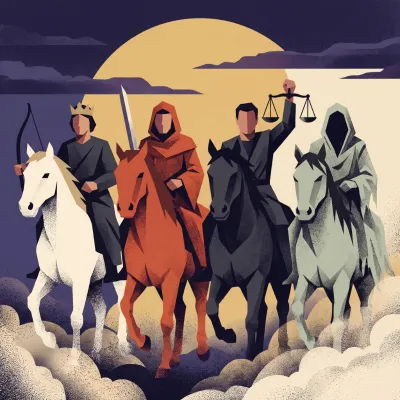
The book of Revelation was not written to frighten God's people. It was written to comfort them. Its first readers were ordinary believers in a hard and hostile world, afraid of what tomorrow would bring. And the vision John sends them does not begin with the horses. It begins in a throne room, with God seated at the center of everything, worshiped without pause. The word apocalypse does not mean disaster. It means an unveiling, the pulling back of a curtain so you can finally see what was there all along. Conquest, war, hunger, and death have ridden through every century. Revelation lets you see them clearly, and see the one thing you could never see with your own eyes: whose hand breaks the seals and sets the limits. In this episode, we walk through the four horsemen of Revelation chapter 6. We begin with the sealed scroll that no one was worthy to open, and the Lion of Judah who turns out to be a Lamb that was slain. We look at the living creatures who call each rider forward, the white horse of conquest, the red horse of war, the black horse of famine with its scales and its day's wage for a quart of wheat, and the pale horse named Death with Hades following behind. We trace how the prophets Jeremiah and Ezekiel spoke of the same sword, famine, plague, and wild beasts, and why the martyrs under the altar cry out, "How long?" Every rider is given, permitted, and limited. Evil in this vision is real, but it is never sovereign. Bible verses included in this episode: “Worthy is the Lamb who was slain.” (Revelation 5:12) “And I looked, and behold, a white horse! And its rider had a bow, and a crown was given to him, and he came out conquering, and to conquer.” (Revelation 6:2) “Its rider was permitted to take peace from the earth, so that people should slay one another, and he was given a great sword.” (Revelation 6:4) “A quart of wheat for a denarius, and three quarts of barley for a denarius, and do not harm the oil and wine!” (Revelation 6:6) “And its rider's name was Death, and Hades followed him. And they were given authority over a fourth of the earth, to kill with sword and with famine and with pestilence and by wild beasts of the earth.” (Revelation 6:8) This message is for anyone who watches the news and feels that everything is coming apart, or who feels the pale rider waiting at the end of the hall. The Bible does not tell you the riders are not real. It tells you they are not in charge. The riders are real, but they are held. The seals are broken, but only by wounded and loving hands. They answer to a Lamb, and the Lamb is for you.