
Díly podcastu
 33 min
Bible Chapters Explained
Ezekiel and the Valley of Dry Bones: When God Brings Back What You Thought Was Dead
Our bones are dry. Our hope is lost. We are cut off. Those three sentences were spoken by God's own people in exile in Babylon. The temple was ash, the throne of David sat empty, and every visible evidence of God's promises had been destroyed. So they wrote the ending themselves: it is over. Heaven heard those three sentences. God's answer was to carry a prophet out in the Spirit and set him down in the middle of a valley full of bones, bones so old and so dry the sun had bleached them white. Then He made that prophet watch what He does with things everyone has agreed are finished. In this episode, we walk through Ezekiel chapter 37. We meet Ezekiel, a priest who never served a day in the temple, who lost his homeland, his calling, and his wife. We follow him as God walks him back and forth through the devastation, asks him, "Can these bones live?", and commands him to preach to the dead. We watch the bones rattle together, receive sinews, flesh, and skin, and still lie without breath, until God sends the ruach, the wind, breath, and Spirit, and they stand up an exceedingly great army. And we see how the vision reaches forward to the two sticks joined as one, to the promised shepherd from David's line, to the tomb of Lazarus, to the risen Jesus breathing on His disciples, and to the gospel itself. Salvation is not self improvement. It is resurrection. It always was. Bible verses included in this episode: “And He said to me, ‘Son of man, can these bones live?’ So I answered, ‘O Lord God, You know.’” (Ezekiel 37:3) “Thus says the Lord God to these bones: ‘Surely I will cause breath to enter into you, and you shall live.’” (Ezekiel 37:5) “And breath came into them, and they lived, and stood upon their feet, an exceedingly great army.” (Ezekiel 37:10) “I will put My Spirit in you, and you shall live, and I will place you in your own land.” (Ezekiel 37:14) “I am the resurrection and the life. He who believes in Me, though he may die, he shall live.” (John 11:25) “But God, who is rich in mercy, because of His great love with which He loved us, even when we were dead in trespasses, made us alive together with Christ.” (Ephesians 2:4-5) This message is for anyone with a valley of their own: a marriage that stopped sharing a heart, a child who walked away, a faith that has gone dry, or a calling buried long ago. God knows exactly how dead it is, He has heard your hopeless sentences, and He answers them without anger. So do not write the ending yourself. Keep the word of God moving over your valley, and ask Him for the breath. Can these bones live? He has already shown us His answer.
 34 min
Bible Chapters Explained
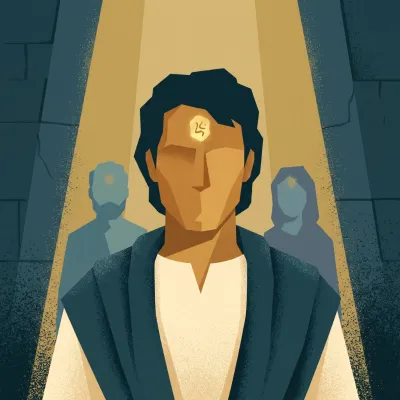
The Seal of God: What Scripture Reveals About Those Who Belong to Him
You can love the Bible for forty years and still lie awake at two in the morning, wondering whether you truly belong to God. Paul wrote to people in that exact condition. Near the end of his life, to a young pastor holding together a shaken church, he described the seal of God and even told us what is written on it. That seal has two lines. The first is about something God knows. The second is about something that shows. Together, they are how Scripture describes the people who belong to Him. In this episode, we explore what the Bible reveals about the seal of God. We trace the first line back to Moses on a day when no one could tell who belonged to the Lord. We see Abraham receive circumcision as a seal of a righteousness he already had by faith, and learn why the Holy Spirit is not a token but a first installment of our inheritance. We walk through Judah handing his seal to Tamar, the gold plate engraved "Holy to the Lord" on the high priest's forehead, the mark Ezekiel saw placed on those who grieved, the signet ring pulled off Jehoiachin and given again to Zerubbabel, and the Lamb who alone could open the sealed scroll. A seal is not an emotion. It is something pressed in from outside by someone else. You do not carry the name because you can feel it. You carry it because He pressed it. Bible verses included in this episode: “Nevertheless, God's solid foundation stands firm, sealed with this inscription: ‘The Lord knows those who are his,’ and, ‘Everyone who confesses the name of the Lord must turn away from wickedness.’” (2 Timothy 2:19) “And he received circumcision as a sign, a seal of the righteousness that he had by faith while he was still uncircumcised.” (Romans 4:11) “And you also were included in Christ when you heard the message of truth, the gospel of your salvation. When you believed, you were marked in him with a seal, the promised Holy Spirit.” (Ephesians 1:13) “And do not grieve the Holy Spirit of God, with whom you were sealed for the day of redemption.” (Ephesians 4:30) “Go throughout the city of Jerusalem and put a mark on the foreheads of those who grieve and lament over all the detestable things that are done in it.” (Ezekiel 9:4) “They will see his face, and his name will be on their foreheads.” (Revelation 22:4) “The Spirit himself testifies with our spirit that we are God's children.” (Romans 8:16) This message is for anyone in a quiet house, worn out, or haunted by something in the past that whispers God must have written you off. Nothing in these passages ties the seal of God to your feelings. If something in you keeps turning toward Him, that is the second line of the inscription, showing. He knows those who are His. He pressed His name into you a long time ago, He did not do it lightly, and He is not going to lose you now.
 33 min
Hard Bible Questions
7 Signs You Are Under Spiritual Attack, and How God Tells You to Fight Back
There are seasons when nothing on the surface has changed, and yet everything inside you feels heavier. You are irritable with people you love, anxious for reasons you cannot name, and tired in a way sleep does not fix. You wonder if you are losing your faith or simply failing as a Christian. But what if some of what you feel is not weakness at all? What if it is resistance from an enemy who does not want you to draw closer to God? In this episode, we explore seven signs Scripture gives of spiritual attack: a sudden pull toward sin, a heaviness you cannot explain, accusation that never lets up, confusion about what is true, fear that will not release, division in your relationships, and a slow drift away from God Himself. We also keep a careful balance, because not every hard day is an attack, and fear of the enemy can become its own trap. Then we turn to how God tells you to fight back. The enemy is already defeated at the cross. You are called not to win a victory still in doubt, but to stand in the victory Jesus secured, clothed in the full armor of God, taking every thought captive, praying at all times, and standing shoulder to shoulder with other believers. Bible verses included in this episode: “For our struggle is not against flesh and blood, but against the rulers, against the authorities, against the powers of this dark world and against the spiritual forces of evil in the heavenly realms.” (Ephesians 6:12) “Be alert and of sober mind. Your enemy the devil prowls around like a roaring lion looking for someone to devour.” (1 Peter 5:8) “The thief comes only to steal and kill and destroy; I have come that they may have life, and have it to the full.” (John 10:10) “Having disarmed the powers and authorities, he made a public spectacle of them, triumphing over them by the cross.” (Colossians 2:15) “Submit yourselves, then, to God. Resist the devil, and he will flee from you.” (James 4:7) “The one who is in you is greater than the one who is in the world.” (1 John 4:4) “Simon, Simon, Satan has asked to sift all of you as wheat. But I have prayed for you, Simon, that your faith may not fail.” (Luke 22:31-32) You are not crazy, you are not failing, and you are not alone. The lion roars, but a roar is not a bite. The accuser speaks day and night, but his voice is not the verdict of heaven. Put on the armor, draw near to the God who is already near to you, and stand. The One who lives inside you is greater.
 33 min
Hard Bible Questions
The Five-Fold Ministry Gifts Explained - How to Know Which One You Carry
Many believers quietly decided years ago that whatever God was handing out got handed out somewhere else, among better people. Nobody ever came and told them what they were for, and after enough silence, the conclusion formed on its own. But you can know which gift you carry, and you find it by looking outward instead of inward. A gift is easier to see in other people than in yourself. Something happens to people when you are around, and it has been happening for years. There is no test to pass and no ceremony that turns an ordinary believer into someone useful. In this episode, we explore the five gifts Paul names in Ephesians 4: the apostle, the prophet, the evangelist, the pastor, and the teacher. We see why Christ gives people as gifts, how these gifts were handed out like spoils after His victory, and what the body actually receives when each one is present. Through Paul's ambition to preach where Christ was not known, the prophets Judas and Silas strengthening the church, Philip the evangelist, Paul's charge to the Ephesian elders, and the Levites who explained the law in Jerusalem, we look at each gift along with the natural trait that can imitate it for years. We also walk through how to read your own life backward: what keeps repeating, what people come to you for, what grief you carry for the church, and what your gift has cost you. And we see why the people around you often name the gift first, and how all five were first found in Jesus Himself. Bible verses included in this episode: “So Christ himself gave the apostles, the prophets, the evangelists, the pastors and teachers.” (Ephesians 4:11) “When he ascended on high, he took many captives and gave gifts to his people.” (Ephesians 4:8) “It has always been my ambition to preach the gospel where Christ was not known, so that I would not be building on someone else’s foundation.” (Romans 15:20) “Judas and Silas, who themselves were prophets, said much to encourage and strengthen the believers.” (Acts 15:32) “Be shepherds of the church of God, which he bought with his own blood.” (Acts 20:28) “They read from the Book of the Law of God, making it clear and giving the meaning so that the people understood what was being read.” (Nehemiah 8:8) “You call me ‘Teacher’ and ‘Lord,’ and rightly so, for that is what I am.” (John 13:13) “From him the whole body, joined and held together by every supporting ligament, grows and builds itself up in love, as each part does its work.” (Ephesians 4:16) Your gift may have no title and no audience, but that does not touch whether it is real. Christ came out of the grave with His hands full, and the giving has not stopped for anyone still breathing. A body is being built, and it is still missing what you were given to bring.
 33 min
Words of Jesus
What did Jesus mean when He said we should forgive others “seventy times seven”?
Peter asked a real question from real pain: how often must I forgive my brother? As many as seven times? Seven felt generous. It sounded like a full week of grace, a thorough attempt at peace. But Jesus answered with a number that makes counting pointless: “seventy times seven.” Jesus was not lowering the seriousness of sin or asking wounded people to pretend nothing happened. He was confronting the reflex in all of us that wants mercy to have a safe limit. In His kingdom, forgiveness is not a quota to fulfill but a posture to carry, the steady readiness to release a debt into God’s hands, because that is what God has done with us. In this episode, we explore what Jesus meant by “seventy times seven” and why He followed it with the parable of the unforgiving servant, a man forgiven an unpayable debt who seized a fellow servant by the throat over a small one. We look at the echoes behind the number, from Lamech’s boast of seventy-sevenfold vengeance in Genesis to Daniel’s seventy weeks, and we see how Jesus turns endless payback into endless mercy. We also look at how forgiveness works in real discipleship as an act, a process, and a way of seeing. Forgiveness is not the same as trust, reconciliation, or removing consequences, and it does not erase boundaries. For the days when forgiveness feels impossible, because the wound is fresh, the offense keeps repeating, the offender is gone, or the person we cannot forgive is ourselves, Jesus meets us with grace. Bible verses included in this episode: “Lord, how often will my brother sin against me, and I forgive him? As many as seven times?” Jesus said to him, “I do not say to you seven times, but seventy times seven.” (Matthew 18:21–22) “Should not you have had mercy on your fellow servant, as I had mercy on you?” (Matthew 18:33) “Forgive us our debts, as we also have forgiven our debtors.” (Matthew 6:12) “Be kind to one another, tenderhearted, forgiving one another, as God in Christ forgave you.” (Ephesians 4:32) Imagine setting down the heavy book where you have kept every wrong written in the margins, and closing it for good. If you are tired of carrying what others did to you, Jesus is not giving you a chore. He is giving you a key. When mercy keeps count, it is no longer mercy. Let grace set the number, let the cross set the measure, and let your heart learn the math of the kingdom.
 32 min
Hard Bible Questions
What the Armor of God Really Means When You Feel Too Weak to Fight
Many people read Ephesians 6 as a battle plan for strong Christians, but Paul wrote these words while chained as a prisoner in Rome. He was not writing from comfort. He was writing from weakness. And the first command he gives is not to attack, conquer, or prove your strength. It is to be strong in the Lord. In this episode, we look deeper into the Armor of God and discover that it is not a heavy checklist for tired believers. It is God’s own armor, given to those who have run out of strength. The belt of truth, the breastplate of righteousness, the shield of faith, the helmet of salvation, the gospel of peace, and the sword of the Spirit are not things we create by effort. They are gifts we receive from Christ. We’ll explore why Paul keeps repeating one command: stand. Not charge. Not win the war in your own power. Just stand. Because the victory has already been won at the cross, the believer does not fight for victory but from victory. This message is for the day when grief feels too heavy, fear feels too loud, and faith feels thin. The Armor of God was made for that day. When you cannot feel strong, you can still hide behind Christ. When you cannot fight, you can still pray. And when you feel too weak to do anything else, you can still stand. Bible verses included in this episode: “Finally, be strong in the Lord and in his mighty power.” (Ephesians 6:10) “For our struggle is not against flesh and blood, but against the rulers, against the authorities, against the powers of this dark world and against the spiritual forces of evil in the heavenly realms.” (Ephesians 6:12) “Put on the full armor of God, so that you can take your stand against the devil's schemes.” (Ephesians 6:11) “Therefore put on the full armor of God, so that when the day of evil comes, you may be able to stand your ground, and after you have done everything, to stand.” (Ephesians 6:13) “Stand firm then.” (Ephesians 6:14) “He put on righteousness as his breastplate, and the helmet of salvation on his head; he put on the garments of vengeance and wrapped himself in zeal as in a cloak.” (Isaiah 59:17) "Stand firm then, with the belt of truth buckled around your waist, with the breastplate of righteousness in place, and with your feet fitted with the readiness that comes from the gospel of peace." (Ephesians 6:14-15) "In addition to all this, take up the shield of faith, with which you can extinguish all the flaming arrows of the evil one." (Ephesians 6:16) "Take the helmet of salvation and the sword of the Spirit, which is the word of God." (Ephesians 6:17) "And having disarmed the powers and authorities, he made a public spectacle of them, triumphing over them by the cross." (Colossians 2:15) "And pray in the Spirit on all occasions with all kinds of prayers and requests. With this in mind, be alert and always keep on praying for all the Lord's people." (Ephesians 6:18)
 30 min
Bible Books Explained
Ephesians Explained - Why It Was Written to You
Most people read Ephesians looking for instructions. They find rules, advice, and things to do. But that is not why Paul wrote it. In this episode, we walk through the entire book of Ephesians and uncover what makes it unlike any other letter in the Bible. Paul wrote it from a prison cell, not to fix a broken church, but to reveal something already finished. A plan older than the world itself. A grace too large to earn and too deep to lose. We look at why some of the oldest copies of this letter have no city name in the opening, what a real wall in the Jerusalem temple tells us about who belongs to God now, the one word in chapter 4 that holds the whole letter together, the prayer Paul could not hold back in chapter 3, the armor in chapter 6 that was never yours to build, and what it means that Paul called himself an ambassador in chains. If you are tired of a faith that feels like a performance you can never get right, this letter was written for you. Not as a ladder to climb, but as a home to walk into. Key verses: "He chose us in him before the foundation of the world, that we should be holy and blameless before him." (Ephesians 1:4) "For by grace you have been saved through faith. And this is not your own doing; it is the gift of God, not a result of works, so that no one may boast." (Ephesians 2:8-9) "For he himself is our peace, who has made us both one and has broken down in his flesh the dividing wall of hostility." (Ephesians 2:14) "For we do not wrestle against flesh and blood, but against the rulers, against the authorities, against the cosmic powers over this present darkness, against the spiritual forces of evil in the heavenly places." (Ephesians 6:12)
 29 min
Bible Chapters Explained
Ephesians 3 - When Faith Feels Weak
What do you read when your faith still exists, but it feels weak, tired, and barely alive? In this episode, we walk through Ephesians 3, one of the most powerful chapters in the New Testament for seasons when belief feels more like a burden than a fire. From Paul’s prison cell comes a message of hope, strength, love, and supernatural power for anyone who feels discouraged. Paul says, “Although I am less than the least of all the Lord’s people, this grace was given me: to preach to the Gentiles the boundless riches of Christ.” (Ephesians 3:8) He also writes, “I ask you, therefore, not to be discouraged because of my sufferings for you, which are your glory.” (Ephesians 3:13) Then Paul bows in prayer and says, “For this reason I kneel before the Father, from whom every family in heaven and on earth derives its name.” (Ephesians 3:14 to 15) He prays, “I pray that out of his glorious riches he may strengthen you with power through his Spirit in your inner being.” (Ephesians 3:16) He continues, “So that Christ may dwell in your hearts through faith.” (Ephesians 3:17) And, “And I pray that you, being rooted and established in love, may have power, together with all the Lord’s holy people, to grasp how wide and long and high and deep is the love of Christ.” (Ephesians 3:17 to 18) Paul then prays, “To know this love that surpasses knowledge, that you may be filled to the measure of all the fullness of God.” (Ephesians 3:19) And he closes with one of the greatest promises in Scripture, “Now to him who is able to do immeasurably more than all we ask or imagine, according to his power that is at work within us, to him be glory in the church and in Christ Jesus throughout all generations, for ever and ever! Amen.” (Ephesians 3:20 to 21) This episode is for the person whose faith feels like a flicker. Ephesians 3 reminds us that God strengthens the inner being, roots us in the love of Christ, fills us with His fullness, and works within us with a power greater than anything we can ask or imagine.
 37 min
Hard Bible Questions
Who Is The Holy Spirit Really - This Powerful Truth Will Change Your Life
Who is the Holy Spirit really? Many people think of the Holy Spirit as a feeling, a glow, a force, or a spiritual influence. But Scripture reveals Someone far greater and far closer. The Holy Spirit is not an “it.” He is God. He is personal. He speaks, guides, comforts, convicts, teaches, seals, and brings the life of Christ into the believer from the inside out. In this episode, we explore the powerful truth of who the Holy Spirit is and why it changes everything. From Genesis to Pentecost, from creation to new birth, the Spirit is present in the work of God. He hovered over the waters, empowered prophets, rested upon Jesus, filled the early church, and now dwells in believers as the presence of God within them. We’ll also look at how the Holy Spirit reveals the beauty of the Trinity. The Father, Son, and Holy Spirit are not three gods, and they are not one Person wearing different masks. Scripture shows one God in three Persons, working together in perfect unity. The Father sends, the Son redeems, and the Spirit applies the work of salvation to our hearts. This is not just a doctrine to understand. It is a truth to live by. If the Holy Spirit dwells in you, then you are not alone, not abandoned, and not powerless. He is the Helper Jesus promised, the Spirit of truth who glorifies Christ, the seal of your redemption, and the witness in your heart that you belong to the Father. Bible verses included in this episode: “The Spirit of God was hovering over the face of the waters.” (Genesis 1:2) “Another Helper… to be with you forever.” (John 14:16) “He dwells with you and will be in you.” (John 14:17) “He will guide you into all the truth.” (John 16:13) “He will glorify me.” (John 16:14) “You have lied to the Holy Spirit… You have not lied to man but to God.” (Acts 5:3–4) “Baptizing them in the name of the Father and of the Son and of the Holy Spirit.” (Matthew 28:19) “The grace of the Lord Jesus Christ and the love of God and the fellowship of the Holy Spirit be with you all.” (2 Corinthians 13:14) “This is my beloved Son.” (Matthew 3:17) “I will pour out my Spirit on all flesh.” (Joel 2:28) “The Spirit of the Lord is upon me, because he has anointed me to proclaim good news to the poor.” (Luke 4:18) “And when Jesus was baptized, immediately he went up from the water, and behold, the heavens were opened to him, and he saw the Spirit of God descending like a dove and coming to rest on him; and behold, a voice from heaven said, ‘This is my beloved Son, with whom I am well pleased.’” (Matthew 3:16–17) “When the Spirit of truth comes, he will guide you into all the truth… He will glorify me.” (John 16:13–14) “All these are empowered by one and the same Spirit, who apportions to each one individually as he wills.” (1 Corinthians 12:11) “And do not grieve the Holy Spirit of God, by whom you were sealed for the day of redemption.” (Ephesians 4:30) “For through him we both have access in one Spirit to the Father.” (Ephesians 2:18) “For there is one God, and there is one mediator between God and men, the man Christ Jesus.” (1 Timothy 2:5) “Praying in the Holy Spirit… keep yourselves in the love of God… waiting for the mercy of our Lord Jesus Christ.” (Jude 20–21) “Do you not know that your body is a temple of the Holy Spirit within you… you are not your own?” (1 Corinthians 6:19) “I will give you a new heart, and a new spirit I will put within you… And I will put my Spirit within you, and cause you to walk in my statutes.” (Ezekiel 36:26–27) “If by the Spirit you put to death the deeds of the body, you will live.” (Romans 8:13) “We all… beholding the glory of the Lord, are being transformed into the same image… For this comes from the Lord who is the Spirit.” (2 Corinthians 3:18) “The Spirit himself bears witness with our spirit that we are children of God.” (Romans 8:16) “God has sent the Spirit of his Son into our hearts, crying, ‘Abba! Father!’” (Galatians 4:6) “You were sealed with the promised Holy Spirit, who is the guarantee of our inheritance.” (Ephesians 1:13–14) “The Spirit himself intercedes for us with groanings too deep for words.” (Romans 8:26) The Holy Spirit is not distant, vague, or impersonal. He is the living presence of God within His people. He leads us to Christ, brings us to the Father, gives power for new life, and reminds us that we are never alone.
 33 min
Stories of Bible Characters
Archangel Michael - Heaven_s Strongest Angel
Before the first human drew a breath, God created mighty spiritual beings to serve him. Among them, one warrior stands alone as the commander of angelic armies and the defender of the people of God. In this episode, we uncover the real story of Archangel Michael. We move beyond the popular myths to see what Scripture actually reveals about this chief prince who stands in the middle of spiritual war. We explore the profound meaning of his name, which poses a question that echoes through eternity: Who is like God? We follow Michael from the ancient visions of Daniel to the final cosmic battles in Revelation. We see him resisting the prince of Persia, contending with the devil over the body of Moses, and leading the armies of heaven to cast down the dragon. This journey reveals that even the strongest angel is a humble servant whose authority is borrowed from the Creator. This episode is a call to understand the reality of spiritual warfare and to find comfort in the fact that no power of darkness can overturn the will of the Lord. Scripture References "I will ascend. I will raise my throne. I will make myself like the Most High." (Isaiah 14:13 to 14) "Michael and his angels fought against the dragon, and the dragon and his angels fought back. But he was not strong enough." (Revelation 12:7 to 9) "At that time Michael, the great prince who protects your people, will arise." (Daniel 12:1) "Multitudes who sleep in the dust of the earth will awake: some to everlasting life, others to shame and everlasting contempt." (Daniel 12:2) "But even the archangel Michael, when he was disputing with the devil about the body of Moses, did not dare to bring a slanderous accusation against him but said, 'The Lord rebuke you.'" (Jude 1:9) "For our struggle is not against flesh and blood, but against the rulers, against the authorities, against the powers of this dark world." (Ephesians 6:12 to 18) "For the Lord himself will come down from heaven, with a loud command, with the voice of the archangel and with the trumpet call of God." (1 Thessalonians 4:16) "Do not do it. I am a fellow servant with you and with your brothers and sisters who hold to the testimony of Jesus. Worship God." (Revelation 19:10) This episode shows that Michael’s story is not meant to draw our attention away from the Creator. Instead, it serves as a powerful reminder that there is no one like God. Not Satan, not any angel, and not any power on earth.
 34 min
Words of Jesus
“Upon this ROCK I will build my CHURCH”
What did Jesus mean when He said, “Upon this rock I will build my church”? This powerful statement from Matthew 16:18 has shaped Christian identity for centuries. It was not a casual phrase. It was a public promise from Jesus that He Himself would build His church, that death would not overcome it, and that the confession of who He is would stand at the center of His people. In this episode, we explore the meaning of “this rock” in its biblical context. Jesus spoke these words near Caesarea Philippi, a place known for massive rock cliffs and pagan worship. In that setting, He asked His disciples the most important question: “Who do you say I am?” Peter answered, “You are the Messiah, the Son of the living God.” From there, Jesus declared that He would build His church. We’ll look at the three key layers of meaning: Peter’s role as a foundational witness, Peter’s confession that Jesus is the Messiah and Son of God, and Christ Himself as the chief cornerstone. These truths do not fight against each other. Together, they show a church that is built on Christ, confessed through the apostles, and made alive by believers who become living stones in God’s house. This episode also explains the meaning of the keys of the kingdom, binding and loosing, and the promise that the gates of Hades will not overcome Christ’s church. Jesus is not building a fragile institution based on human strength. He is building His people on a foundation that cannot fail. Bible verses included in this episode: “You are the Messiah, the Son of the living God.” (Matthew 16:16) “You are Peter, and on this rock I will build my church.” (Matthew 16:18) “Built on the foundation of the apostles and prophets, with Christ Jesus himself as the chief cornerstone.” (Ephesians 2:20) “I will give you the keys of the kingdom of heaven.” (Matthew 16:19) “The gates of Hades will not overcome it.” (Matthew 16:18) The church belongs to Jesus. He is the builder, the owner, the cornerstone, and the victorious Lord over death itself. When He says, “I will build my church,” He gives every believer courage to hold the confession, stay close to the Cornerstone, and trust that what Christ builds will stand.